
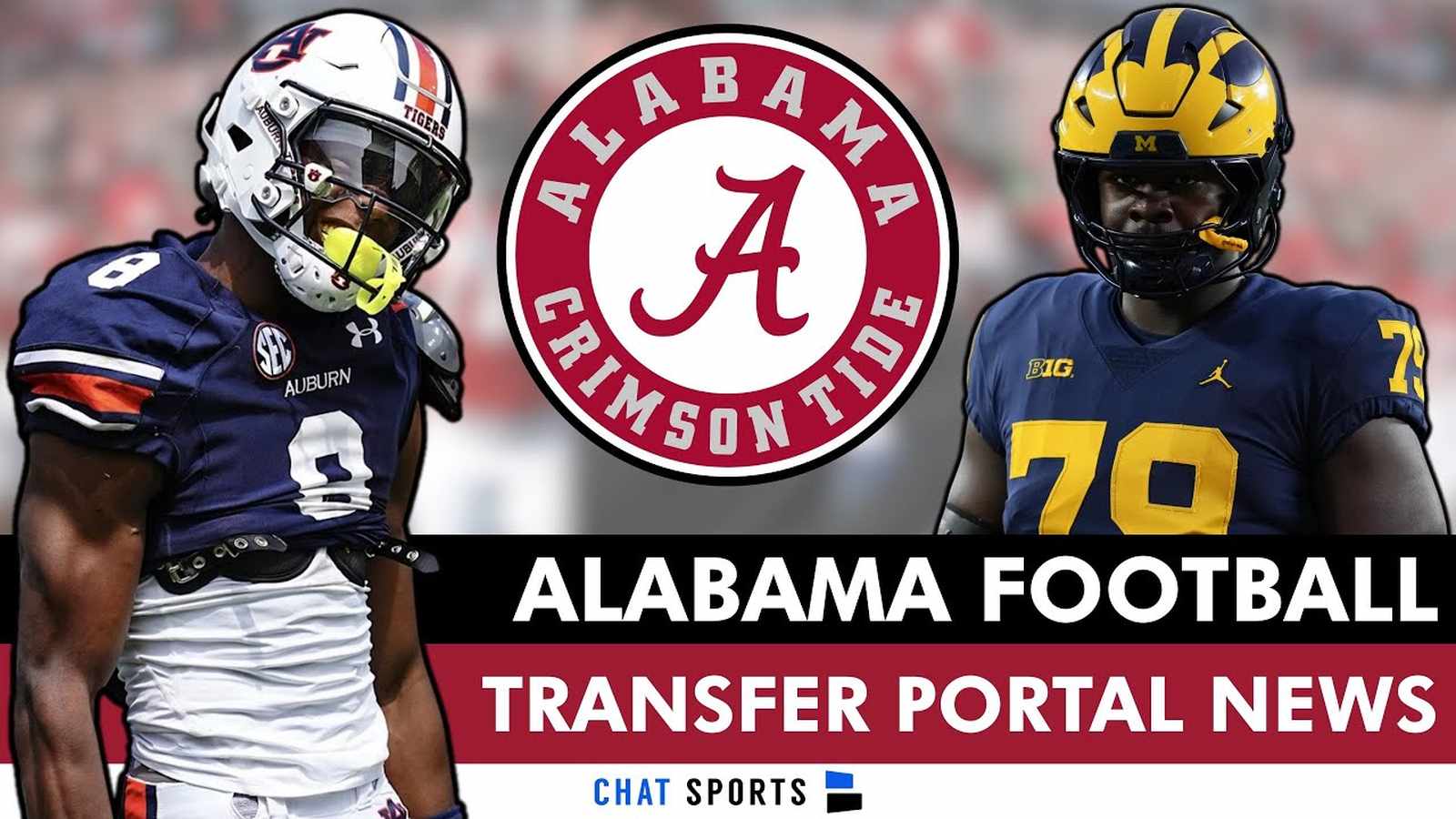
Quick Read
- The January 2026 NCAA transfer portal window for Division I players was open from January 2nd to January 16th.
- Alabama saw significant departures, including offensive lineman Wilkin Formby (Texas A&M) and defensive linemen Keon Keeley (Notre Dame), James Smith (Ohio State), and Qua Russaw (Ohio State).
- Key offensive losses included wide receivers Isaiah Horton (Texas A&M) and Jalen Hale (SMU), while running back Hollywood Smothers de-committed.
- The Crimson Tide made strategic additions, bringing in tight end Josh Ford (Oklahoma State), offensive linemen Kaden Strayhorn and Ty Haywood (Michigan), and wide receiver Noah Rogers (NC State).
- Defensive reinforcements included linebacker Caleb Woodson (Virginia Tech) and defensive linemen Devan Thompkins (USC) and Kedrick Bingley-Jones (Mississippi State).
- Special teams were bolstered with kicker Lorcan Quinn (Marshall), long snapper Ethan Stangle (Syracuse), and punter Adam Watford (North Alabama).
The collegiate football landscape, perpetually in motion, once again saw a seismic shift during the January 2026 NCAA transfer portal window. For storied programs like the Alabama Crimson Tide, this period is less about resting on laurels and more about strategic roster reconstruction. From January 2nd to January 16th, Division I players had the opportunity to declare their intent to transfer, a critical two-week stretch that saw Alabama both bid farewell to key talents and welcome promising new faces. Teams participating in the College Football Playoff National Championship Game were granted an extended five-day window from January 20th to 24th, further extending the drama of the offseason reshuffle.
Key Departures Reshape Crimson Tide Roster
The Crimson Tide experienced a significant exodus of scholarship players, a testament to the competitive nature of modern college football and the allure of new opportunities. Among the most notable departures was offensive lineman Wilkin Formby, a seasoned player who logged over 1,000 snaps in the past two seasons, including starting at right tackle in 2025. His decision to transfer to Texas A&M leaves a substantial gap on the offensive line, a unit already facing changes. Another significant loss came on the defensive front with Keon Keeley, a former five-star defensive lineman, choosing Notre Dame. Keeley’s departure, after contributing 19 tackles and three sacks over two seasons, underscores the ongoing challenge of retaining top-tier talent.
The defensive line saw further shifts with James Smith and Qua Russaw, both former five-star recruits, opting to join Ohio State. Smith, a junior defensive lineman, had a career-high 28 tackles and 2.5 sacks in 2025, while Russaw, a wolf outside linebacker, recorded 50 tackles and two interceptions in two seasons, despite battling a foot injury in 2025. Their move to the Big Ten represents a considerable blow to Alabama’s defensive depth. Kelby Collins, who spent the 2025 season with Alabama after transferring from Florida, also made a move, heading to South Carolina.
Wide receiver was another position hit hard by transfers. Isaiah Horton, who started alongside Germie Bernard and Ryan Williams in 2025 and was third on the team with 42 receptions and 511 receiving yards, transferred to Texas A&M. Jalen Hale, who missed the entire 2024 season due to injury, also sought a new beginning at SMU after limited snaps in 2025. Other wide receivers, including Cole Adams (Vanderbilt), Aeryn ‘Bubba’ Hampton, and Rico Scott (who initially entered the portal but later returned to Alabama), also explored their options. The dynamic with Rico Scott highlights the fluid and sometimes uncertain nature of the transfer portal, where commitments can be fleeting or reconsidered.
Beyond these prominent names, Alabama also saw other key players seek transfers: Kameron Howard (DB) to Boston College, Roq Montgomery (OL) to Western Kentucky, Richard Young (RB), Jaylen Mbakwe (WR/DB) to Georgia Tech, Joseph Ionata (C) to Georgia Tech, Olaus Alinen (OL) to Kentucky, Noah Carter (LB) to Georgia Tech, Peter Notaro (K) to West Virginia, Micah DeBose (OL) to Vanderbilt, Arkel Anugwom (OL) to Northwestern, Jordan Renaud (DL), Cam Calhoun (DB), David Bird (LS), and walk-ons Jessie Washington III (RB) and MJ Chirgwin (WR). The sheer volume across various positions indicates a significant restructuring effort for the Crimson Tide.
Strategic Additions Bolster Key Positions
While the departures were numerous, Alabama’s coaching staff was equally active in securing talent from the transfer portal, addressing immediate needs and building for the future. The Crimson Tide made strategic moves to reinforce both sides of the ball and special teams. On the offensive side, former Oklahoma State tight end Josh Ford committed to Alabama, bringing three seasons of eligibility and a proven track record of 13 catches for 137 yards and two touchdowns in two seasons with the Cowboys. The offensive line, which saw several losses, was bolstered by the addition of two former Michigan offensive linemen: Kaden Strayhorn and Ty Haywood, both with four seasons of eligibility remaining, signaling a long-term investment in the trenches.
The wide receiver room, depleted by transfers, gained Noah Rogers from NC State. Rogers, who previously started his career at Ohio State, brings two seasons of eligibility and 919 receiving yards and three touchdowns over two seasons with the Wolfpack, offering an immediate boost to the passing game. However, a notable setback was the de-commitment of NC State running back Hollywood Smothers, who was initially projected as Alabama’s starting running back in 2026, forcing a re-evaluation of the backfield strategy.
Defensively, Alabama secured Caleb Woodson, a linebacker from Virginia Tech, for his final season of eligibility. Woodson arrives with an impressive collegiate resume of 152 tackles, 11.5 tackles-for-loss, and 2.5 sacks in three seasons. The defensive line also saw reinforcements with Devan Thompkins from USC and Kedrick Bingley-Jones from Mississippi State. Thompkins, a former three-star recruit, amassed 55 tackles, nine tackles-for-loss, and 4.5 sacks across his career, while Bingley-Jones adds experience with 40 tackles and 2.5 tackles-for-loss over five collegiate seasons. Caleb Smith, a defensive lineman from Washington and an in-state product, also joined the Crimson Tide with four seasons of eligibility.
Special teams were not overlooked, with crucial additions addressing key roles. Marshall kicker Lorcan Quinn, an Irishman who demonstrated accuracy with 21 of 26 field goals as a freshman, including nine of 11 from beyond 40 yards, committed to the Crimson Tide. Replacing the departed long snapper David Bird, Alabama secured Ethan Stangle from Syracuse, who was the Orange’s starting long snapper in 2025. Additionally, North Alabama punter Adam Watford, known for his impressive 46.6 yards per punt average and 18 punts inside the 20-yard line in 2025, joined for his final season of eligibility. These additions highlight a meticulous approach to covering all facets of the game.
The Dynamic Chess Game of Roster Management
The January 2026 transfer portal window underscored the intense, ongoing chess game of college football roster management. For Alabama, it was a period of both significant challenge and strategic opportunity. The departures, many of whom were experienced players or highly-touted recruits, necessitated swift and effective countermeasures. The coaching staff responded by targeting specific positions and bringing in a mix of immediate impact players and developmental talent. The flow of players in and out of Tuscaloosa reflects a broader trend across college football, where player mobility is at an all-time high, making every offseason a critical period of adaptation and rebuilding.
The sheer volume and caliber of transfers, both incoming and outgoing, during this window suggest that Alabama is actively and aggressively adapting to the new realities of college football roster construction, indicating a determined effort to maintain its elite status by strategically retooling with a blend of proven talent and promising youth.