
Quick Read
- Asian stock markets closed Friday with mixed results due to AI fears and Middle East tensions.
- Tokyo’s Nikkei 225 fell 1.1% as AI worries impacted financial institutions and major companies.
- South Korea’s Kospi surged 2.3% to a new record, boosted by defense contractors and BlackRock’s investment in SK Hynix.
- Hong Kong’s Hang Seng dropped 0.8% after reopening from Lunar New Year holidays.
- Higher oil prices, driven by potential US-Iran conflict, could influence Federal Reserve interest rate decisions.
BANGKOK (Azat TV) – Asian stock markets concluded trading on Friday, February 20, 2026, with a decidedly mixed performance, as investor anxieties over the economic implications of massive artificial intelligence investments converged with escalating geopolitical risks in the Middle East. While key benchmarks in Tokyo and Hong Kong experienced declines, South Korea’s Kospi surged to a new record high, illustrating a fragmented regional outlook.
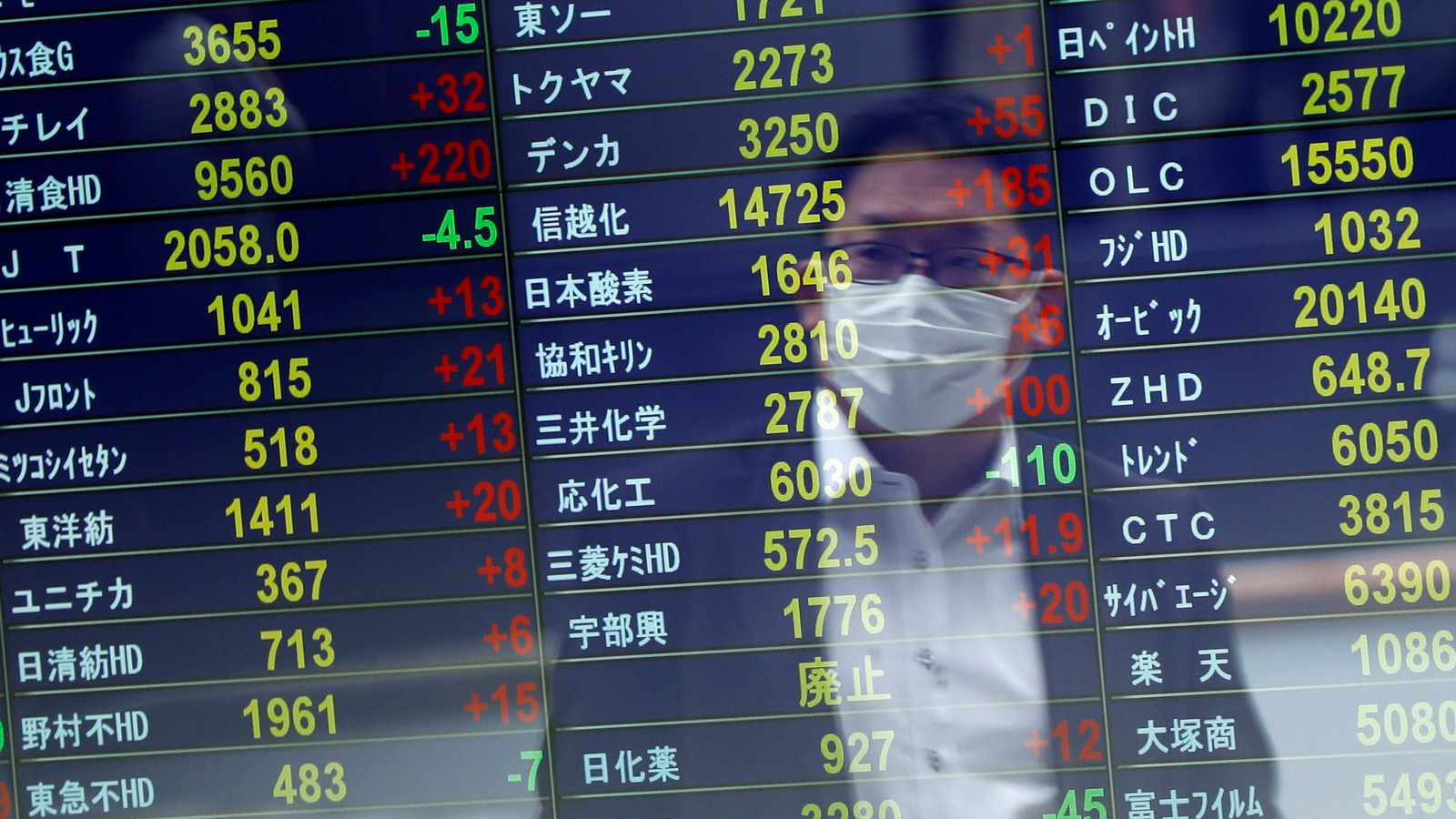
A primary driver of market jitters was the growing concern among investors regarding the disruptive potential of artificial intelligence technologies. This fear directly impacted financial institutions with exposure to private credit companies lending to businesses vulnerable to AI-driven competition. Tokyo’s Nikkei 225, for instance, fell 1.1% to 56,825.70. Shares in major banks like Mitsubishi UFJ Financial Group (MUFJ) dropped 2.2% after Blue Owl Capital, a private-credit company partnered with MUFJ, saw a 5.9% decline on Thursday. Beyond financials, market heavyweights such as Toyota Motor Corp. and Sony also shed 3.7% and 3.2%, respectively, signaling broader apprehension about AI’s reach across sectors, as reported by the Associated Press.
AI Fears and Geopolitical Tensions Weigh on Asia Stocks
The specter of a potential conflict between the United States and Iran further complicated the market landscape, pushing global oil prices to their highest levels since early August. Both nations have signaled readiness for military action if talks concerning Tehran’s nuclear program falter, according to the Associated Press. This geopolitical backdrop contributed to a cautious sentiment, with investors toggling between these risks and specific regional developments, as noted by Finimize.
Adding to the complexity, trading volumes across Asia were thinner than usual due to ongoing Lunar New Year holidays, with markets in mainland China and Taiwan remaining closed until the following week. This reduced liquidity meant that relatively smaller orders could exert disproportionate influence on index movements, amplifying market swings. Hong Kong’s Hang Seng, reopening after a three-day holiday, lost 0.8% to 26,481.67, with its Hang Seng TECH Index particularly affected.
South Korea’s KOSPI Bucks the Trend with Record Gains
In stark contrast to the declines seen in Japan and Hong Kong, South Korea’s Kospi index exhibited robust growth, jumping 2.3% to a new record of 5,808.53. This impressive rally was primarily fueled by strong performances from major defense contractors, such as Hanwha Aerospace, whose shares soared 6.4%. The company is among many benefiting from increased military spending in various countries globally. Furthermore, the Kospi’s ascent was bolstered by a significant institutional disclosure: BlackRock revealed a 5% stake in SK Hynix, a development that often sets the tone in low-volume trading sessions, Finimize highlighted.
Elsewhere in the region, market performance remained varied. Australia’s S&P/ASX 200 edged 0.1% lower to 9,081.40, while the SET index in Bangkok also recorded a 0.7% loss. Conversely, India’s Sensex managed to add 0.7%, reflecting a split narrative across Asia where mature economies grapple with policy normalization discussions, and faster-growing nations lean on strong economic activity, according to Finimize.
Global Economic Indicators and US Market Context
The mixed performance in Asian markets unfolded against a backdrop of varied global economic signals. On Thursday, Wall Street benchmarks saw modest declines, with the S&P 500 slipping 0.3%, the Dow Jones Industrial Average dropping 0.5%, and the Nasdaq composite losing 0.3%. Companies like Booking Holdings and Carvana experienced significant drops (6.1% and 7.9% respectively), despite reporting stronger-than-expected profits, primarily due to fears of AI-powered competition. Walmart, however, presented a mixed picture, delivering strong quarterly results but a weak profit forecast for the upcoming year.
Higher oil prices, driven by geopolitical tensions, also boosted energy stocks in the US, with Occidental Petroleum jumping 9.4%. The rising crude prices could influence the Federal Reserve’s monetary policy, potentially delaying interest rate cuts as officials seek further evidence of falling inflation. Meanwhile, US economic reports offered a mixed bag, with a decrease in unemployment claims suggesting a slowing pace of layoffs and accelerating manufacturing growth in the mid-Atlantic region, but also a wider-than-expected trade deficit in December. The dollar strengthened against the Japanese yen but slipped against the euro, while gold, silver, and Bitcoin all saw price increases.
The day’s trading across Asian markets underscored the intricate interplay of technological disruption, geopolitical uncertainty, and regional economic fundamentals, demonstrating how global anxieties around AI and Middle East stability can lead to highly divergent outcomes across different national economies, particularly amidst periods of reduced trading liquidity.