
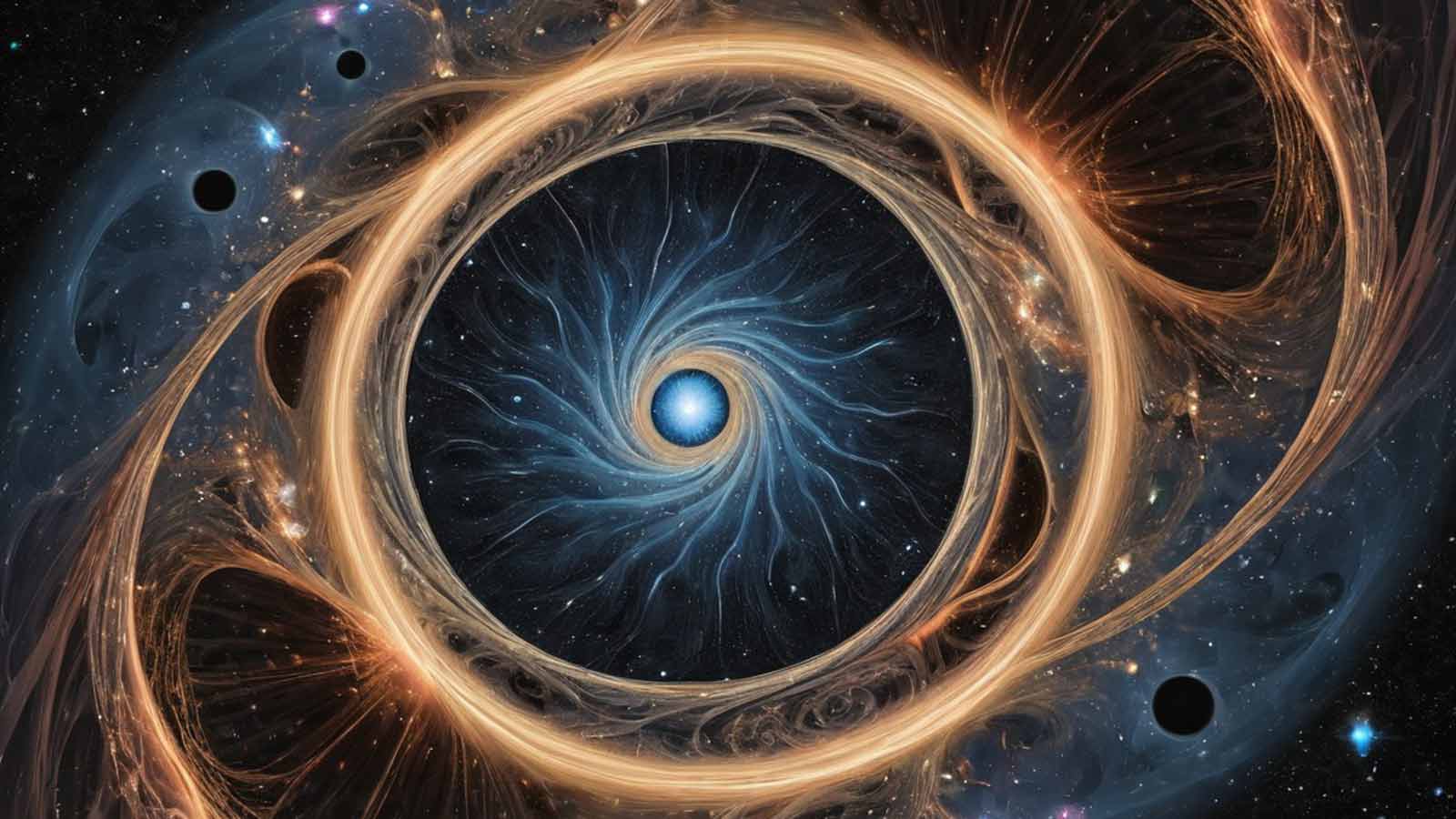
- New research from the University of Sheffield suggests black holes could transition into ‘white holes’.
- ‘White holes’ would eject matter, energy, and potentially even time back into the universe.
- The study proposes a novel link between time and dark energy, the force driving the universe’s expansion.
- Quantum mechanics plays a crucial role in this new understanding of black holes, suggesting a beginning rather than an end at their singularity.
- This theory could revolutionize our understanding of fundamental physics and the evolution of the cosmos.
Black Holes: Cosmic Graveyards Giving Birth to New Universes?
For decades, black holes have been perceived as the ultimate cosmic dead ends – regions of spacetime where gravity is so intense that nothing, not even light, can escape. Einstein’s theory of General Relativity painted a picture of matter collapsing into an infinitely dense point called a singularity, a point where the laws of physics as we know them break down. However, groundbreaking new research from the University of Sheffield challenges this long-held view, suggesting that black holes might not be endings, but rather potential beginnings, capable of transitioning into ‘white holes’ and ejecting matter back into the universe. This revolutionary concept could fundamentally alter our understanding of the cosmos and the very nature of time itself.
From Singularity to Eternity: Quantum Mechanics Offers a New Perspective
The traditional understanding of black holes, based on classical physics, culminates in the singularity – a point of infinite density where our current laws of physics fail. However, this new study, published in the journal Physical Review Letters , utilizes the principles of quantum mechanics to propose a radically different scenario. Quantum mechanics, which governs the universe at the atomic and subatomic level, suggests that time, as we understand it, cannot simply end. Instead of a singularity representing a final crushing point, the researchers theorize it could represent a transition to a new phase of spacetime, a ‘white hole’.
White Holes: Black Holes in Reverse?
While black holes are known for their immense gravitational pull, sucking in everything around them, including light and even time, the concept of a white hole is essentially the reverse. Theorized but never definitively observed, white holes are thought to eject matter, energy, and even time back into the universe. The Sheffield University research suggests that a black hole, upon reaching its singularity, might undergo a quantum transition, effectively turning ‘inside out’ and becoming a white hole. This process would imply that what is drawn into a black hole might eventually be expelled back into the cosmos, potentially in a different form or even in a different time.
The Role of Dark Energy: A Cosmic Clock?
An intriguing aspect of this research is the proposed link between time and dark energy. Dark energy is the mysterious force believed to be responsible for the accelerating expansion of the universe. The researchers suggest that dark energy might act as a fundamental clock, providing a universal reference point against which time can be measured. This novel idea allows for a new way to understand the phenomena occurring within a black hole, where the traditional concept of time breaks down. By using dark energy as a backdrop, the researchers were able to develop a theoretical model where the singularity transitions into a white hole, effectively suggesting that time itself doesn’t end but rather enters a new phase.
Revolutionizing Cosmology: New Beginnings in the Fabric of Spacetime
If the theory holds true, it could have profound implications for our understanding of cosmology. The idea that black holes might be gateways to ‘white holes’ opens up the tantalizing possibility of a cyclical universe, where matter is drawn into black holes and eventually ejected to form new regions of spacetime. This could potentially offer a new perspective on the Big Bang and the ultimate fate of the universe. Furthermore, this research presents novel approaches to reconciling the seemingly disparate fields of gravity and quantum mechanics, potentially paving the way for groundbreaking new fundamental theories that could unlock further secrets of the cosmos.
The University of Sheffield’s research offers a revolutionary perspective on black holes, suggesting they might not be the universe’s ultimate destroyers but rather transformative entities capable of birthing new beginnings. By bridging the gap between quantum mechanics and our understanding of gravity and dark energy, this theory opens up exciting new possibilities for exploring the fundamental nature of the cosmos and the enigmatic relationship between space and time. While further research is undoubtedly needed, this work has the potential to reshape our understanding of the universe’s most mysterious phenomena.
The article reports on the University of Sheffield’s new research proposing that black holes could transition into white holes, potentially revolutionizing our understanding of the universe. The research connects quantum mechanics, general relativity, and dark energy to suggest a new perspective on the life cycle of black holes. The search intent addressed is to provide readers with information about this cutting-edge research in astrophysics and cosmology. The main keywords identified and incorporated are: black holes, white holes, dark energy, quantum mechanics, general relativity, universe, and University of Sheffield. The article aims for a neutral, journalistic tone while highlighting the potentially transformative nature of this scientific discovery.