

Quick Read
- Governor Newsom declared a State of Emergency for Orange County due to a chemical threat.
- A 7,000-gallon tank of methyl methacrylate (MMA) is at risk of exploding in Garden Grove.
- Internal tank temperatures have reached 90°F, rising 1 degree per hour.
- Over 40,000 residents have been evacuated; shelters are reaching capacity.
- MMA is a toxic, flammable chemical used in aerospace plastics; exposure causes respiratory distress.
The Escalation of the Garden Grove Crisis
California Governor Gavin Newsom officially declared a state of emergency in Orange County on Saturday, as emergency crews struggle to stabilize a volatile chemical tank at an aerospace manufacturing facility in Garden Grove. The crisis, which began as a minor vapor release on Thursday afternoon, has rapidly evolved into a high-stakes race against time. According to the Orange County Fire Authority (OCFA), the internal temperature of a 7,000-gallon tank containing methyl methacrylate (MMA) has risen to 90 degrees Fahrenheit, climbing at a rate of approximately one degree per hour. This exceeds the chemical’s stable storage temperature of 50 degrees, raising the specter of a catastrophic explosion or a massive toxic spill.
The emergency declaration facilitates the deployment of state resources and makes state-owned properties, such as fairgrounds, available for the thousands of displaced residents. As of Saturday morning, an estimated 40,000 people across Garden Grove, Cypress, Stanton, Anaheim, Buena Park, and Westminster remain under mandatory evacuation orders. OCFA Incident Commander Craig Covey emphasized the gravity of the situation, stating that allowing the tank to fail or explode is “unacceptable,” though he admitted that crews are preparing for three distinct scenarios: a pressurized explosion, a structural rupture leading to a spill, or a successful “curing” process where the chemical solidifies without a violent release.
Chemical Profile: The Volatility of Methyl Methacrylate
Methyl methacrylate is a colorless, volatile liquid primarily used in the production of resins and plastics, including Plexiglass. While essential for the aerospace industry, the chemical is highly flammable and reactive. The U.S. Environmental Protection Agency (EPA) classifies MMA as a respiratory irritant that can cause significant health complications upon exposure. According to Dr. Regina Chinsio-Kwong, the Orange County health officer, inhalation of MMA vapors can lead to lung and skin irritation, headaches, dizziness, and nausea. While the EPA has suggested potential links to long-term chronic issues, the immediate concern is the acute toxicity of the vapor plume currently being monitored by specialized hazmat teams.
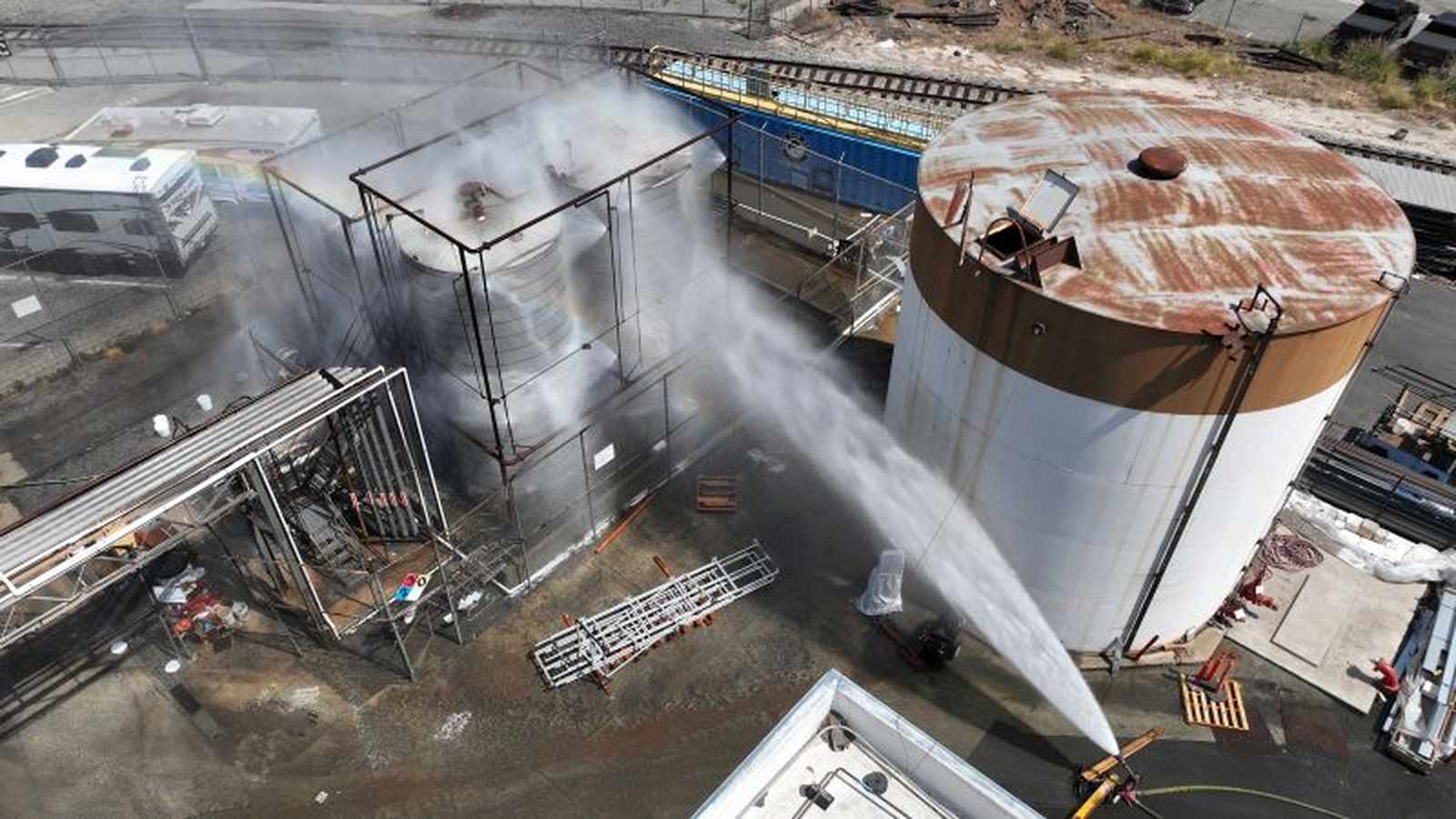
The manufacturing site, operated by UK-based GKN Aerospace, contains additional hazards. Firefighters worked through Friday night to successfully neutralize a separate 15,000-gallon tank nearby to prevent a chain-reaction event. However, the primary 7,000-gallon tank remains in a state of “thermal runaway,” a process where an increase in temperature changes the conditions in a way that causes a further increase in temperature, often leading to a destructive outcome. Crews are utilizing unmanned hose lines and sprinkler systems to provide external cooling, a tactic Covey compared to an ice cube freezing from the outside inward to slow the internal reaction.
Institutional Response and Public Safety Logistics
The logistical scale of the evacuation has strained local infrastructure. The American Red Cross has opened multiple shelters, several of which reached capacity by Saturday morning, forcing the opening of additional sites in Anaheim and Huntington Beach. Beyond residential displacement, the crisis has impacted civic functions; the Orange County Registrar of Voters announced the closure of several voting centers and ballot boxes ahead of the June 2 primary election. Residents have been urged to utilize alternative voting locations as the exclusion zone remains strictly enforced by the Garden Grove Police Department.
Despite the proximity of major Southern California landmarks, Disneyland Resort and Knott’s Berry Farm remain operational. Both attractions are located approximately 5 to 7 miles from the GKN Aerospace facility and are outside the current evacuation perimeter. Park officials have stated they are in constant communication with the OCFA and the EPA to monitor air quality. Currently, air monitoring stations have not detected toxic levels of MMA outside the immediate evacuation zone, though authorities warn that a shift in wind or a sudden tank rupture could alter the safety profile of the surrounding areas.
Environmental Mitigation and Accountability
Contingency planning is now focusing on the potential for a massive environmental disaster. If the tank ruptures rather than explodes, thousands of gallons of MMA could flow into local storm drains and river channels, eventually reaching the Pacific Ocean. OCFA officials are developing diversion strategies to contain any potential spill within the facility’s parking lot. GKN Aerospace has issued a statement expressing regret for the disruption and confirming their cooperation with federal and state investigators. However, the incident raises significant questions regarding industrial safety protocols in densely populated urban corridors, particularly the maintenance of relief valves and cooling systems for volatile materials.
The Garden Grove incident underscores a critical vulnerability in urban industrial planning, where the proximity of high-tech manufacturing to residential centers creates a low-probability but high-impact risk. The transition from a localized vapor leak to a state-level emergency within 48 hours highlights the volatility of chemical polymerization processes and the limitations of current mitigation technologies when faced with thermal runaway. As state and federal agencies pivot from immediate crisis management to long-term investigation, the focus will likely shift toward the regulatory oversight of GKN Aerospace and the adequacy of municipal emergency alert systems, which some residents reported failing to reach them until hours after the initial risk was identified.