
Quick Read
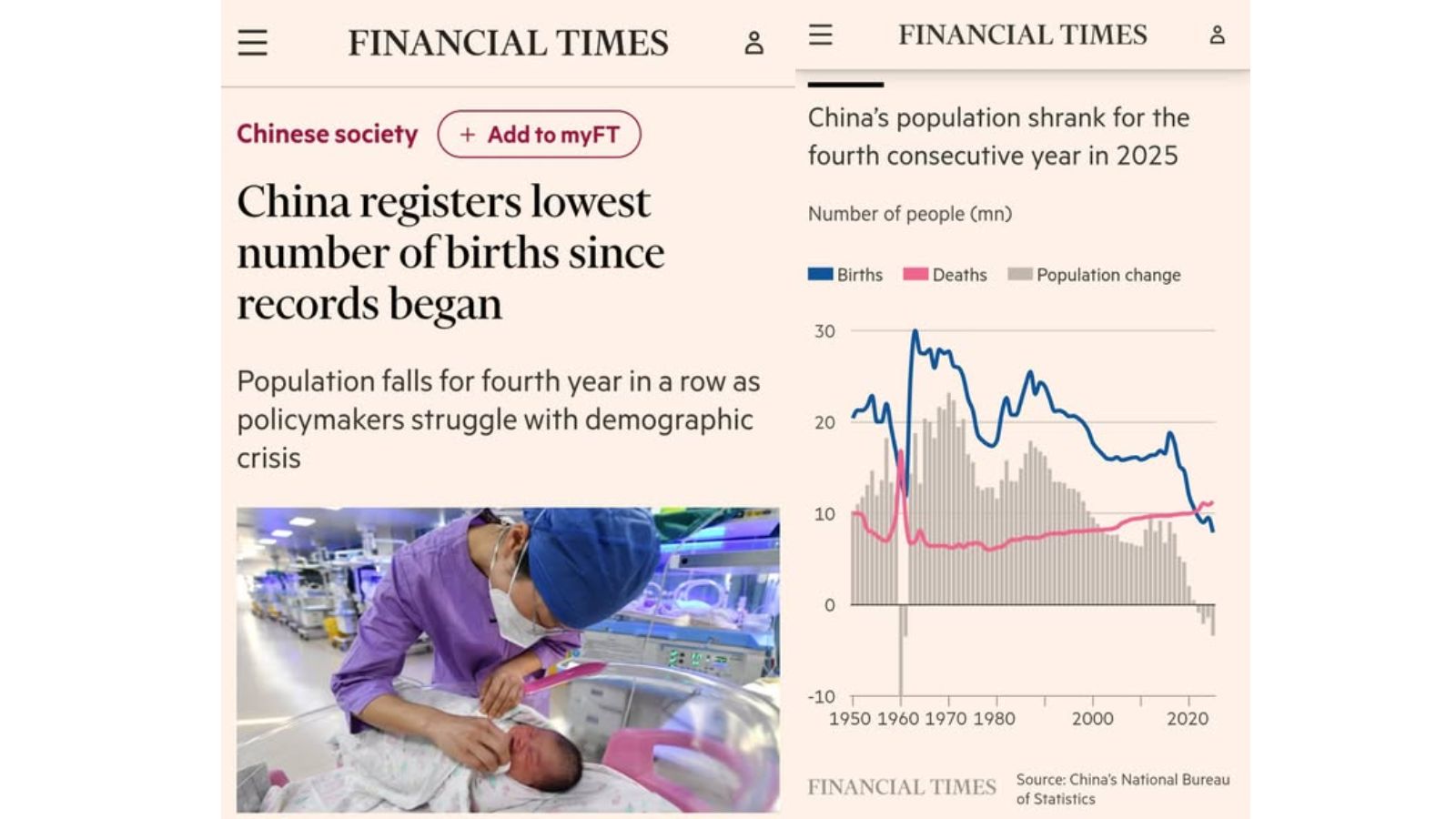
- China recorded its lowest newborn figure in 2025 since records began—about 7.9 million births—while more than 11 million people died, compressing the population by roughly 3.4 million to around 1.405 billion.
- It marks the fourth consecutive year of population decline.
- Despite loosening the one-child policy, simplifying marriage registration, and launching birth-stimulation programs, gains remain limited due to high living costs, economic uncertainty, rising education levels, and social-security concerns.
- The fertility rate sits around 0.98, far below the 2.1 replacement level, portending labor shortages, a graying populace, and mounting pressure on social systems.
The latest figures, reported in part by the Financial Times, underscore a demographic crisis that has persisted through the mid-2020s. With births hovering near 7.9 million in 2025 and deaths surpassing 11 million, China’s population contracted by approximately 3.4 million people within a single year, bringing the total to roughly 1.405 billion. While official data vary in cadence and granularity, the trajectory is unmistakable: fewer children in a country of hundreds of millions of households, many of which are grappling with the everyday costs of modern life.For four consecutive years, the country has observed a net population decline, a pattern that has policymakers and economists watching closely. Beijing has experimented with a spectrum of measures designed to nudge birth rates higher—expanding access to childcare, increasing parental leave, streamlining marriage registrations, and relaxing the once-rigid limits of family planning. Yet the outcomes remain constrained. Analysts point to a complex mix of economic pressures: the soaring cost of housing and education, broad economic uncertainty, and concerns about long-term social security, all of which weigh on the decision to start or expand a family.At the core of the discussion is the fertility rate, currently estimated around 0.98. This stands in stark contrast to the replacement level of 2.1 needed to keep population numbers stable without immigration. A rate this low has wide-ranging implications. Economists warn that a shrinking labor force will eventually slow economic growth, while a growing share of seniors will press the state and private sectors to sustain health care, pensions, and social services with a diminishing base of working-age contributors. In a society that has long emphasized education and career attainment, the decision to have children often collides with the realities of tuition costs, housing prices, and the perceived value of investing in a smaller, urban lifestyle rather than a larger family unit.
China’s response has tilted toward automation. In public discourse and policy circles, there is a clear intention to compensate for the shrinking workforce by accelerating the adoption of automation and robotics, particularly within manufacturing corridors that have long served as the backbone of the economy. Robots and smart systems are seen as partial antidotes to labor shortages, enabling production lines to sustain output levels even as human labor contracts. While this pivot can blunt some adverse effects of demographic decline—raising productivity and reducing the immediate talent gap—it is not a catch-all solution. The broader demographic shift will continue to press on wage growth, consumer demand, and the structure of the job market for decades to come.
Beyond the factory floor, the demographic picture has become more nuanced. Urbanization and rising educational attainment, especially among women, have been linked to delayed childbearing and smaller family sizes in China’s major cities. The aging population will demand more extensive health care options, elder care infrastructure, and pension provision, all of which require sustainable funding models in a shrinking tax base. The challenge is not merely to coax more births in the near term but to align social contracts with the realities of a society where generations live longer and work fewer years relative to their lifespan. These dynamics will shape consumption patterns, housing markets, and the pace at which new industries can scale up to accommodate a changing workforce landscape.
Looking ahead, policy solutions will need to go beyond encouraging births. They must address the underlying costs and risks that families face in modern China. Expanding affordable child care, improving parental leave policies, ensuring accessible education, and strengthening social safety nets could help tilt decisions toward larger families. At the same time, the adoption of automation must be pursued thoughtfully to avoid widening income inequality or undermining employment opportunities for young workers. The conversation now centers on how to balance a high-skills, high-productivity economy with a demographically sustainable social framework—an issue that will occupy policymakers for years to come as the 2020s progress and the 2030s approach.
Ultimately, China’s demographic crisis is less a single headline and more a long-running structural challenge. The country’s ability to weather a slowing workforce will depend on coordinated reforms across education, housing, social security, and innovation policy, paired with a pragmatic embrace of automation where it strengthens efficiency without eroding the social compact that binds communities. As 2026 unfolds, observers will be watching not just the numbers of births and deaths, but how governance, industry, and households adapt to a world in which population dynamics are shifting at a pace not seen in recent memory.