
Quick Read
- Chinese humanoid robots performed intricate kung fu and acrobatic stunts at the Spring Festival Gala.
- The performance showcased advanced capabilities like backflips, sword swinging, and coordinated movements.
- Experts view the display as a demonstration of China’s technological prowess and leadership in humanoid robotics.
- The event reignited discussions about China’s manufacturing ambitions and competition with Western tech firms.
- State data indicates China registered over 450,000 smart robotics companies by late 2024.
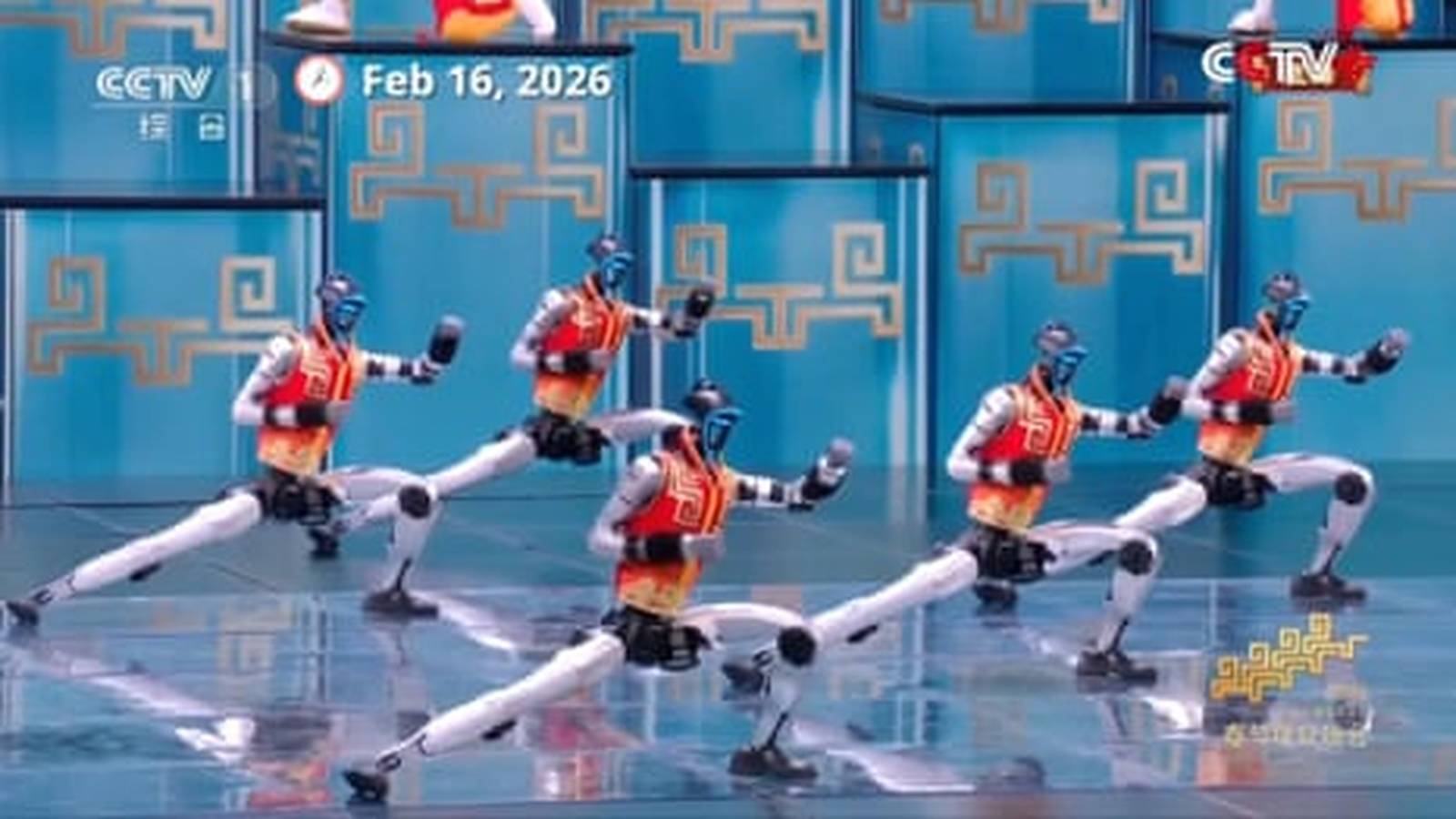
BEIJING (Azat TV) – Chinese humanoid robots captivated a global audience on Monday during the annual China Media Group’s Spring Festival Gala, China’s most-watched television broadcast, by performing an array of intricate kung fu and acrobatic stunts. The dazzling display, featuring lunges, backflips, and synchronized movements, has not only highlighted China’s accelerating technological prowess in robotics but has also intensified discussions about its growing lead over Western counterparts in this rapidly evolving field.
Advanced Robotics Display at Spring Festival Gala
The performance, which took center stage at the 2026 Spring Festival Gala, saw advanced humanoid robots developed by several Chinese robotics firms execute a range of complex maneuvers. These included sophisticated kung fu sequences, comedy sketches, and meticulously choreographed dance routines alongside human performers. Clips of the event, which quickly circulated online, underscored a significant leap from last year’s Lunar New Year broadcast, where robot movements were noticeably simpler.
Unitree Robotics, one of the key firms involved, showcased its G1 and H2 humanoid robots in a large-scale, synchronized performance that combined martial arts and acrobatics. The company stated that the routine broke several technical records, including continuous freestyle vaulting, airborne flips reaching over three meters in height, and complex single-leg and wall-assisted backflips. A standout sequence involved a spin of seven-and-a-half rotations, described by Unitree as another first for humanoid robots. During the performance, a cluster of humanoid robots achieved coordinated movements at speeds up to four meters per second while maintaining formation, marking the fastest such synchronized action. Newly developed dexterous hands allowed the robots to grip and exchange martial arts props seamlessly. The H2 robot notably appeared as a “Sword Grandmaster” in the main gala and later as the iconic “Monkey King” at a separate venue in Yiwu.
China’s Technological Prowess and Global Ambitions
The gala performance is widely viewed as a strategic showcase of China’s technological leadership. Kyle Chan, an expert in China’s technology development at the Brookings Institution, a policy organization in Washington D.C., observed that Beijing frequently uses these public robot performances to “dazzle domestic and international audiences with China’s technological prowess.” Chan emphasized that unlike AI models or industrial equipment, humanoid robots offer highly visible examples of China’s advancements that resonate with general audiences globally.
Georg Stieler, the head of robotics and automation at the global technology consulting firm Stieler Technology and Marketing, highlighted the unique symbolism of China’s prime-time broadcast. He noted the ‘directness of the pipeline from industrial policy to prime-time spectacle,’ suggesting a concerted effort to demonstrate national technological achievements. Stieler pointed to the ability to run ‘large numbers of near-identical humanoids in synchronised motion with stable gaits and consistent joint behaviour’ as a key indicator of China’s progress, contrasting it with the ‘fundamentally a single choreographic mode’ seen in previous years.
Expert Insights on Humanoid Robot Capabilities
While the performance was undeniably impressive, experts also offered a nuanced perspective on the robots’ current capabilities. Stieler cautioned that ‘stage performance does not equate to industrial robustness, yet.’ He explained that the robots’ intricate movements were the result of being trained for a specific routine ‘hundreds or thousands of times’ and that they could not simply be instructed to perform something entirely different on the fly. These dance motions, he added, involved ‘very little environmental perception’ and were essentially ‘imitation learning plus a balance-keeping controller,’ which has ‘little bearing on reliability in unstructured environments’ required for factory-grade deployment.
Despite these current limitations in unstructured environments, the unveiling of this latest generation of robots undeniably underscores China’s broader technological ambitions. Major government initiatives such as Made in China 2025 and the 14th Five-Year Plan have prioritized robotics and AI as key strategic areas. By the end of 2024, China had registered 451,700 smart robotics companies, boasting a total capital of 6.44 trillion yuan (approximately $932.16 billion), according to state data.
The Race for Robotics Dominance
The advanced display at the Spring Festival Gala reignited intense discussions about the global competition in robotics, particularly with Western nations. Kyle Chan noted that while China and the U.S. are ‘neck-and-neck on AI,’ humanoid robots represent ‘an area where China can claim to be ahead of the US, particularly in terms of scaling up production.’
The sentiment is echoed by prominent figures in the industry. Morgan Stanley projects that China’s humanoid robot sales will more than double to 28,000 units in 2026. Elon Musk, CEO of Tesla, has openly stated his expectation that Chinese companies will be his biggest competitors as Tesla pivots its focus toward embodied AI and its flagship humanoid, Optimus. Last month, Musk notably remarked, “People outside China underestimate China, but China is an ass-kicker next level.” This perspective is further highlighted by some observers, such as Gizmodo, which suggested that the Chinese kung fu robots ‘put Western efforts to shame,’ contrasting their fluidity with instances of Tesla’s Optimus struggling with basic tasks.
Marina Zhang, a technology professor at the University of Technology Sydney, suggested that such a visible showcase likely signifies a new phase in China’s manufacturing masterplan. In this phase, she explained, ‘robotics becomes a linchpin in the shift from low-cost assembly to high-end, smart manufacturing.’
The impressive and highly synchronized performance of China’s humanoid robots at the Spring Festival Gala serves as a powerful testament to the nation’s rapid advancements in robotics, acting not just as entertainment but as a strategic declaration of its growing technological leadership and competitive edge in the global race for AI and automation dominance.