
Quick Read
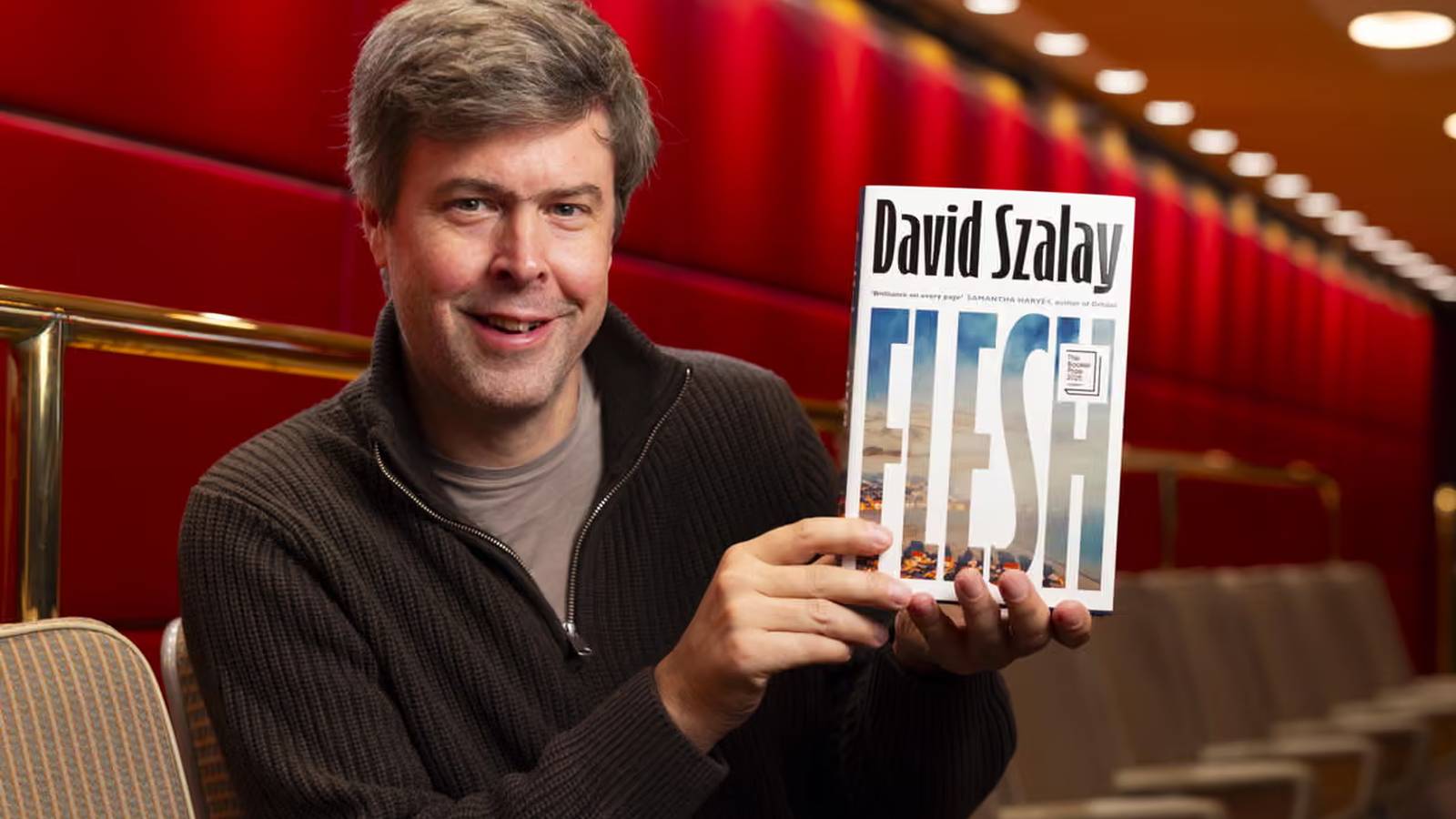
- David Szalay won the 2025 Booker Prize for his novel Flesh.
- Flesh follows the life of István, exploring masculinity, class, migration, trauma, and power.
- The decision was unanimous among the judges, led by Roddy Doyle.
- Szalay’s win marks the tenth Booker for publisher Jonathan Cape.
- Szalay drew inspiration from personal failure and the physical experience of existence.
Booker Prize 2025: Szalay’s Flesh Takes Center Stage
On a brisk November evening in London, the literary world gathered at Old Billingsgate for a moment that would mark another chapter in the history of the Booker Prize. Amid anticipation and the soft hum of conversation, Hungarian-British author David Szalay was announced as the 2025 Booker Prize winner for his novel Flesh. It was a unanimous decision, said panel chair and former Booker laureate Roddy Doyle. The judges, Doyle revealed, “had never read anything quite like it.”
Tracing István’s Journey: From Hungary to London’s Elite
Flesh is Szalay’s sixth work of fiction and arguably his most unflinching. The novel follows István, a working-class Hungarian, from his turbulent youth in an apartment complex with his mother, through the rigid discipline of military life, and onward to the elite circles of London’s uber-rich. Szalay’s signature spare prose strips away ornamentation, exposing the sinews and bones of István’s journey. The book opens with a startling incident—one that sets the tone for a narrative steeped in trauma, resilience, and transformation.
As István moves through each stage of his life, Szalay interrogates themes of masculinity, class, migration, and power. The protagonist’s experience is shaped as much by his physicality as by his circumstances. It’s a perspective Doyle, speaking for the panel, found both rare and vital: “It homes in on a working-class man, which ordinarily doesn’t get much of a look in. It presents us with a certain type of man and invites us to look behind the face.”
Unpacking the ‘Dark’ Joy of Flesh
The description of Flesh as a “dark book” might suggest a bleak reading experience, but the judges were quick to note its unexpected joys. Doyle himself reflected on the emotional constraints often placed on men, relating the book’s themes to his own upbringing: “Without anybody being consciously aware of it, I was reared, for example, never to cry. I became aware of that and decided it was nonsense, but István is that type of man.”
In a review for The Guardian, Keiran Goddard called Flesh “all bone,” commending Szalay’s mastery of the flinty, spare sentence: “In this novel he has pared things back even more brutally.” The book’s style, stripped to its essentials, amplifies the isolation and vulnerability of its protagonist, making the reader feel every bruise and triumph in István’s life.
Competition and Context: A Strong Shortlist
The 2025 Booker shortlist featured formidable contenders. Among them were Andrew Miller’s The Land in Winter (the bookies’ favorite), Kiran Desai’s The Loneliness of Sonia and Sunny (her first novel since her 2006 win), Susan Choi’s Flashlight, Katie Kitamura’s Audition, and Ben Markovits’s The Rest of Our Lives. Yet, according to Doyle, Szalay’s work stood apart. When pressed on whether any other title came close, Doyle answered, “the answer is ‘kinda yes’,” but declined to specify, insisting it would be “unfair, a bit cruel.”
Notably, the panel brought together a diverse group: actor Sarah Jessica Parker, writers Chris Power, Ayọ̀bámi Adébáyọ̀, and Kiley Reid. Their unanimous support for Flesh speaks to the novel’s resonance across perspectives and backgrounds.
Behind the Pages: Szalay’s Personal Inspiration
Born in Montreal to a Hungarian father and Canadian mother, Szalay’s own journey mirrors the transnational currents of his protagonist. He grew up in London, spent time in Lebanon and the UK, and now resides in Vienna. After Oxford, he worked in financial advertising sales—a job that inspired his debut novel, London and the South-East. His bibliography includes Spring, The Innocent, and the short story collection Turbulence.
Writing for The Guardian, Szalay shared that Flesh was “conceived in the shadow of failure.” In autumn 2020, he abandoned a four-year novel project that felt stagnant. Out of that disappointment, a new intent emerged: to capture the feeling that “our existence is a physical experience before it is anything else, that all of its other aspects proceed from that physicality.”
The Booker Legacy and Publisher’s Triumph
Szalay’s win marks the tenth Booker for Jonathan Cape, an imprint of Penguin, cementing its place as the most decorated publisher in the prize’s history. Last year’s winner, Orbital by Samantha Harvey, also hailed from Cape, as did recent laureates Paul Lynch (Prophet Song), Shehan Karunatilaka (The Seven Moons of Maali Almeida), and Damon Galgut (The Promise).
For Szalay, the £50,000 award and the recognition it brings are more than accolades—they are validation of a style that trusts readers to find meaning in what is left unsaid. Flesh is available through Vintage Publishing for £18.99, with discounted copies at the Guardian Bookshop.
A Novel That Invites Reflection
As the literary world celebrates Szalay’s achievement, the conversation turns to the deeper themes of Flesh. The novel’s focus on a working-class man’s inner life, its unsparing look at migration and trauma, and its refusal to sentimentalize masculinity set it apart from recent Booker winners. It’s a book that asks, sometimes quietly, sometimes with a jolt: what does it mean to inhabit a body, to be shaped by forces we barely recognize, to seek meaning in the everyday?
Szalay’s approach is not to offer answers, but to open a space for reflection—one that honors complexity and ambiguity. In a literary landscape often crowded with grand gestures and ornate prose, Flesh finds its power in restraint.
David Szalay’s victory with Flesh signals a renewed interest in fiction that foregrounds the lived, physical experience and dares to probe beneath the surface of masculinity and class. The novel’s spare style and unvarnished honesty challenge readers to confront the reality behind social roles and personal histories—a testament to the enduring relevance of literary innovation in 2025.