
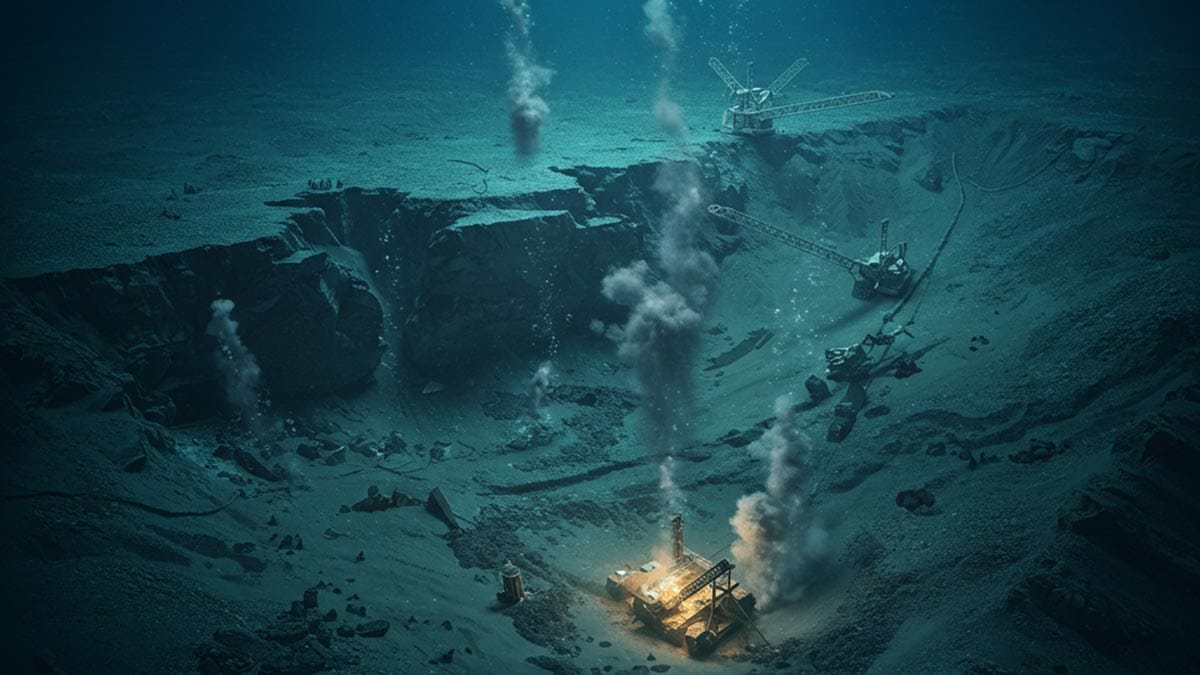
- A 1979 deep sea mining test in the Clarion Clipperton Zone has caused long-term ecological damage.
- Scientists found reduced populations of larger organisms, though some smaller species have recovered.
- The findings support calls for a moratorium on deep sea mining during UN-led talks.
- The Metals Company plans to submit the first formal mining application in June 2025.
- Environmental groups and 32 governments advocate for halting deep sea mining.
Deep Sea Mining Impacts Still Felt After 40 Years
A 2023 expedition to the Clarion Clipperton Zone in the Pacific Ocean has revealed that the ecological impacts of a 1979 deep sea mining test are still evident. The study, led by Britain’s National Oceanography Centre and published in the journal Nature, found that the collection of polymetallic nodules from an eight-metre strip of seabed caused long-term sediment changes and reduced populations of larger organisms. While some smaller, more mobile species have shown signs of recovery, the overall ecosystem remains significantly altered.
Scientific Findings
Daniel Jones, the expedition leader, emphasized the importance of the study in understanding the long-term impacts of deep sea mining. “Although we saw some areas with little or no recovery, some animal groups were showing the first signs of recolonization and repopulation,” he said. The findings highlight the fragility of deep sea ecosystems and the potential risks of large-scale mining operations.
UN-Led Talks and Calls for Moratorium
Delegations from 36 countries are currently attending a council meeting of the UN’s International Seabed Authority in Kingston, Jamaica, to discuss regulations for deep sea mining. Environmental groups, supported by 32 governments and 63 large companies and financial institutions, are calling for a moratorium on mining activities. Louise Casson, a Greenpeace campaigner, stated, “This latest evidence makes it even more clear why governments must act now to stop deep sea mining before it ever starts.”
The Metals Company’s Plans
Despite the ongoing discussions, Canada’s The Metals Company (TMC) plans to submit the first formal mining application in June 2025. TMC argues that deep sea mining has a smaller environmental impact compared to traditional terrestrial mining. Craig Shesky, TMC’s chief financial officer, explained, “You just have to move a lot less material to get the same amount of metal — higher grade means better economics, but also means lower environmental impacts.”
Future Implications
As the UN-led talks continue, the debate over deep sea mining remains contentious. The findings from the 2023 expedition underscore the need for careful consideration of the environmental consequences before any large-scale mining operations are approved. The decisions made in the coming months will have significant implications for the future of deep sea ecosystems and global environmental policy.