
Quick Read
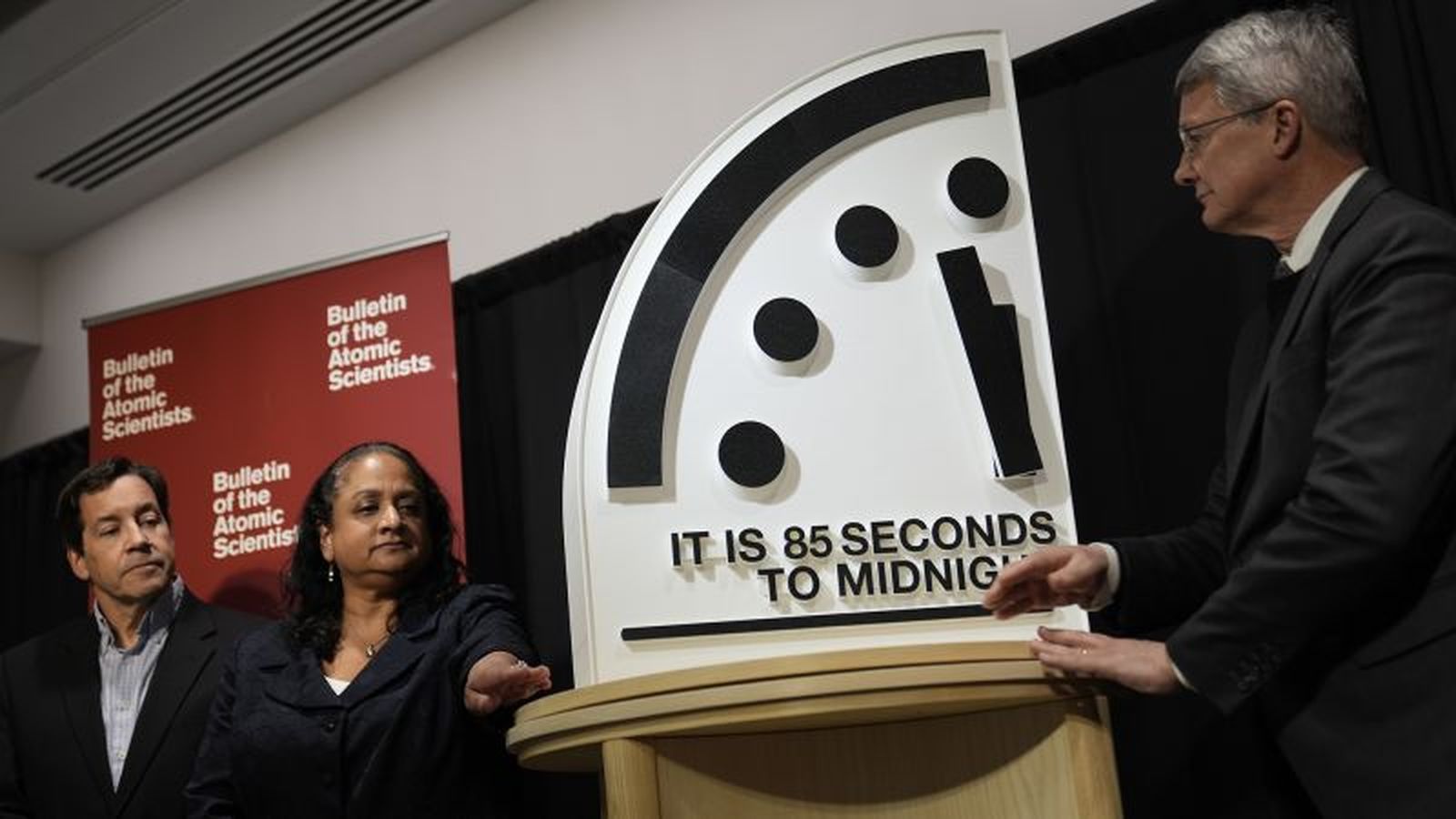
- The Doomsday Clock was set to 85 seconds to midnight on January 27, 2026, the closest it has ever been to catastrophe.
- Key reasons cited by the Bulletin of the Atomic Scientists include escalating nuclear risks, the climate crisis, and unchecked disruptive technologies like AI.
- The New START Treaty between the U.S. and Russia, limiting nuclear weapons, is set to expire on February 4, potentially leading to an arms race.
- Biological threats, such as synthetic mirror life, and the spread of misinformation via AI tools were also major concerns.
- The Clock, a symbolic measure, aims to spark conversations and encourage global action on existential threats.
CHICAGO (Azat TV) – The symbolic Doomsday Clock was set to an unprecedented 85 seconds to midnight on Tuesday, January 27, 2026, marking the closest humanity has ever been to global catastrophe, according to the Bulletin of the Atomic Scientists. This stark adjustment reflects escalating threats from nuclear proliferation, the climate crisis, emerging biological dangers, and the unchecked spread of disruptive technologies like artificial intelligence, all contributing to a heightened state of global insecurity.
The Bulletin of the Atomic Scientists, which established the clock in 1947 at the dawn of the nuclear age, made the announcement from its offices at the Keller Center, home to the University of Chicago Harris School of Public Policy. Midnight on the clock symbolizes the moment humanity renders Earth uninhabitable through self-made technologies and actions. The previous year, the clock stood at 89 seconds to midnight, following settings of 90 seconds in both 2023 and 2024.
Escalating Global Threats Fueling the Change
Bulletin President and CEO Alexandra Bell emphasized the lack of sufficient progress in addressing existential risks. “Humanity has not made sufficient progress on the existential risks that endanger us all,” Bell stated, adding, “Every second counts and we are running out of time.” The decision to move the clock closer to midnight was driven by a confluence of factors.
Dr. Daniel Holz, chair of the Bulletin’s science and security board and a professor at the University of Chicago, highlighted the intensification of global conflicts and a significant development in nuclear arms control. “Rather than heed this warning, major countries became even more aggressive, adversarial and nationalistic,” Holz noted in a news briefing. He specifically cited the rapidly approaching expiration of the New START Treaty on February 4, the last remaining agreement governing nuclear weapons stockpiles between the United States and Russia. This expiration, Holz warned, leaves nothing to prevent a runaway nuclear arms race for the first time in over half a century.
Beyond nuclear concerns, the Bulletin pointed to persistent ‘grave dangers’ in the life sciences, particularly in emerging areas such as the development of synthetic mirror life. Despite repeated international warnings, the global community lacks a coordinated plan, leaving the world unprepared for potentially devastating biological threats. The climate crisis also remains a significant driver for the clock’s movement, with insufficient action to mitigate its impacts.
The Pervasive Impact of Disruptive Technologies and Misinformation
A critical new element in the Bulletin’s assessment is the rapid growth and unregulated use of artificial intelligence (AI) tools. Experts contend that AI supercharges the spread of misinformation and disinformation, severely hampering efforts to address all other global threats and exacerbating impending disasters. Maria Ressa, a 2021 Nobel Peace Prize Laureate and cofounder of Rappler, a Filipino news outlet, spoke at the Bulletin’s briefing, asserting, “We are living through an information armageddon.” She underscored the foundational role of shared facts: “Without facts, you can’t have truth. Without truth, you can’t have trust… The radical collaboration this moment demands becomes impossible.”
Understanding the Doomsday Clock’s Role
The Doomsday Clock was conceived by scientists involved in the Manhattan Project, including artist Martyl Langsdorf who created its iconic visual. Initially focused on nuclear threats, its scope expanded in 2007 to include the climate crisis. The time is set annually by experts on the Bulletin’s science and security board, in consultation with a board of sponsors formed by Albert Einstein in 1948 and first chaired by J. Robert Oppenheimer, which today includes eight Nobel laureates.
While not a definitive measurement of existential threats, the clock is designed to spark essential conversations about difficult scientific topics and global crises. Dr. Michael Mann, Presidential Distinguished Professor at the University of Pennsylvania, described it as an “imperfect metaphor” but acknowledged its enduring power as “an important rhetorical device that reminds us, year after year, of the tenuousness of our current existence.” Eryn MacDonald, senior analyst with the Union of Concerned Scientists’ Global Security Program, noted in 2022 that the shift from minutes to seconds regrettably reflects current reality.
Pathways to Turn Back the Clock
The Bulletin maintains that moving the Doomsday Clock back remains possible through bold, substantial actions. A historic example occurred in 1991 when the clock was set farthest from midnight—17 minutes—following the signing of the Strategic Arms Reduction Treaty between the U.S. and the Soviet Union. Former Bulletin president and CEO Rachel Bronson stated, “We at the Bulletin believe that because humans created these threats, we can reduce them.” This requires serious work and global engagement across all levels of society.
Individuals are encouraged not to underestimate the power of discussing these issues to combat misinformation and press leaders for action. Personal lifestyle changes, such as reducing carbon footprints through transportation choices, energy consumption, food waste reduction, and proper recycling, are also cited as ways to help mitigate the climate crisis.
The Doomsday Clock, while a symbolic construct, continues to serve as a potent, albeit imperfect, rhetorical device for galvanizing public and political attention towards existential threats that transcend national borders, demonstrating its enduring relevance in an era of complex global challenges.