
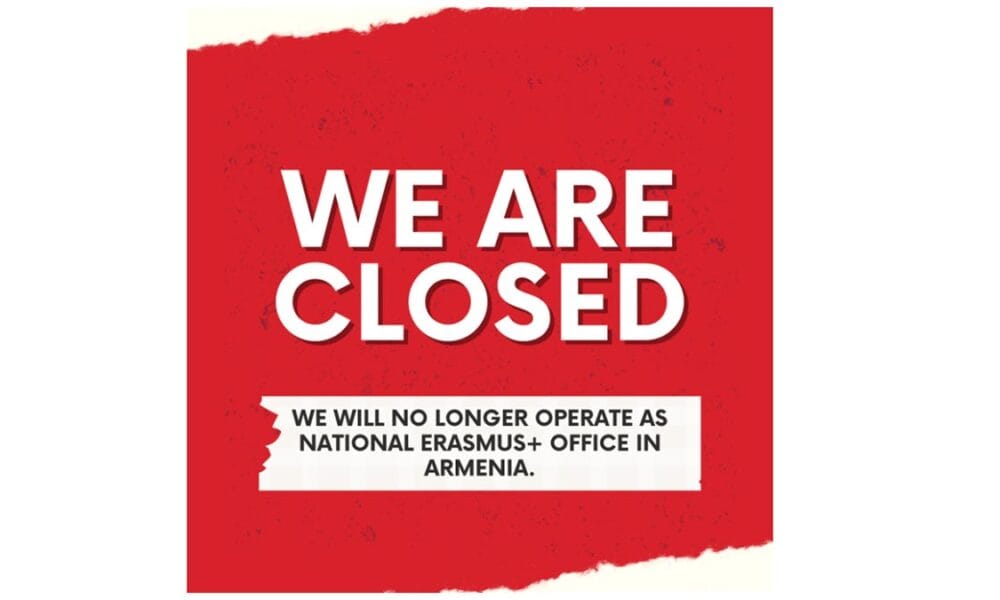
On January 1, 2025, Armenia’s Erasmus+ National Office officially ceased operations following a decision by the Ministry of Education, Science, Culture, and Sports. This move, justified as a realignment of national educational priorities, has ignited debate about its implications for Armenia’s higher education system and its position within global academic networks.
The Ministry argued that Erasmus+ projects primarily benefited European universities, offering limited advantages to Armenia’s higher education system. They criticized the projects as being tourism-driven and lacking alignment with Armenia’s strategic goals. While such claims may resonate with calls for greater policy focus, they fail to account for the program’s tangible contributions to specific sectors of Armenian education.
Erasmus+ had positioned Armenia as a regional leader in vocational education, ranking first among Eastern Partnership countries in this area. Additionally, Armenia ranked third in capacity-building initiatives for higher education, trailing only Ukraine and Georgia. These accomplishments demonstrated the program’s potential to address targeted developmental needs. The Ministry’s critique, however, focused on the absence of broad, systemic reform, overlooking how incremental achievements often serve as catalysts for more significant change.
Beneficiaries of the program consistently expressed high levels of satisfaction. Recent surveys rated the Erasmus+ National Office’s services at 9.4 out of 10, highlighting its effectiveness in providing support and fostering collaboration. The office also enjoyed strong endorsements from European oversight bodies. Audit reports, including the most recent by BDO London in 2024, praised its performance as “very good,” emphasizing its alignment with both European and Armenian priorities. These indicators raise questions about whether the closure addressed genuine shortcomings or reflected broader structural challenges.
With the closure of the national office, the responsibility for managing Erasmus+ projects now falls directly to the Ministry. While this shift could theoretically enable closer alignment with national objectives, it risks undermining the program’s continuity and effectiveness. The Ministry must now demonstrate its capacity to maintain international partnerships, which are vital for fostering knowledge exchange and innovation in a globally interconnected education landscape.
The closure also points to deeper issues in Armenia’s education policy. International collaboration is more than a tool for academic mobility; it is a mechanism for driving systemic improvement and fostering resilience in the face of global challenges. By limiting access to such opportunities, Armenia risks isolating its education system and losing the momentum built through years of cooperation.
Erasmus+ leaves behind a legacy of collaboration and progress that should inform Armenia’s educational future. Its contributions to capacity building and international engagement offer valuable lessons for policymakers. As Armenia navigates this crossroads, it must seek to balance national priorities with global integration, ensuring that its education system remains competitive, inclusive, and forward-looking.