
Quick Read
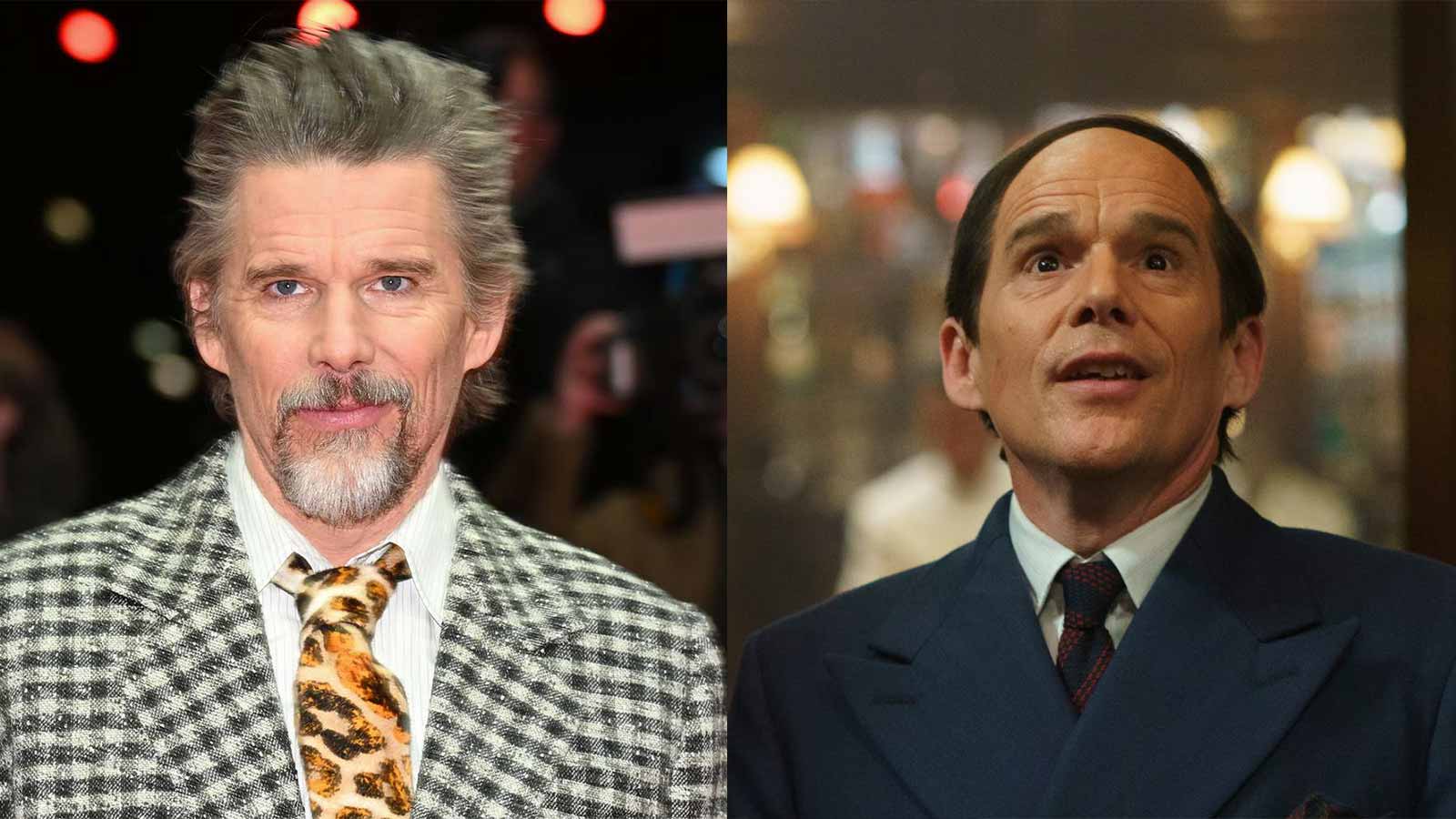
- Ethan Hawke stars as Lorenz Hart in the 2025 film ‘Blue Moon’, directed by Richard Linklater.
- Hawke underwent significant physical and emotional transformation for the role.
- He learned more lines for ‘Blue Moon’ than any previous project.
- Hawke’s career spans from early Broadway work to four Oscar nominations, including for ‘Training Day’.
- His portrait was added to Sardi’s, marking a symbolic achievement in his career.
Ethan Hawke Steps Into the Shadows of Broadway History
There’s a particular electricity in the air when an artist returns to the roots of their craft. For Ethan Hawke, 2025 marks a year where the echoes of Broadway and the challenges of cinematic transformation collide in the film “Blue Moon.” Hawke, now 55, finds himself not just portraying the legendary lyricist Lorenz Hart, but channeling a lifetime’s worth of lessons learned from the stage, the screen, and the shifting tides of fame.
“Blue Moon”: A Portrait of Genius and Turmoil
Nearly a century ago, Richard Rodgers and Lorenz Hart crafted melodies that would become cornerstones of the Great American Songbook. Their partnership, however, was as fragile as it was fruitful. By the 1940s, Hart’s struggles with alcoholism made collaboration nearly impossible, leading Rodgers to join forces with Oscar Hammerstein II and launch “Oklahoma!”—a seismic event in musical theater history.
“Blue Moon” zeroes in on the pivotal moment when Hart, isolated and defeated, attends the opening night celebration of “Oklahoma!” at Sardi’s, the famed Broadway haunt. In the film, Hawke inhabits Hart’s melancholy and wit, his physical transformation underscoring the role’s emotional weight. Director Richard Linklater, a frequent Hawke collaborator, employed subtle camera tricks to shrink Hawke’s presence to Hart’s stature. The actor even shaved the top of his head to achieve Hart’s signature combover—a detail that signals Hawke’s commitment to authenticity.
Preparing for the Role: Dialogue, Discipline, and Dedication
Hawke’s preparation for “Blue Moon” was exhaustive. “It’s definitely the most text I’ve ever had in a movie,” he told CBS News, noting that the sheer volume of dialogue eclipsed anything he’d tackled before. “I remember calling my wife after the first day – I think I had more lines than I had in the previous five films.”
His immersion in Hart’s world required not only technical skill, but emotional endurance. Hawke studied Hart’s history, mannerisms, and the complex relationships that shaped his career. The result is a performance that balances subtlety and intensity—a reflection of Hart’s own internal battles.
Lessons From the Past: Robin Williams and the Weight of Early Success
Hawke’s journey to this role is paved with the wisdom gleaned from mentors and peers. In 1989’s “Dead Poets Society,” Hawke played a shy student opposite Robin Williams. The film, now iconic, proved formative. “There’s a scene where [Williams] is talking about how to grade poetry, and he has all the kids rip it out – I didn’t realize how much I was being taught, and how that sustained me through negative criticism,” Hawke recalled in his interview. Williams’ irreverence and resilience left a mark: “There’s not any rules about being a great actor. Drop dead. So you don’t like it? Suck an egg.”
Yet, early fame is a double-edged sword. “If you let it be the high-water mark of your life, it will be,” Hawke explained. “You don’t want anything at 18 to be the high-water mark of your life.”
From Broadway to Hollywood: Confidence, Criticism, and Growth
Between film projects, Hawke took to the stage, making his Broadway debut in Chekhov’s “The Seagull” in 1992. He admits he brought more confidence than skill—“I had no business being confident at anything. I was a total moron. And I walked in here like I was, you know, John Barrymore.”
The performance was described as “promising,” hinting at greater things ahead. And greater things came: Hawke earned his first Oscar nomination for “Training Day” in 2001, starring alongside Denzel Washington. The role remains a touchstone, even for his family. “When my son was about six, Levon, he said to me, ‘Dad, what’s ‘Training Day?’’ I said, ‘Oh, it’s the movie I did a few years ago. Why?’ He said, ‘’Cause every time we walk down the street, when people pass you, they say, ‘Training Day!’’”
The Changing Nature of Opportunity
Despite critical acclaim, Hawke’s career has not been a straight ascent. After “Training Day,” he found himself declining more roles than he accepted, and the offers began to dwindle. “When you’re young, you think it’s everybody. You don’t realize that this is a young person’s game, and those kinds of job offers, there’s a shelf life on that.” The realization hit “around the same time gray starts appearing in your beard.”
But with age comes new roles and fresh perspectives. Today, Hawke stars as a hard-nosed investigative reporter in the FX series “The Lowdown.” The show’s unpredictability mirrors real life—never quite knowing what’s around the next corner.
Recognition at Sardi’s: A Symbolic Milestone
During a recent interview at Sardi’s, the storied New York restaurant, owner Max Klimavicius surprised Hawke with an offer: a portrait on the wall, joining the ranks of Broadway’s greats. Hawke’s reaction was equal parts stunned and joyful. “Wow! It finally happened. I’ve got my portrait at Sardi’s. I’ve arrived! Things are looking up in this life!”
Facing the Future: Oscar Buzz and Humility
With “Blue Moon” premiering in theaters and Oscar buzz swirling, Hawke remains grounded. “There’s the obvious other part of you that goes, like, ‘Hey, I dedicated my life to this job, and this is seen as a barometer.’ And I would be dishonest if I didn’t say that, like, that would be amazing.”
Yet, he keeps perspective—echoing his mother’s words from childhood, “Que Sera, Sera.” For Hawke, the lesson is clear: take nothing for granted. Every new accolade, every challenge, is another step in a journey that’s far from over.
Hawke’s story reminds us that true artistry is a long game—marked by resilience, reinvention, and a refusal to let early triumphs define a lifetime. As he continues to evolve on screen and stage, his humility may be the secret ingredient that makes each performance unforgettable.