
Quick Read
- Indiana Hoosiers defeated Miami Hurricanes 27-21 to win the College Football Playoff national championship.
- The Hoosiers completed a historic 16-0 undefeated season, their first national title.
- Heisman Trophy winner Fernando Mendoza scored a crucial 12-yard touchdown run in the fourth quarter.
- Indiana’s Jamari Sharpe sealed the victory with an interception in the final minute.
- The win marks an unprecedented “worst-to-first” turnaround for Indiana, historically the NCAA’s losingest program.
The Indiana Hoosiers defied decades of gridiron struggles, stunning the college football world by defeating the Miami Hurricanes 27-21 in the College Football Playoff national championship game in Miami Gardens, Florida, Monday night. This victory not only marked the Hoosiers’ first national title but also capped an improbable 16-0 undefeated season, cementing one of the sport’s most remarkable “worst-to-first” turnarounds.
A Journey from Underdog to Undefeated Champion
For decades, the Indiana Hoosiers were synonymous with futility in college football. Before this season, no program in the history of the NCAA’s largest division had accumulated more losses. Yet, under the guidance of head coach Curt Cignetti, who famously declared “I win. Google me” upon his hiring two years ago, Indiana embarked on an unprecedented journey. Cignetti, a former assistant to Nick Saban, quickly leveraged the evolving landscape of college football, utilizing the transfer portal to build a competitive roster, notably bringing in players from his previous school, James Madison.
This strategic rebuilding culminated in a Heisman Trophy-winning season for quarterback Fernando Mendoza, who had transferred from Cal. Mendoza’s stellar play led the Hoosiers to a Big Ten championship and, ultimately, a dominant playoff run that saw them rout Alabama 38-3 in the Rose Bowl and crush Oregon 56-22 in the semifinal. Their 16-0 record places them alongside Yale’s 1894 team as the only programs in the sport’s largest division to achieve such a feat, a testament to their extraordinary transformation in an era where college football is intensely stratified by financial resources and tradition.
Clutch Plays Define Tense Championship Battle
The national championship game itself was a tense, hard-fought affair. Indiana’s offense, known for its potency, found itself in a defensive struggle early against Miami’s relentless front, which bloodied Mendoza’s lip in the first quarter. The Hoosiers managed a 10-0 lead by halftime, largely due to Miami’s offensive struggles, which included going 0-for-6 on third downs and managing only 69 total yards in the first half. A crucial 85-yard, 14-play drive in the second quarter, aided by Miami penalties, ended with an Indiana touchdown, setting the tone.
As the game progressed, Indiana continued to make critical plays. In the third quarter, when the Hoosiers’ offense stalled, their special teams unit stepped up. Mikail Kamara sprinted off the edge to block a Miami punt, which Indiana recovered in the end zone for a touchdown, extending their lead to 17-7. Miami, however, refused to yield, battling back with touchdowns. But in the fourth quarter, with the game hanging in the balance, Fernando Mendoza made perhaps the play of the season. Facing fourth-and-5 from the 13-yard line, he opted for a quarterback run, finding a hole, staying on his feet, and diving for a touchdown that pushed Indiana’s lead to 24-14. Despite a furious Miami comeback that trimmed the lead to three points, Indiana’s Jamari Sharpe sealed the victory with a game-ending interception of Miami quarterback Carson Beck in the final minute, denying the Hurricanes a potential game-winning drive in their home stadium.
The Shifting Tides of College Football Parity
Indiana’s unlikely ascent to the pinnacle of college football highlights a significant shift in the sport’s landscape. The introduction of Name, Image, and Likeness (NIL) legislation in 2021, coupled with relaxed transfer rules, has fundamentally altered team building. These changes have created a “de facto free agency,” allowing programs with strong booster support and substantial conference payouts, like those from the Big Ten’s lucrative television rights deal, to attract top talent more effectively. Coach Cignetti openly acknowledged that Indiana’s NIL was “nowhere near where people think it is” but emphasized that his roster, though perhaps lacking numerous NFL draft picks, excelled because “the whole was better than the sum of its parts.” This new environment has enabled teams like Indiana, traditionally outside the elite, to compete financially and strategically with established powerhouses, fostering an unprecedented level of parity.
Miami’s Title Hopes Dashed at Home
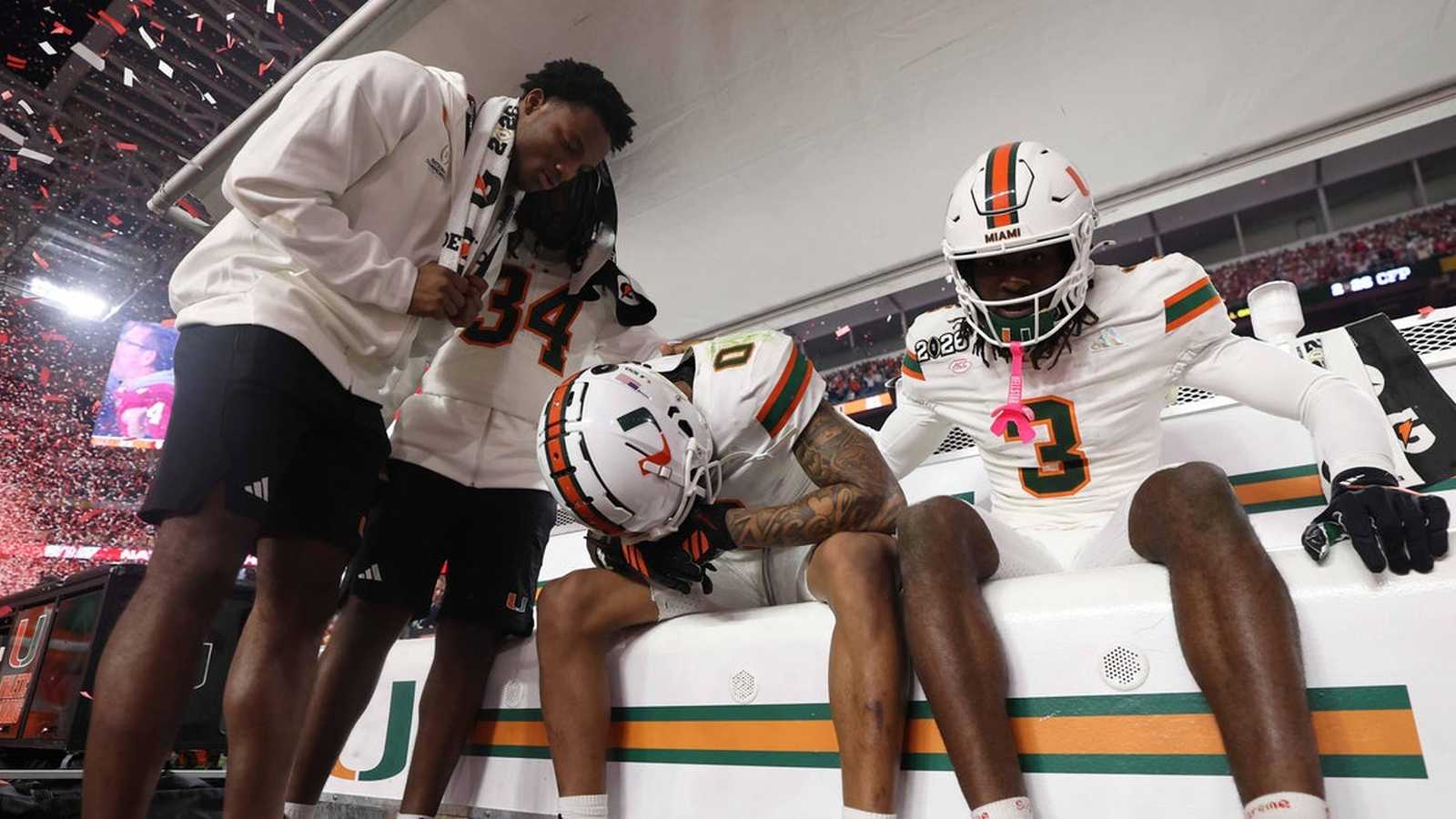
For the Miami Hurricanes, the championship game was a bittersweet experience, as their quest for a long-sought sixth national title was denied on their home turf at Hard Rock Stadium. Under coach Mario Cristobal, who once considered joining the Secret Service before returning to his passion for football, the Hurricanes fought valiantly. Their defensive line, a key strength in their playoff run, managed to pressure Mendoza and record sacks, notably from Rueben Bain Jr. Offensively, Mark Fletcher Jr. and Malachi Toney made significant plays, with Fletcher Jr. scoring two touchdowns. However, costly penalties and offensive inconsistencies, particularly on third downs, ultimately hampered their efforts to overcome the disciplined Hoosiers. The atmosphere in Miami Gardens was electric, with notable attendees including President Donald Trump, Secretary of State Marco Rubio, and Indiana alumnus Mark Cuban, underscoring the magnitude of the event for both programs.
The Hoosiers’ improbable championship underscores a fundamental shift in college football, demonstrating that strategic coaching, effective use of the transfer portal, and robust conference revenue, rather than solely historical prestige, can now propel programs to the sport’s pinnacle, fundamentally reshaping its competitive landscape.