
Quick Read
- James Nesbitt stars as Simon Greene in Netflix’s Harlan Coben thriller ‘Run Away’.
- The series finale reveals Simon’s wife Ingrid murdered Aaron, only to discover Aaron was her son, believed stillborn from a cult.
- The most shocking twist is the incestuous revelation that Aaron and Simon’s daughter Paige were half-siblings.
- Nesbitt and other cast members were kept in the dark about major plot twists, discovering them as they filmed.
- The ending offers no neat resolution, leaving Simon burdened by profound family secrets.
Netflix’s latest Harlan Coben thriller, ‘Run Away,’ didn’t just conclude; it utterly unraveled, leaving audiences and even its lead actor, James Nesbitt, in a state of profound shock. What began as a desperate father’s search for his missing daughter quickly spiraled into a labyrinth of family secrets, murder, and an unthinkable incestuous bombshell that proved Coben’s enduring mastery of the plot twist. Nesbitt, who anchors the series as Simon Greene, admits the finale was a jolt, even for a seasoned actor who has navigated the intricate worlds of the prolific author before.
By the time the credits rolled on the eighth episode, the meticulously constructed world of Simon Greene had crumbled, revealing a foundation built on lies and devastating truths. His wife, Ingrid, was a murderer, his daughter, Paige, harbored an incestuous secret, and the very fabric of their family was on the verge of annihilation. It was a narrative journey that defied expectations, demonstrating why Coben’s thrillers don’t just surprise; they genuinely wound.
The Unraveling: A Family’s Darkest Secrets Exposed
The series initially presents itself as a straightforward missing-person case. Simon Greene embarks on a frantic search for his runaway daughter, Paige. However, as the story progresses, it becomes clear that the central mystery is far more insidious than a simple disappearance. The narrative skillfully employs misdirection, hinting at a nefarious cult, the ‘Shining Truth,’ as the primary antagonist. Yet, as the finale approaches, this seemingly central conspiracy is revealed to be almost a red herring, diverting attention from the true tragedy festering within Simon’s own home.
The penultimate episode leaves Simon shot and his wife, Ingrid, comatose. Paige remains missing, despite the cult leader’s apprehension. But the real revelations emerge when Paige finally resurfaces from rehab, completely unaware of the manhunt her father had undertaken. Her fragmented account of the night Aaron died, her troubled boyfriend, immediately raises Simon’s suspicions. Under intense questioning, Paige finally breaks, confessing that she didn’t kill Aaron; her mother, Ingrid, did. Ingrid had murdered the young man, believing she was protecting her daughter from his toxic, exploitative influence.
The Incestuous Revelation: A Twist That Shakes the Core
While Ingrid’s confession of matricide was a monumental shock, it was not the twist that truly shattered Simon’s world. That came later, through an old photograph in his sister-in-law’s collection: a younger, heavily pregnant Ingrid, standing before the symbol of the Shining Truth cult. The implication crashed down upon him with the force of a tidal wave: Aaron wasn’t just Paige’s boyfriend; he was Paige’s half-brother. And, more horrifyingly, Ingrid was his mother.
This meant that when Ingrid killed Aaron, she was unknowingly murdering her own son, a child she had believed stillborn thirty years prior, while trapped within the cult. Aaron had been born to Ingrid within the cult but was taken from her under the false pretense of death. He was illegally adopted and left in the hands of the cult leader, Casper Vartage, who deemed him ‘un-divine’ and fathered him alongside other illegitimate sons to serve as cult soldiers. When these brothers began finding each other through DNA websites, Vartage panicked, hiring assassins to eliminate them all. Ingrid, however, remained oblivious to this intricate, tragic history.
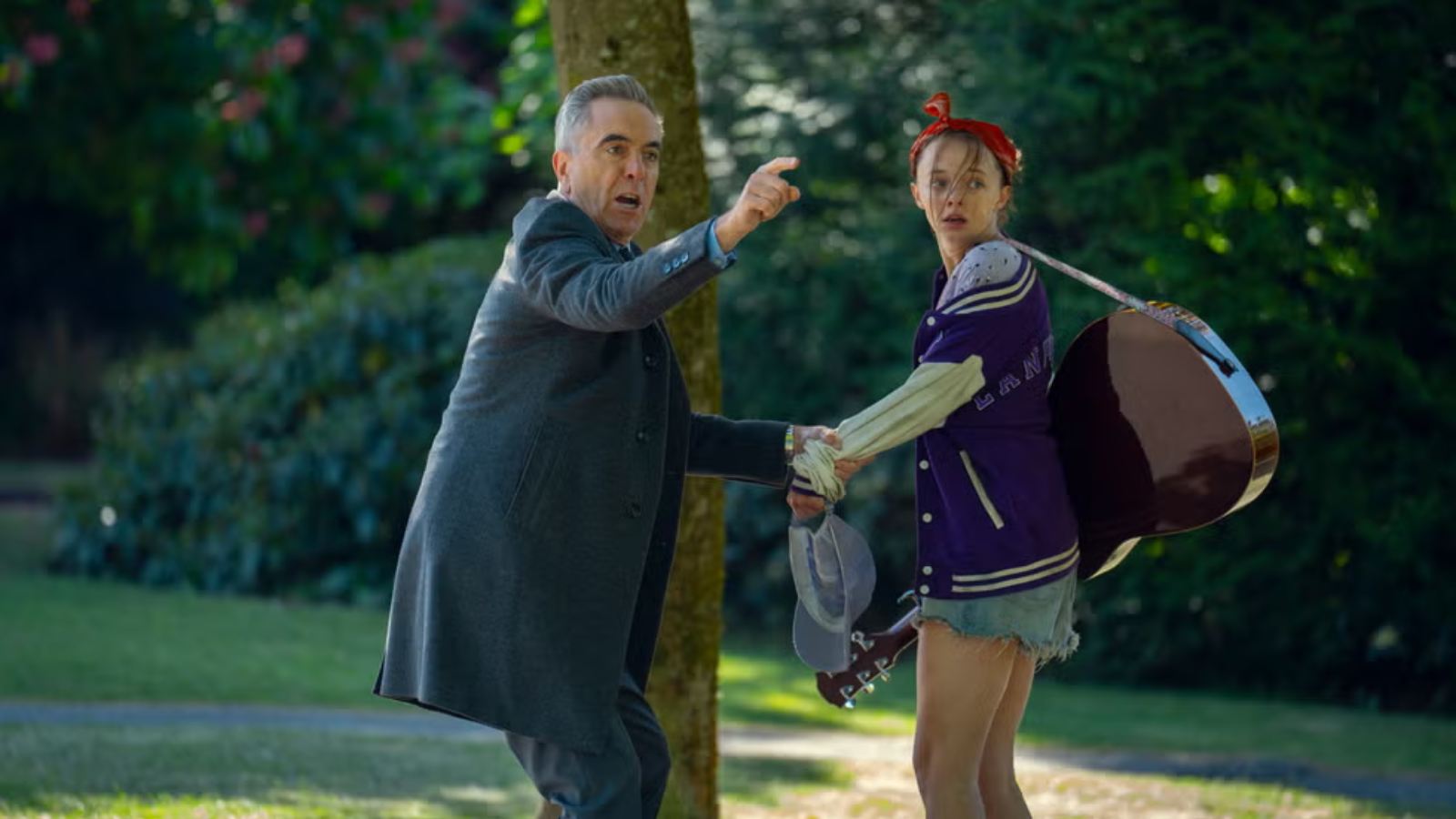
When Paige confided that Aaron had beaten her and dragged her back into drug addiction, Ingrid saw only a predator destroying her daughter’s life. Her decision to kill him was calculated, a desperate act of maternal protection, utterly unaware she was extinguishing the life of the child she had mourned for decades. The trauma of this revelation, as Ingrid recounts it to Simon during a walk in the park, is almost unbearable. Her voice, barely a whisper, confesses the night she went to Aaron’s flat with murder in her heart. Her alibi, an alleged affair with a colleague named Jay, was merely a diversion; Jay had followed her out of concern, but she managed to lose him, proceeding to Aaron’s flat where she committed the murder and mutilated his body to stage it as gang violence. She was then shot by drug dealer Luther, surviving the ordeal but carrying the secret into a coma.
Actor Reactions: Navigating Coben’s Labyrinthine Mind
For actors like James Nesbitt, navigating a Harlan Coben adaptation is a unique challenge. Ruth Jones, who played the doomed private investigator Elena Ravenscroft, confessed to Radio Times that she hadn’t anticipated the narrative’s direction. ‘I didn’t actually [see what was coming],’ she remarked. Nesbitt, making his third appearance in a Coben adaptation after ‘Stay Close’ and ‘Missing You,’ echoed this sentiment, reflecting on Coben’s unparalleled ability to misdirect.
‘[Harlan Coben’s] very good at those twists. In a sense because he’s done so many of them, you’d think you would get it. But you’re still so distracted. You’re so involved in it, you’re just watching where it goes and it just takes different routes all the time. When you finally get to the end, I think it’s quite the shock,’ Nesbitt told IBTimes. He further explained the unique process of acting in a Coben series: actors aren’t given complete scripts in advance. They discover their characters’ dark secrets in real-time, alongside the audience, playing moment by moment, trauma by trauma. ‘You’re just playing the role, you’re not really thinking about how to get there, you’re just getting there slowly and then before you know it, it’s done,’ Nesbitt explained, highlighting the visceral, unmediated experience of portraying such intense emotional journeys.
Harlan Coben himself emphasized the emotional core of his twists. ‘This one has more twists and turns than any. Episode 8 especially – you’ll think you have it solved once, twice and that last minute, you’ll have one more. It has to be emotional, it had to be a twist that would not only make you gasp out loud but hits you in the heart a little bit,’ he stated, underlining his philosophy that true impact comes from emotional resonance, not just intellectual surprise.
The Unbearable Burden of Secrecy
The true genius of ‘Run Away’s’ finale lies not merely in its accumulation of twists, but in how each revelation deepens the moral complexity of every character. Simon, burdened by impossible knowledge, promises Paige he won’t tell Ingrid the truth about Aaron’s biological connection. Simultaneously, he promises Ingrid he knows the truth but will keep it from Paige. He goes to extraordinary lengths to protect his family from truths that could utterly destroy them, becoming complicit in an elaborate architecture of lies.
The final scene, with Simon looking directly into the camera with an expression of profound ambiguity, offers no relief, no neat resolution, only the unbearable weight of secrecy. The show’s creator, Danny Brocklehurst, and Coben intentionally crafted a finale that rejects traditional closure. Paige cannot return home unchanged. Elena, the quirky investigator, lies dead in the woods. Ingrid will wake from her coma carrying the weight of matricide, oblivious to the fact that she murdered her own son. Simon must live with secrets that, if ever revealed, could annihilate his family.
For audiences accustomed to conventional thriller conclusions, ‘Run Away’ delivers something far more unsettling: the stark recognition that sometimes, there is no version of the truth that sets anyone free. This profound ambiguity, combined with Nesbitt’s compelling portrayal of a man trapped between love and devastating secrets, cements ‘Run Away’ as a standout in Coben’s already impressive oeuvre, proving that true horror often resides not in external threats, but in the deepest, most hidden corners of the human heart.