
Quick Read
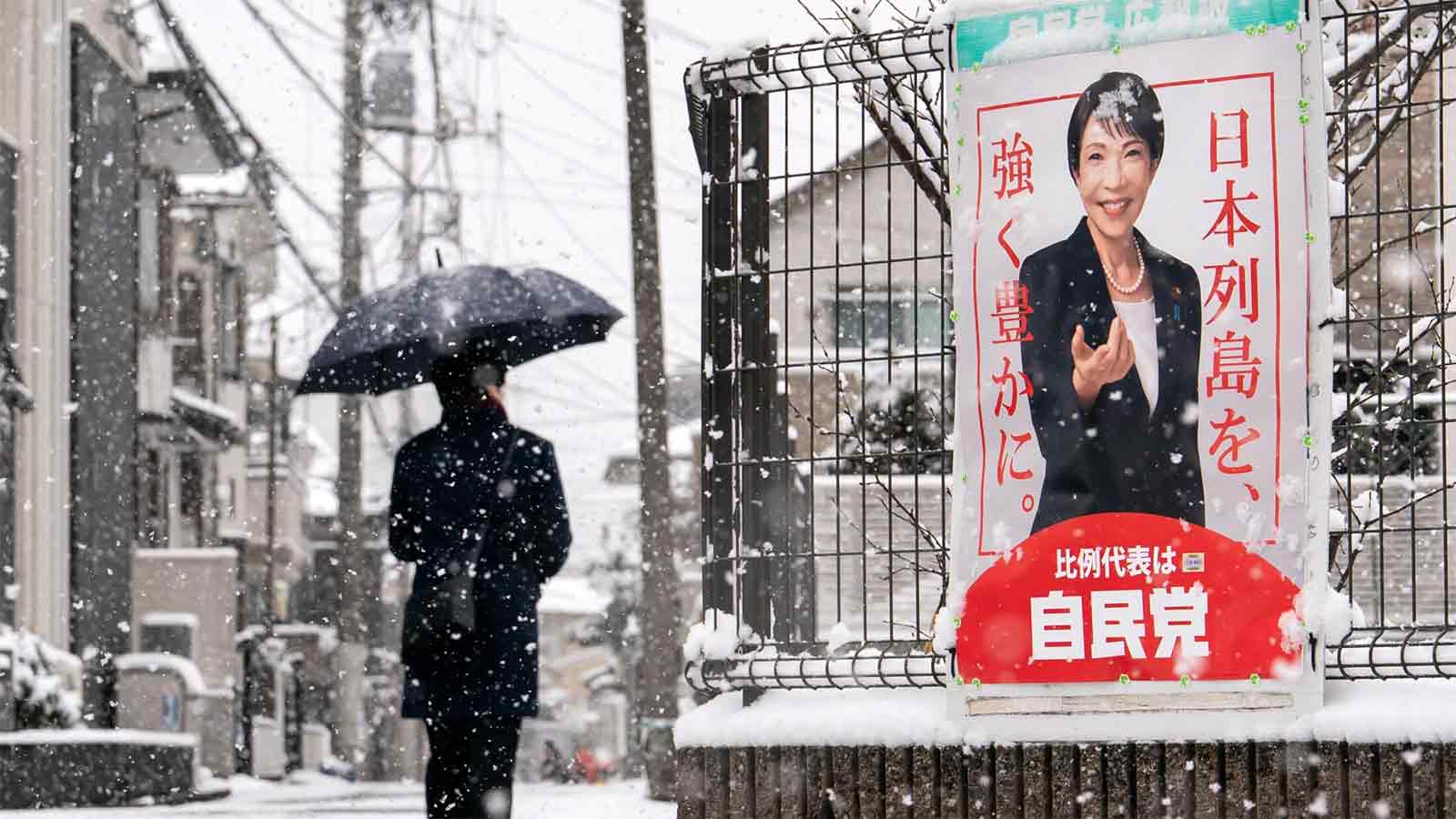
- Japan held a snap Lower House election on Sunday, February 8, 2026, amid heavy snowfall.
- Prime Minister Sanae Takaichi’s LDP-Ishin coalition is projected for a strong victory, potentially around 300 of 465 seats.
- Takaichi pledged to resign if her coalition failed to retain a simple majority.
- Key campaign issues included rising cost of living, increased defense spending, and a tougher stance on China and immigration.
- Early voter turnout dipped compared to the 2024 election, largely due to severe winter weather conditions.
TOKYO (Azat TV) – Voters across Japan cast their ballots on Sunday, February 8, 2026, in a snap Lower House election widely viewed as a referendum on Prime Minister Sanae Takaichi’s leadership. Despite heavy snowfall blanketing large parts of the country, Takaichi’s conservative coalition is largely expected to secure a resounding victory, potentially cementing her authority and significantly shaping Japan’s future domestic and international policies.
Opinion polls, as reported by Reuters and Al Jazeera, had predicted a clear win for the coalition led by Takaichi, Japan’s first female prime minister, with projections suggesting around 300 of the 465 seats in the lower house. This would mark a sharp increase from the 233 seats the Liberal Democratic Party (LDP) and its coalition partner, the Japan Innovation Party (Ishin), were defending. A victory surpassing 310 seats would grant the coalition a super-majority, enabling it to override the upper chamber, where it currently lacks sufficient numbers. Prime Minister Takaichi, 64, who took office in October, had explicitly stated she would resign if her coalition failed to retain a simple majority, underscoring the high stakes of the election.
PM Takaichi Seeks Strong Mandate Amid Economic Concerns
Prime Minister Takaichi’s campaign focused on securing a fresh mandate for her conservative agenda, characterized by a straight-talking style and an image as a hard worker that has resonated particularly with younger voters, even sparking a social media phenomenon dubbed “sanakatsu.” Her policy platform included an acceleration of military spending, partly in response to pressure from US President Donald Trump and to counter China, as reported by Hindustan Times and AP. She also advocated for ‘proactive’ government spending to support ‘crisis management investment and growth,’ highlighting economic security, technology, and industrial policy. Takaichi has also signaled a tougher stance on immigration, calling for stricter rules for foreign property owners and a cap on foreign residents.
The rising cost of living emerged as a central issue for voters, grappling with Japan’s first sustained bout of inflation in a generation. Both the ruling LDP and the opposition Centrist Reform Alliance (CRA) pledged to cut the sales tax on food to zero to alleviate household pressure. The LDP proposed a temporary reduction, while the CRA advocated for a permanent one. Japan’s economy expanded by just 1.1 percent last year and is projected to grow by only 0.7 percent in 2026, according to the International Monetary Fund (IMF), adding urgency to economic relief measures.
Key Policies and International Posture
A decisive victory is expected to grant Prime Minister Takaichi increased political leverage in her increasingly tense relations with China. Just weeks into her premiership, Takaichi, long regarded as a China hawk, raised regional tensions by publicly suggesting Japan could intervene militarily if Beijing attempted to take self-ruled Taiwan by force, a move that Beijing considers part of its territory. A strong popular mandate would likely enable Takaichi to push faster on plans to strengthen Japan’s military, efforts that Reuters notes are expected to further irritate Beijing.
Adding to the campaign’s final stretch, US President Donald Trump publicly endorsed Prime Minister Takaichi, praising her leadership and her coalition’s work. While this backing from a prominent international figure was expected to energize right-leaning voters, Al Jazeera and Hindustan Times noted it also carried the risk of alienating some moderate voters.
Snowfall Challenges Voter Turnout in Snap Election
The snap election was held amid challenging weather conditions, with heavy snowfall sweeping across wide parts of Japan, including central Tokyo, which recorded 3 centimeters of snow. The Japan Meteorological Agency issued warnings for blizzards and traffic disruptions, raising concerns about voter turnout. Early turnout figures stood at 3.72% as of 10 am local time on Sunday, significantly lower than the 6.33% recorded at the same point in the 2024 election, according to Japan’s internal affairs ministry, cited by Bloomberg. Voters braved the wintry conditions, with some describing the difficulties of reaching polling stations. Public broadcaster NHK reported that some remote polling stations would close early to ensure ballots reached counting centers on time, marking this as Japan’s first mid-winter general election since 1990.
The potential for Prime Minister Takaichi to secure a robust mandate, despite the challenges of weather and economic concerns, underscores a significant moment for Japan’s political landscape. Her leadership, characterized by a clear conservative agenda and a willingness to address contentious issues like defense spending and China relations, suggests a distinct direction for the nation, particularly if her coalition achieves the super-majority needed to bypass legislative hurdles.