
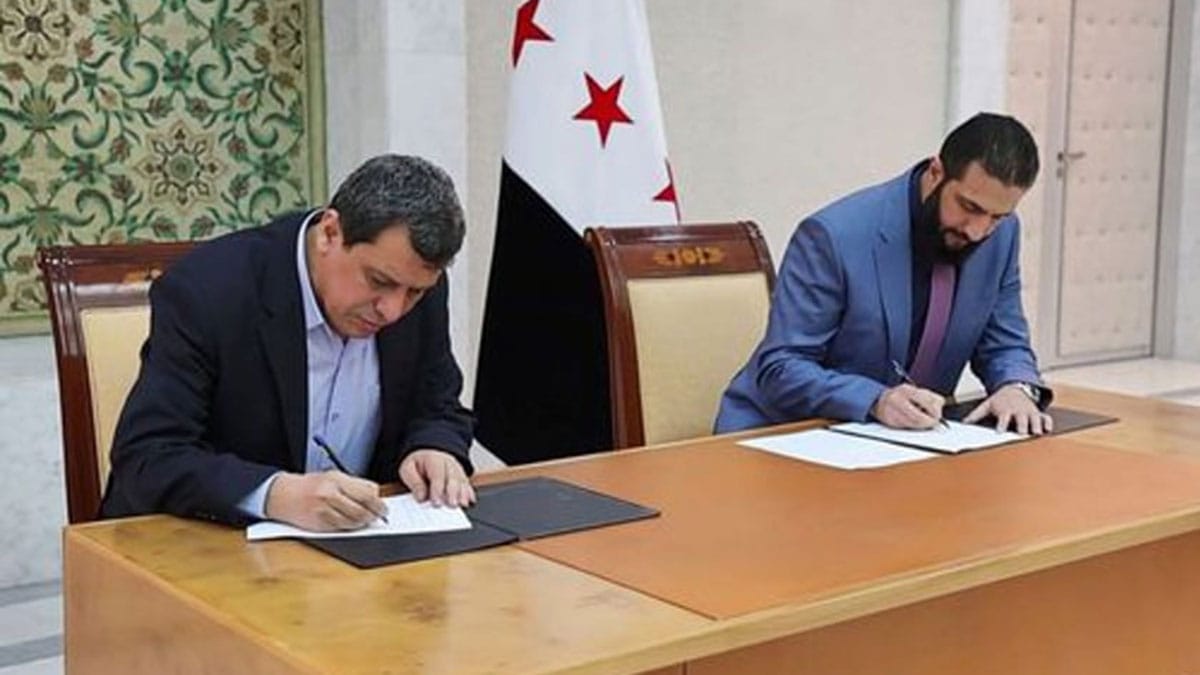
The Kurdish leadership of the Syrian Democratic Forces (SDF) has signed a landmark agreement with the Syrian government in Damascus, marking the integration of all civil and armed structures of Kurdish autonomy in northeastern Syria into Syrian state institutions. The announcement, released Monday by the Syrian President’s office, signals a pivotal moment in Syria’s decade-long civil war and reshapes regional dynamics. The agreement, reached during a meeting between Ahmad Al-Sharaa, representing the Syrian government, and SDF General Commander Mazloum Abdi, aims to restore control of the Syrian central government over the northeastern regions of the country, which have enjoyed de facto autonomy in recent years.
Agreement Signed in Damascus: Syrian Government and SDF Reach Accord.
The agreement signed in Damascus is the culmination of prolonged negotiations and mediation efforts by regional actors. The meeting on Monday marks a willingness from both sides to overcome disagreements and find compromise solutions for the sake of Syrian unity and stability. Details of the discussions are yet to be disclosed, but it is known that the main goal of the agreement is to take steps towards reintegrating northeastern Syria into the country’s central state system. The signing ceremony took place in the Syrian capital, symbolizing the official nature of the agreement and its importance to both parties.
Integration of Civil and Armed Structures: Key Autonomy Areas Rejoin the State.
One of the key points of the agreement is the integration of the civil and armed structures of Kurdish autonomy into Syrian state institutions. This includes various spheres of governance, such as local administration, education, healthcare, and social services. The integration of armed structures is also of significant importance, as it envisages the incorporation of SDF forces into the Syrian armed forces or other state security bodies. This step aims to eliminate the parallel governance system and ensure Syria’s territorial integrity under unified state administration.
Border Crossings, Airports, and Oil Fields: Control Transferring to Damascus.
The agreement announcement specifically highlighted the integration of economically and strategically important infrastructure in northeastern Syria. It is stated that border crossings, airports, and oil and gas fields, previously controlled by Kurdish autonomy, are now being transferred under the control of the Syrian central government. This move carries considerable economic and political significance as it allows Syria to regain control over its natural resources and trade routes, crucial for the country’s economic recovery and development.
Kurdish Autonomy Within Syria: Impact of Integration on Kurdish Self-Determination.
While noting the necessity of integration, the agreement also emphasizes the status of the Kurdish population within the Syrian state. The announcement states that the Kurdish population is an integral part of Syria and enjoys civil rights in accordance with the country’s Constitution. This suggests that integration does not imply suppression of Kurdish identity and culture but, on the contrary, aims to ensure the equal participation of the Kurdish population in Syria’s political, economic, and cultural life within a unified state framework. The agreement likely includes mechanisms and guarantees aimed at protecting Kurdish cultural and linguistic rights, as well as preserving certain forms of self-governance at the local level.
Syria-Wide Ceasefire: A Crucial Component of the Agreement.
Another crucial aspect of the agreement is the ceasefire agreement across Syria. The Syrian conflict, which has lasted for over a decade, has caused numerous casualties and devastation in the country. The establishment of a ceasefire, if actually implemented, could be a significant step towards lasting peace and stability in Syria. Details of the ceasefire agreement are yet to be released, but it is expected to include a cessation of all military operations between the parties, as well as the resumption of dialogue and a political settlement process.
Regional Implications: Future of a Unified Syria and Neighboring Countries’ Reactions.
The integration of Kurdish autonomy into Syria has broad regional implications. The restoration of a unified Syria could alter the balance of power in the Middle East and affect the interests of neighboring countries such as Turkey, Iraq, and Iran. Turkey, which has consistently been concerned about the strengthening of Kurdish autonomy in Syria, may welcome this agreement if it leads to the containment of Kurdish formations and the strengthening of the Syrian central government. On the other hand, for Iraq and Iran, a unified and stable Syria could contribute to strengthening regional security and economic cooperation. The international community, particularly the UN and major regional players such as Russia and the United States, will also be closely monitoring this process and may become involved in further settlement efforts.
Path to Unity: Syrian Integration as Guarantee for Peace and Stability.
The Kurdish agreement to integrate into Syrian state institutions can be seen as a historic step towards restoring the country’s unity and establishing lasting peace. The Syrian civil war has left deep scars on the country’s society and economy, and restoring national cohesion becomes a priority to ensure future stable development. The agreement, if successfully implemented, could lay the foundation for a pan-Syrian dialogue and a national reconciliation process that will contribute to the country’s political and economic recovery, as well as strengthening regional stability.