
Quick Read
- Lara Trump is considering a Senate run in North Carolina following Senator Thom Tillis’s retirement.
- Donald Trump endorsed Lara Trump as his first choice for the seat.
- Lara Trump’s conservative platform contrasts with potential Democratic contender Roy Cooper’s progressive policies.
- The race is seen as critical for both parties in the 2026 midterm elections.
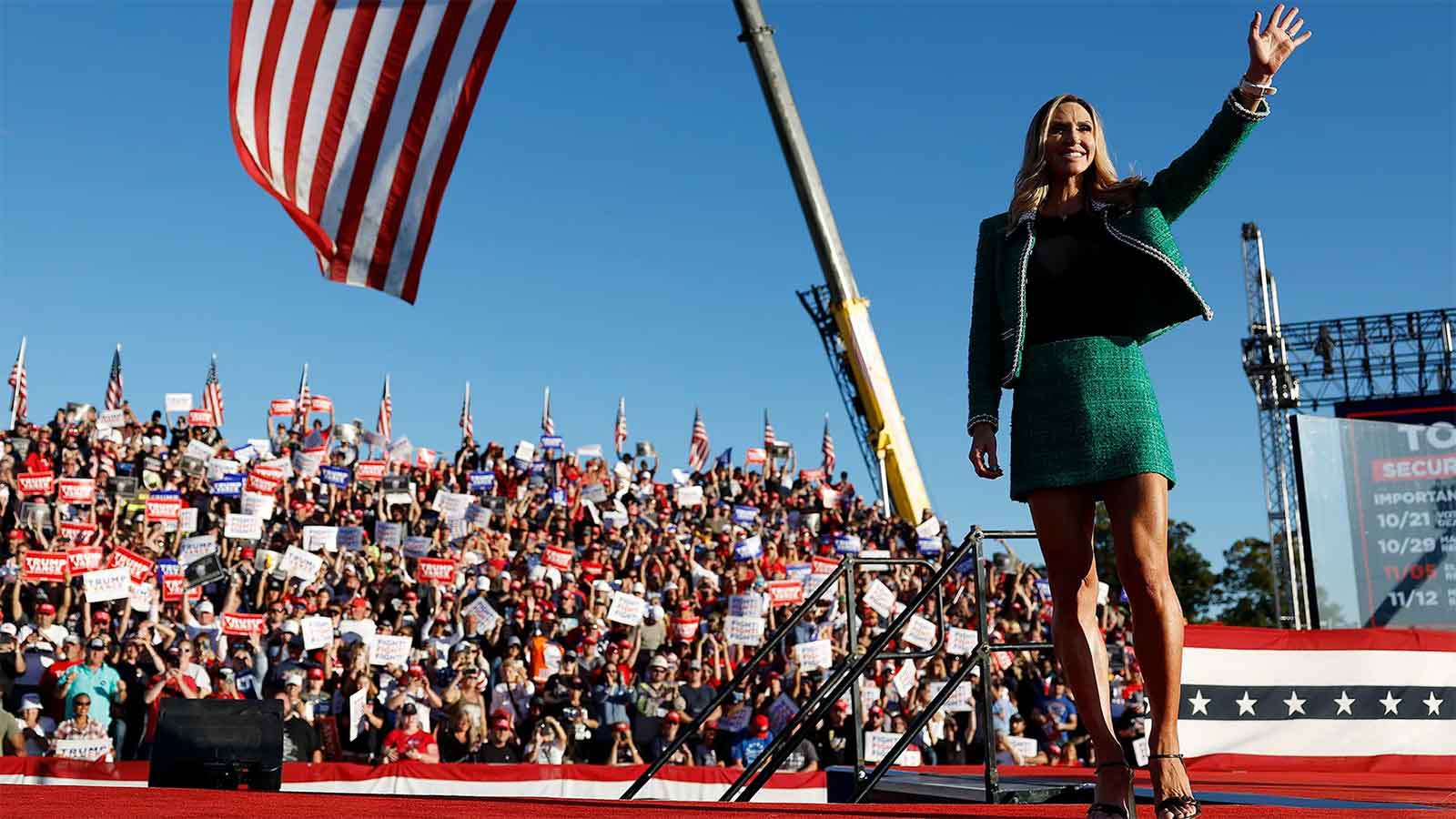
The political landscape in North Carolina is undergoing a seismic shift following the surprise announcement by Republican Senator Thom Tillis that he will not seek re-election in 2026. Tillis, who has represented the state since 2015, has left a gaping hole in the GOP field, prompting speculation about potential candidates to fill his seat. Among those rumored to be considering a run is Lara Trump, daughter-in-law of President $1 Trump and a North Carolina native.
Lara Trump: A Strong Contender
Lara Trump, a prominent conservative figure and former co-chair of the Republican National Committee, is widely seen as a leading contender for the Senate seat. Her potential candidacy is bolstered by her family name, which carries significant weight in Republican politics. On Tuesday, Donald Trump himself endorsed the idea, stating, “Lara would always be my first choice.” Republican strategist Jonathan Felts echoed this sentiment, noting, “If your name’s Trump, you’ve got a pretty good advantage.”
In a Fox News interview earlier this week, Lara Trump acknowledged that a Senate bid is under consideration. “It is something that, if it works out and the timing works and it works for my family, it is absolutely something that I would consider doing,” she said. Her decision could have a domino effect, as other Republican candidates may defer their bids in her favor. Rep. Pat Harrigan, R-N.C., for instance, has already expressed his willingness to back her should she enter the race.
Lara Trump’s platform aligns closely with the policies of her father-in-law, emphasizing energy independence, economic growth, and conservative social values. Her advocacy for “energy dominance” has been a recurring theme, contrasting sharply with the environmental policies championed by potential Democratic contender and former North Carolina Governor Roy Cooper.
North Carolina’s Political Landscape
The race for Tillis’s seat is shaping up to be a pivotal battleground in the 2026 midterm elections. Democrats, who currently face the uphill task of flipping four seats to gain a Senate majority, view North Carolina as a critical opportunity. Morgan Jackson, a Democratic consultant, remarked, “If Democrats want to take back the Senate, it starts in North Carolina.”
On the Democratic side, former Governor Roy Cooper has emerged as a potential frontrunner. Known for his progressive stance on renewable energy and climate policy, Cooper’s decision to run could set the stage for a high-profile clash with Lara Trump. Cooper’s administration was instrumental in advancing clean energy initiatives, including a roadmap to achieve net-zero greenhouse gas emissions by 2050. However, his entry into the race is not yet confirmed, with advisors stating that he is still weighing his options.
Other Democrats, such as former Representative Wiley Nickel, have already declared their candidacy, but the field remains fluid. Much like the Republican side, Democratic strategists are watching and waiting for Cooper’s decision before solidifying their plans.
The Broader Impact
The implications of Tillis’s retirement extend beyond North Carolina. Nationally, Republicans are seeking to expand their 53-47 majority in the Senate by targeting Democratic-held seats in states like Georgia, Michigan, and New Hampshire. Meanwhile, Democrats are focusing on battleground states like North Carolina and Maine, where Republican Senator Susan Collins faces re-election in a state that voted for Kamala Harris in 2024.
In North Carolina, the race is also expected to influence debates on key issues such as energy policy. While Tillis had a mixed record on environmental matters, his departure could lead to a stark policy shift depending on his successor. Lara Trump’s stance prioritizes traditional energy sources like oil and natural gas, whereas Cooper’s policies have leaned heavily on renewable energy development. As Scott Schang, Director of the Environmental Law and Policy Clinic at Wake Forest University, pointed out, “The future of North Carolina’s environmental landscape hangs in the balance.”
The coming weeks will likely bring more clarity to the evolving political dynamics in North Carolina. As potential candidates finalize their decisions and campaign strategies, voters will be watching closely to see how the race unfolds. For now, Lara Trump remains a wildcard whose entry into the race could significantly reshape the Republican field and the broader electoral landscape.
The stakes in North Carolina’s Senate race are high, not just for the state but for the nation. With key policy issues and the balance of power in the Senate hanging in the balance, the race promises to be one of the most closely watched contests of the 2026 midterms.