
Quick Read
- A derailment of Lisbon’s iconic Glória Funicular killed 16 and injured 21.
- The accident occurred on September 3, 2025, during the evening rush hour.
- Emergency services rescued victims within two hours, but investigations are ongoing.
- World leaders, including French President Macron, expressed condolences.
- The funicular, a 140-year-old landmark, was undergoing regular maintenance.
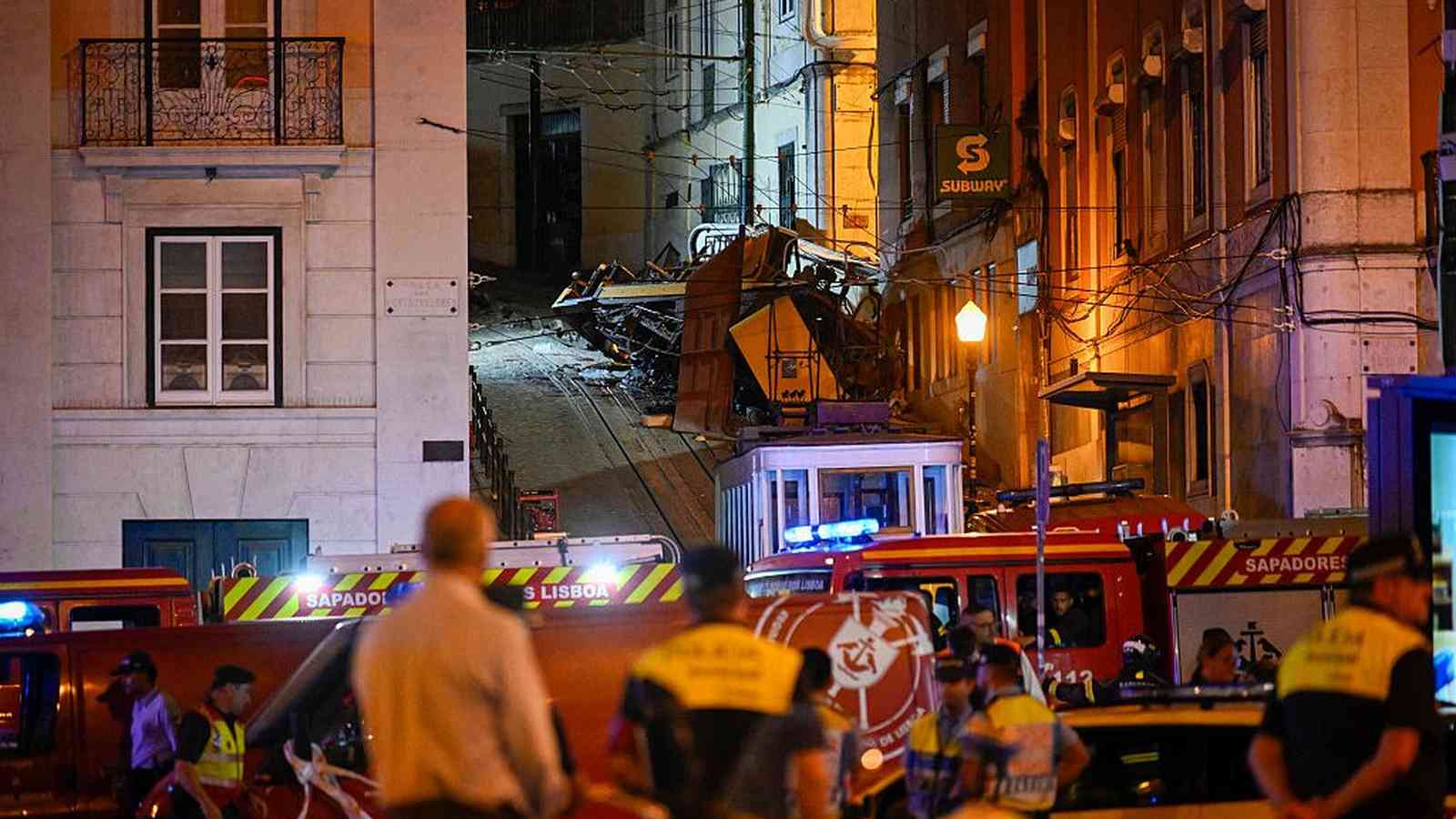
The historic Glória Funicular in Lisbon, Portugal, experienced a catastrophic accident on Wednesday, September 3, 2025, resulting in the tragic loss of 16 lives and leaving 21 others injured, five of whom are in critical condition. The derailment, which took place at approximately 6:15 p.m. local time, sent shockwaves throughout Portugal and the world. The funicular, a beloved symbol of Lisbon’s heritage, crashed into a building on the steep Rua da Glória, near Avenida da Liberdade, overturning and causing significant destruction.
The Accident: A Nation in Shock
Witnesses described the horrifying scene as the funicular appeared to lose control while descending the steep incline. Eyewitness Teresa d’Avó told Portuguese newspaper Observador, “It was out of control, without brakes. We all started running because we thought it would hit the one below.” The funicular ultimately crashed into a building, collapsing “like a cardboard box,” as another witness told SIC TV.
The Glória Funicular, a 140-year-old system operating since 1885, is one of Lisbon’s most iconic tourist attractions. It shuttles passengers between Restauradores Square and Bairro Alto, a neighborhood renowned for its vibrant nightlife. Despite its vintage charm, the funicular was equipped with modern electric motors and a brakeman to ensure safe operations. However, the cause of the derailment remains unclear, with authorities launching a thorough investigation.
Immediate Response and Rescue Efforts
Emergency services arrived swiftly, with dozens of firefighters, medics, and police working tirelessly to rescue survivors from the wreckage. According to Portugal’s National Institute for Medical Emergencies, some victims were pulled from the debris within two hours. Among the injured were 11 foreign nationals, including citizens from Germany, Spain, France, Italy, South Korea, and Canada, as reported by DW.
Tragically, one of the victims was identified as André Jorge Gonçalves Marques, the brakeman operating the funicular at the time. The Portuguese transport union Sitra confirmed his death, expressing condolences to his family and colleagues.
In the aftermath, Lisbon Mayor Carlos Moedas described the incident as “a tragic moment for the city.” Prime Minister Luís Montenegro declared Thursday a day of national mourning, stating, “The government deeply regrets this tragedy and extends its solidarity to the victims and their families.” Flags flew at half-mast across Lisbon and at European Union institutions in Brussels.
Investigations Underway: Searching for Answers
The Portuguese public prosecutor’s office, alongside the national transport safety authority and Carris—the company that operates the funicular—has initiated a multi-agency investigation. Carris CEO Pedro Bogas assured the public that all scheduled maintenance had been conducted according to protocol, with the last major overhaul completed in 2022. However, questions have arisen regarding the integrity of the cable system and the braking mechanisms.
Preliminary reports suggest that the funicular may have derailed due to a failure in its counterweight cable system. The funicular, which operates on a haulage cable that balances two cars, is designed to safely navigate the steep gradient of Rua da Glória. Experts are examining whether the cable came loose or if the braking system failed to activate, allowing the car to accelerate uncontrollably.
Local media shared video footage of the aftermath, showing the wrecked funicular lying on its side against a building, surrounded by debris and smoke. Eyewitness accounts will play a crucial role in piecing together the sequence of events leading to the crash.
Global Condolences and Lisbon’s Grief
The tragedy has elicited an outpouring of sympathy from world leaders. French President Emmanuel Macron expressed solidarity with Portugal, stating, “The French people join the Portuguese in mourning after the tragic cable car accident in Lisbon.” Similarly, European Commission President Ursula von der Leyen and Spanish Prime Minister Pedro Sánchez conveyed their condolences on social media.
Lisbon’s Catholic Patriarch Rui Valério also offered prayers for the victims, thanking rescue teams for their swift response. Meanwhile, European Parliament President Roberta Metsola called the accident “a tragedy that has shaken Europe deeply.”
The Glória Funicular has long been a symbol of Lisbon’s rich cultural heritage, carrying approximately three million passengers annually. Its designation as a national monument in 1997 underscores its historical significance. For many, the accident is not just a loss of life but a blow to Lisbon’s identity.
The Glória Funicular tragedy has left an indelible mark on Portugal, prompting both grief and a call for accountability. As investigations continue, the nation and the world stand united in mourning the lives lost in this heartbreaking incident.