
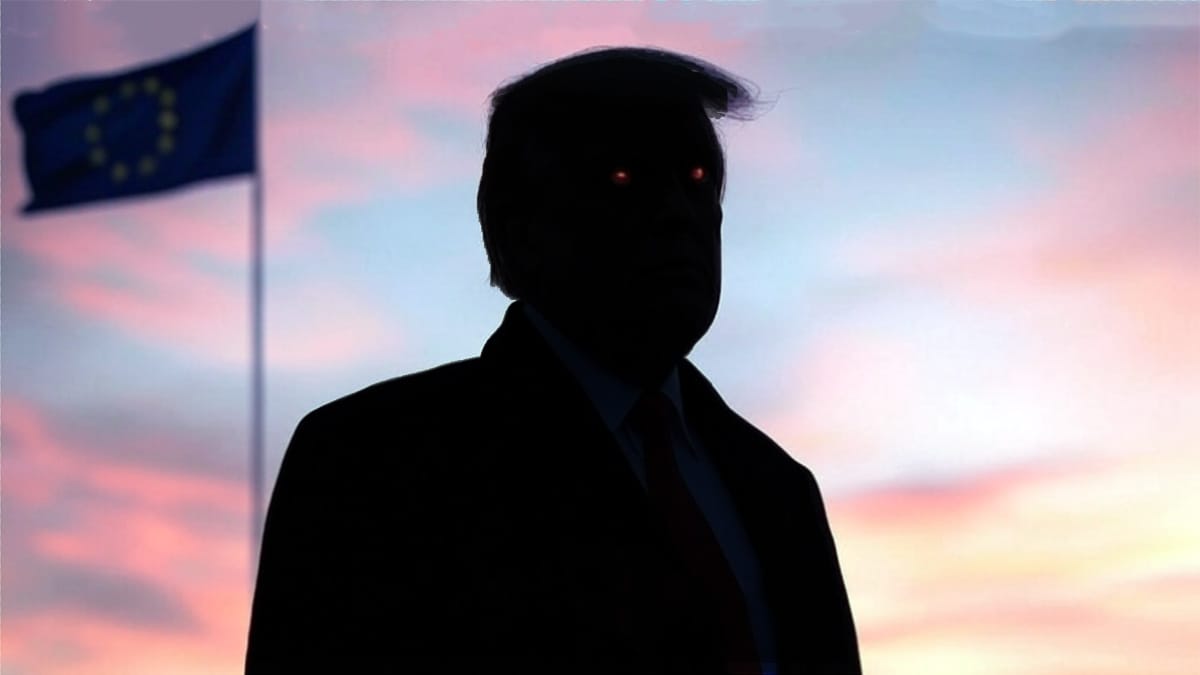
“Make Europe Great Again.” This slogan, surprisingly, reflects the processes unfolding in Europe today in response to geopolitical shifts and growing uncertainty. Would it be surprising if such a thought were voiced by Donald Trump, aiming to win European elections? And who would have thought that his policies would rally European leaders and push Europe to become more sovereign and powerful?
Trump and Zelenskyy: The Spark of European Revival?
A recent event, the meeting between US President Donald Trump and Ukrainian President Volodymyr Zelenskyy at the White House, might outwardly seem like routine diplomatic engagement. However, it carried deep symbolism. Zelenskyy’s demeanor and words betrayed an inner struggle and conflicting emotions – resentment, disappointment, but also dignity and resolve. It’s no secret that Ukraine is going through tough times, fighting for its existence. And when a potential leader of your most crucial ally tries to belittle you, you have to stand up and defend your country’s independence and sovereignty.
This episode, paradoxical as it may seem, became a positive catalyst for Europe. Trump’s stance, a vivid expression of isolationist policy, along with the US’s actions in recent years, unexpectedly united Europe. The European Union began to invest more decisively in developing its own military capabilities, aiming to reduce dependence on the United States. As a result, a completely new challenge is emerging for Russia: a militarily independent entity near its borders, with a population of over 500 million and a rich history, including numerous bloody wars. This union possesses not only economic but also significant military potential, and it steadfastly supports Ukraine.
Europe on the Path to Military Independence: A New Challenge for Russia
Looking back historically, it becomes evident that Ukraine has received only a small fraction of the promised military aid. In the case of the US, only about 30% of the pledged support has been delivered. Yet, even under these conditions, Ukraine has shown incredible resistance to Russian aggression, despotism, and genocidal actions. What was the secret of this resistance? Perhaps the main factors were threefold: the unwavering will of the Ukrainian people to fight for their freedom and independence, the partial but crucial military assistance from allies, and the consistent development of their own military industry. Today, the Ukrainian army is already recognized as one of the most combat-capable forces in Europe.
Trump’s attempts to assume a mediating role have caused unease towards the US, especially among European partners. The current US administration, by the way, spares no effort to portray this war as a “proxy war” between the US and Russia. But are the real causes of the war limited to this? In reality, the Ukrainian conflict is much deeper and multi-layered. On one hand, it is the struggle of post-Soviet countries to maintain their sovereignty and choose the path of European integration. On the other hand, it is a clash of major economic and geopolitical interests, encompassing not only traditional trade routes and energy resources but also new domains: cryptocurrencies and high technologies.
Three Pillars of Ukrainian Resistance: Lessons for Europe
The US and Russia, despite their current animosity, have certain overlapping interests in this conflict. The opening of Europe-Asia transport routes is mutually beneficial only if both sides can control these routes. Otherwise, they might try to block their opening. And this applies not only to the situation around Ukraine. Numerous conflicts in recent years—in Gaza, Syria, and Artsakh—fit into this same logic of controlling strategic infrastructure and geopolitical positions.
Solutions to such complex and multi-layered problems are rarely found in the political arena. All involved parties are now in a peculiar trap, including the current US administration, whose main concern is the internal democratic opposition, which they are trying to weaken in every way, preventing it from regaining its strength. In the current geopolitical reality, it is becoming clear that military solutions alone are insufficient, but the absence of force can lead to irreversible losses. So, what will happen next?
The Uncertainty of US Role: Proxy War or Multi-layered Conflict?
History teaches us that solutions to such global crises often come through technological progress. Just as the creation of nuclear weapons ended World War II, radar and the decryption of messages contributed to Nazi Germany’s defeat, and the inventions of GPS and the internet foreshadowed the emergence of the winning side in the Cold War, so too will the current crisis likely be resolved by some revolutionary technology that will create a new balance of power.
When such a new technological solution emerges, it is likely that several major centers of power in the world will collapse or lose their influence. And only after that will the force factor be reactivated to form new rules and stability.
There are many examples of this throughout history, from firearms to nuclear weapons and the digital revolution. Superpowers have formed and disappeared precisely because of technological leaps or their absence. And now, humanity is once again standing on the threshold of such a turning point. It remains to be seen what kind of technological revolution awaits us, one that will transform the world order.
Awaiting a Technological Revolution: New Balance of Power
By the way, in my opinion, artificial intelligence (AI), decentralized blockchain technologies, and quantum computers are not yet that breakthrough revolution, but merely prepare the ground for a powerful upcoming technology that could finalize the digital revolution. What specific technologies might these be, and in what directions should we work so that we too can play a leading role in this global race? We can discuss this separately if it is of interest to our readers.