
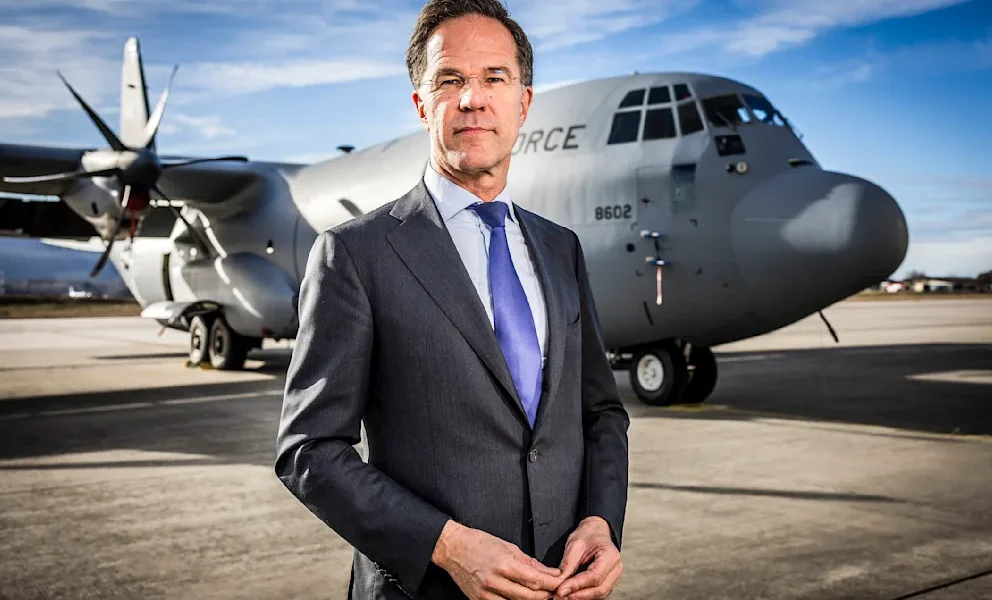
In a recent interview at Ramstein Air Base, NATO Secretary-General Mark Rutte presented an unambiguous assessment of the alliance’s strategic priorities. He emphasized that NATO members must significantly increase defense spending, particularly Germany, to ensure that Europe is prepared for the evolving security threats. The interview reflects a decisive shift in NATO’s posture, urging member states to adopt a “war mindset” to prevent future conflicts. Rutte’s remarks underscore the necessity of industrial mobilization, deterrence strategies, and unwavering support for Ukraine, positioning NATO as a bulwark against Russian expansionism.
Rutte categorically stated that defense spending must go beyond the two percent GDP benchmark, highlighting that recent increases in European military budgets were partly driven by pressure from U.S. President Donald Trump. While acknowledging Trump’s controversial rhetoric, Rutte conceded that the insistence on higher defense spending had led to substantial investments. The Secretary-General singled out Germany, stressing that its economic strength necessitates a much greater contribution to NATO’s collective security. Fair burden-sharing, according to Rutte, is critical to preventing the U.S. from shouldering a disproportionate defense responsibility.
❝I have a good life. That’s why I’m here, protecting it❞
Conscripts of the Finnish Army 🇫🇮 channel the spirit of sisu as they endure freezing temperatures, determined to contribute to their country’s defence
Link to full video in the thread ⤵️ pic.twitter.com/qkgS4wkR5O
— NATO (@NATO) February 2, 2025
The interview also revealed Rutte’s firm stance on war preparedness. He argued that avoiding conflict is only possible through robust deterrence, making it imperative for NATO members to fortify their military capabilities. His remarks conveyed a direct warning against projecting weakness, emphasizing that Russia’s invasion of Ukraine was a consequence of prior underestimations of Russian ambitions. NATO’s response must involve not only deterrence but also a significant increase in the production of military equipment, including tanks, aircraft, and ammunition. The Secretary-General pointed out that Germany, given its advanced defense industry, has a crucial role in ramping up production to meet these strategic needs.
Ukraine remains a focal point in NATO’s security calculus. Rutte framed the war as a decisive moment for European stability, warning that a Ukrainian defeat would signify peace under Russian occupation, an outcome he described as unacceptable. He reaffirmed NATO’s commitment to providing military aid, training, and logistical support to Ukraine, emphasizing that any future negotiations must ensure Russia is unable to reclaim even a single square kilometer of Ukrainian territory.
What does it take to be a recon trooper? 🪖
Find out what are the skills needed for one of the most demanding jobs in the Alliance ⬇️
— NATO (@NATO) February 3, 2025
Beyond Russia, Rutte also highlighted NATO’s increasing concerns regarding China’s military buildup. While the focus remains on European security, he acknowledged that global strategic shifts require NATO to address multiple fronts, including the Arctic. Trump’s emphasis on Arctic defense, according to Rutte, was justified, as securing NATO’s northern flank is an emerging priority.
The NATO Secretary-General’s interview signals a decisive moment for the alliance. The urgency of the message is clear: European nations must act immediately to bolster their defense capabilities, ensuring that NATO remains a credible deterrent against Russian and other global threats. The path forward requires increased military production, financial commitment, and strategic cohesion. Rutte’s call for action is not merely a policy recommendation but a stark recognition of the geopolitical reality—one that demands preparedness and unwavering unity.