
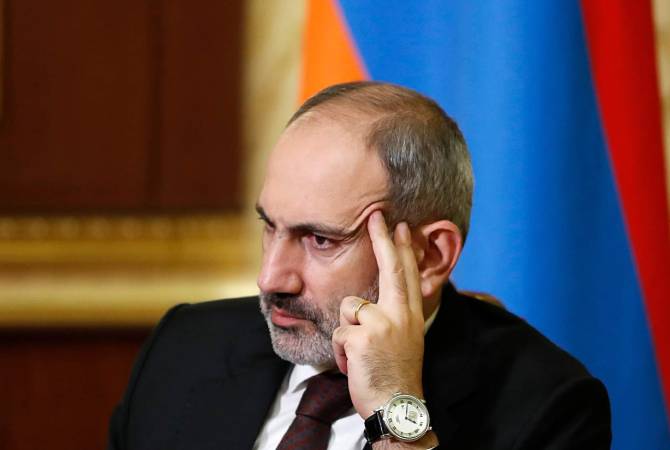
Prime Minister Nikol Pashinyan’s recent statements on social assistance programs, healthcare reforms, government vehicle reductions, and traffic cameras reflect a leader seemingly entangled in his own perpetual contradictions. His positions frequently shift from one extreme to another, raising questions about his leadership style, consistency, and vision for Armenia’s future.
Pashinyan claims that the number of families receiving social assistance has decreased due to increased employment. However, these “positive” figures fail to address the unchanged levels of poverty and the lack of improvement in living standards. The rise in employment is primarily attributed to external factors, such as migration caused by the Russia-Ukraine war and temporary construction projects, rather than domestic policy successes. On one hand, Pashinyan speaks about enhancing social support, while on the other, he blames the unemployed, labeling it as a psychological issue. This dismissive approach ignores the systemic causes of poverty and undermines those facing genuine challenges.
Pashinyan admits that Armenia is unprepared to transition to comprehensive healthcare insurance, citing risks of systemic failure. Despite healthcare budgets doubling since 2018, public satisfaction has not increased. While budget increases are significant, they have not translated into foundational reforms in the sector. His hesitance to implement necessary changes reflects a reluctance to take responsibility, stalling the development of a critical area for Armenia’s future.
In a recent announcement, Pashinyan proposed a “radical” approach to reducing government vehicles. This contradicts his earlier symbolic attempts at cutting state expenditures post-revolution. The current move, while presented as decisive, appears to be more of a political performance than a systematic optimization effort. Over time, Pashinyan’s promises have evolved into performative measures with little connection to real institutional reform.
An example of this is traffic cameras. In 2018, Pashinyan criticized traffic cameras as a mechanism of corruption under previous administrations. Now, he proposes resolving the issue through a public referendum, effectively shifting responsibility to citizens while adopting a neutral stance. His initial opposition to traffic cameras has now turned into an outright dismissal of their positive contributions to road safety and public order. This reversal underscores a lack of clear direction and a populist approach to governance.
Pashinyan’s contradictory positions raise questions about his ability to lead and make sound decisions. His actions and statements often appear erratic. Are these inconsistencies a result of attempts to appease everyone, or do they reflect deeper psychological challenges? Frequent shifts in positions suggest a populist strategy aimed at appealing to all sides, even at the expense of contradicting his own past statements. Instead of implementing major reforms, Pashinyan avoids decisive actions, seemingly out of fear of failure. Despite government claims of statistical “successes,” these achievements fail to address systemic issues like poverty, inequality, and infrastructure deficiencies.
Pashinyan appears to believe that progress has been achieved in the social, healthcare, and economic spheres. However, in areas like law enforcement, where he perceives failures, he has responded with personnel purges—a topic that will be explored in a follow-up article.
Nevertheless, Pashinyan’s leadership is increasingly characterized by contradictions and superficial populism. His inability to maintain consistency and deliver meaningful reforms erodes public trust and undermines Armenia’s development prospects. Armenia deserves leadership with a clear vision, dedication to national interests, and the courage to implement transformative changes. If Armenia is to develop, it is essential to move beyond the current populist and counterproductive policies and foster a leadership committed to meaningful progress.