


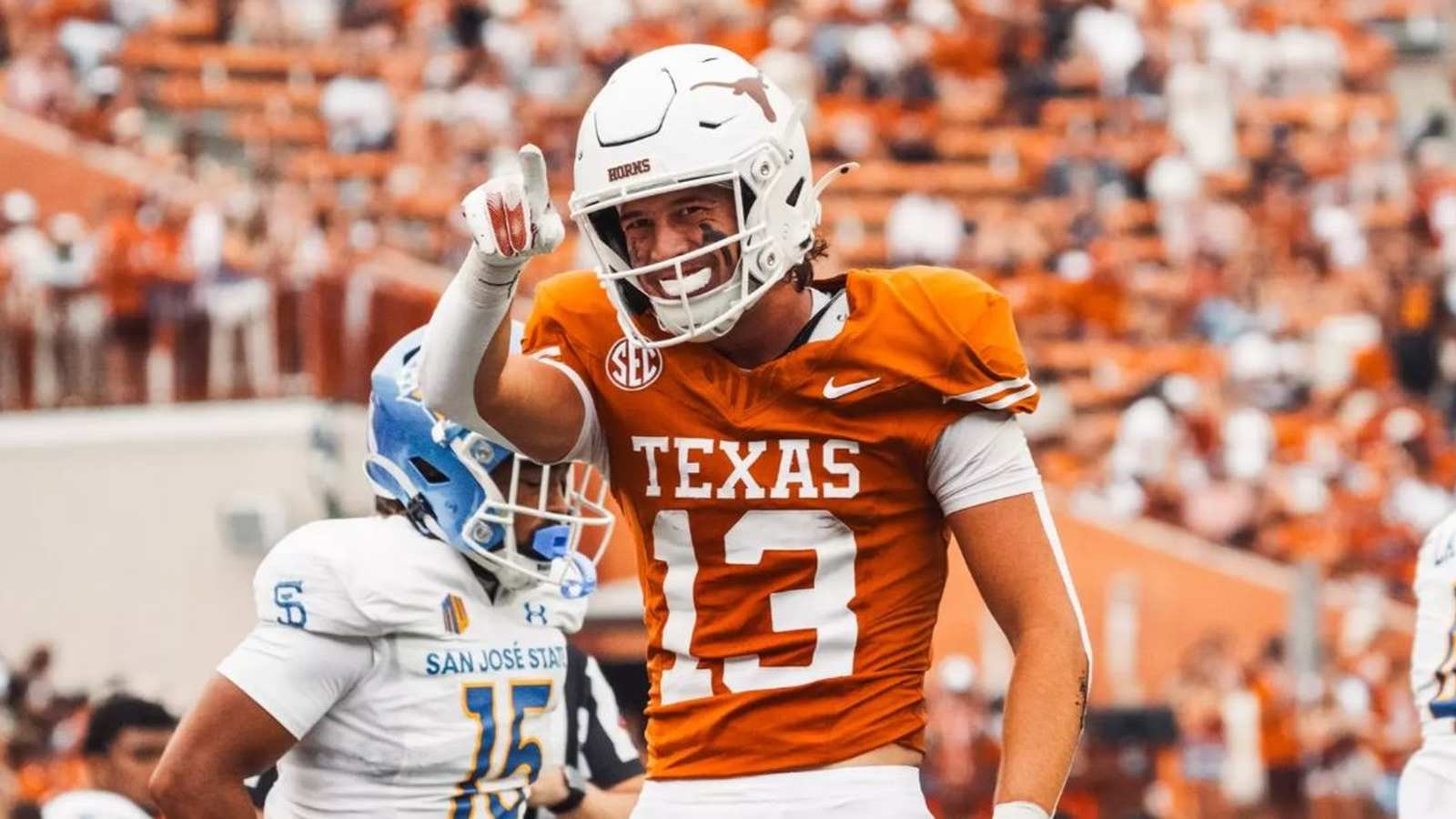
In a move that reverberates across the fiercely contested landscape of college football, star wide receiver Parker Livingstone has officially committed to the University of Oklahoma, dramatically shifting allegiances from rival Texas. Announced on Tuesday, January 6, 2026, Livingstone’s decision to enter the transfer portal and subsequently join the Sooners has ignited conversations about the evolving nature of the Red River Rivalry and the immediate impact on both storied programs.
Livingstone, a 6-foot-4, 191-pound redshirt freshman from Lucas, Texas, was a highly touted prospect, ranked as the No. 149 overall recruit in the 2024 class. After redshirting in 2024 and appearing in four games as a true freshman, he exploded onto the scene for the Longhorns in 2025. According to On3, Livingstone hauled in 29 receptions for 516 yards and six touchdowns, quickly establishing himself as a dynamic playmaker. He was the team’s fourth-leading receiver and one of only three Longhorns to surpass 500 receiving yards, also leading Texas players with more than two catches at an impressive 17.8 yards per reception, as reported by Yahoo Sports. With three years of eligibility still remaining, his potential for continued growth and impact is immense.
An Unexpected Departure and Its Ripple Effect on Texas
The news of Livingstone’s departure from Austin sent ripples through the Texas football community, particularly for quarterback Arch Manning. Livingstone and Manning were roommates, and the bond between them was evident. Manning’s reaction, an Instagram story featuring him and Livingstone accompanied by a teary-eyed emoji, underscored the personal impact of the transfer. This was not just a roster change; it was the dissolution of a partnership, both on and off the field.
Livingstone himself expressed a sense of reluctance regarding his move. In a poignant social media post, he conveyed, “Never in a million years did I think I would be going into the portal looking for a new home. Some things are out of my control. Such is the reality of the ever-changing landscape of college football.” This statement offers a glimpse into the complex and often difficult decisions players face in the era of the transfer portal, where personal desires can sometimes clash with the strategic realities of collegiate athletics.
For Texas, Livingstone’s exit comes at a challenging time for their wide receiver room. While leading receiver Ryan Wingo is set to return, the Longhorns have also seen former No. 2 receiver DeAndre Moore enter the portal and tight end Jack Endries declare for the NFL Draft. As Arch Manning, a preseason Heisman favorite, prepares for his fourth season in 2026, reloading at the receiver position will be paramount. Manning closed out the previous season strongly, with four touchdowns in the Citrus Bowl victory over Michigan and 11 total touchdowns across the Longhorns’ final three games, setting high expectations for his return. The pursuit of other transfer portal talents, such as Auburn receiver Cam Coleman, highlights Texas’s immediate need to rebuild its aerial attack.
Oklahoma’s Strategic Score: Fueling Playoff Aspirations
For the Oklahoma Sooners, landing Parker Livingstone is a significant coup. His arrival addresses a crucial “position of need” this offseason, providing head coach Brent Venables with a dynamic and proven playmaker at wide receiver. Livingstone was viewed as a top-15 receiver in the portal, making his commitment a major win for the Sooners’ recruiting efforts.
The Sooners’ front office has been exceptionally active in the transfer portal, commencing the week with six prior commitments. These additions include Colorado State running back Lloyd Avant, Colorado State tight end Rocky Beers, Oregon defensive back Dakoda Fields, Arkansas offensive lineman E’Marion Harris, Virginia wide receiver Trell Harris, and Western Kentucky offensive lineman Caleb Nitta, alongside Florida tight end Hayden Hansen. The aggressive recruitment strategy underscores Oklahoma’s determination to bolster its roster across multiple positions, particularly after a season that saw 22 former OU players enter the transfer portal, as reported by The Oklahoman.
Oklahoma is fresh off its first College Football Playoff appearance since 2019, where they initially took a commanding 17-0 lead over Alabama in their First Round matchup before ultimately falling 34-24. Despite the loss, Coach Venables expressed immense pride in his team, stating, “We couldn’t have done it if they didn’t stick with it, if they didn’t continue to believe when a lot of the things were going on around them. They could’ve bowed out, and they chose not to.” This sentiment reflects a program built on resilience and a clear vision for future success.
With Livingstone joining an offense that is expected to feature quarterback John Mateer, expectations in Norman are soaring. Mateer, who completed 62.2% of his passes for 2,885 yards and 14 touchdowns, alongside 431 rushing yards and eight scores in 12 games in 2025, was initially non-committal about his future after the Crimson Tide loss. “I haven’t really thought about it yet,” Mateer stated, adding, “I’m pretty sure I’ll take some time and weigh all the options and we’ll see.” However, ESPN’s Kirk Herbstreit emphatically implored Mateer to return, predicting, “My guess is, he’s going back to OU.” The prospect of Mateer and Livingstone leading the offense has led many to believe that “back-to-back College Football Playoff appearances are certainly the expectation for the Sooner faithful,” as noted by On3.
The Broader Implications for College Football’s Evolving Landscape
Parker Livingstone’s transfer is more than just a player changing teams; it’s a microcosm of the seismic shifts occurring in college football. The transfer portal, coupled with Name, Image, and Likeness (NIL) opportunities, has fundamentally altered player mobility and team construction. Athletes now have unprecedented agency, allowing them to seek out new environments for personal growth, increased playing time, or better financial prospects. While this offers players greater freedom, it also introduces an element of unpredictability for coaching staffs and fan bases.
The Red River Rivalry, already one of college football’s most intense matchups, will now have an added layer of intrigue. A player who was a significant offensive weapon for Texas will now line up against them, potentially altering the dynamic of future contests. This transfer highlights how quickly fortunes can change and how vital strategic recruitment from the portal has become for programs aiming for national contention.
Livingstone’s decision underscores the accelerating pace of change in collegiate athletics, where loyalty is increasingly balanced against opportunity and personal agency. His move to Oklahoma is not merely a transaction but a potent symbol of a new era, one where traditional rivalries are intensified by the personal narratives of players navigating a complex, ever-shifting landscape, making every roster decision a high-stakes gamble with profound implications for championship aspirations.