
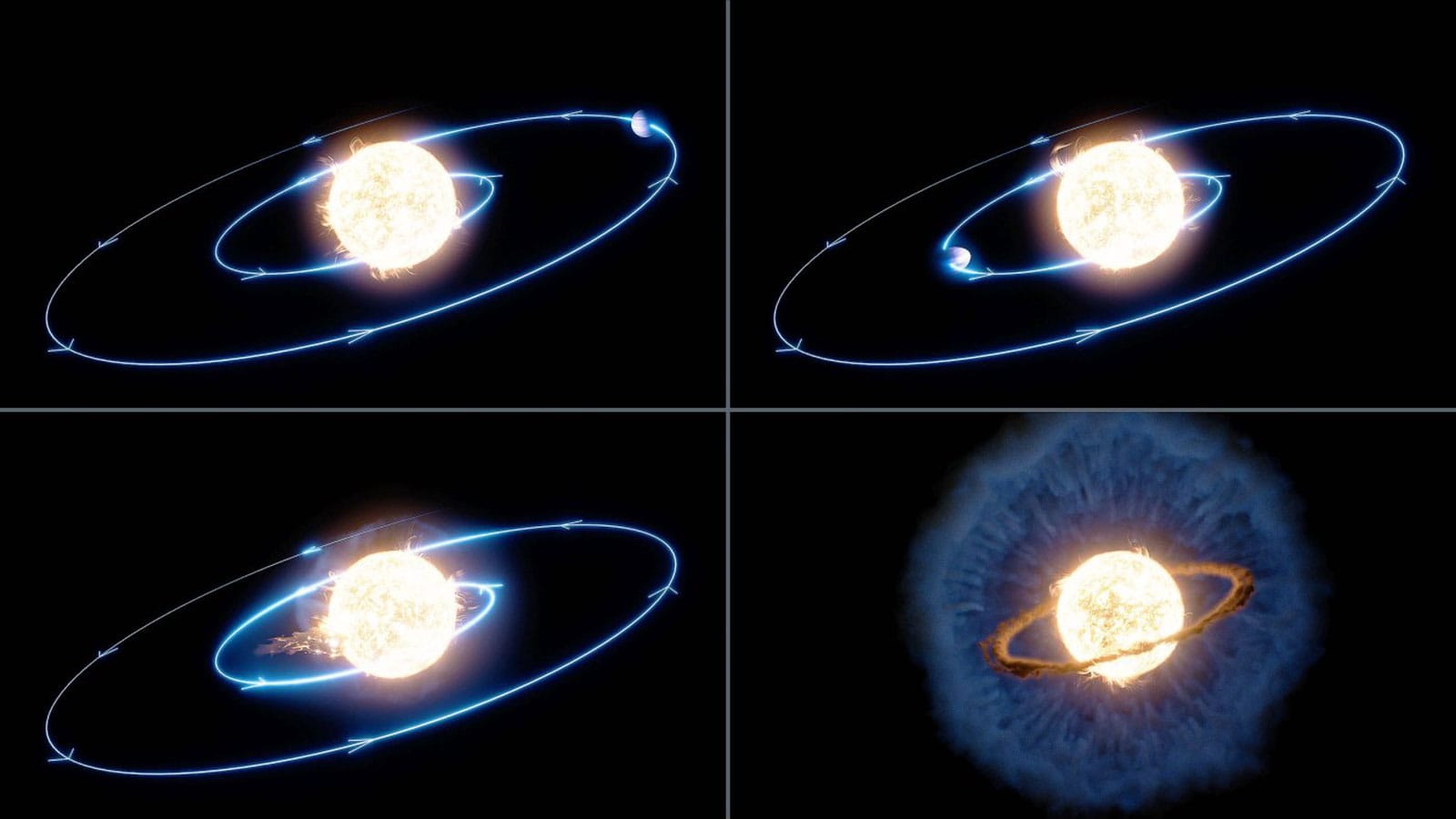
- NASA’s James Webb Space Telescope captured the first recorded planetary engulfment event.
- The planet, Jupiter-sized, spiraled inward over millions of years before being engulfed.
- Webb’s instruments revealed a hot gas disk and a cooler dust cloud post-engulfment.
- This event offers insights into the final stages of planetary systems, including our own.
NASA’s Webb Telescope Observes First Planetary Engulfment
In a groundbreaking astronomical discovery, NASA’s James Webb Space Telescope (JWST) has captured the first-ever recorded instance of a planet being engulfed by its host star. This rare event provides unprecedented insights into the final stages of planetary systems, challenging previous theories about how such phenomena unfold.
What Happened: A Planet’s Slow Demise
The event, formally labeled ZTF SLRN-2020, took place approximately 12,000 light-years away in the Milky Way galaxy. Contrary to earlier assumptions that planetary engulfments occur in a dramatic, sudden manner, data from Webb’s instruments revealed a slower, more gradual process. The planet, roughly the size of Jupiter, orbited its host star much closer than Mercury does to the Sun. Over millions of years, its orbit decayed, causing it to spiral inward until it eventually grazed the star’s outer atmosphere.
Once the planet made contact with the star’s atmosphere, a runaway process ensued. The closer the planet got, the faster it fell, ultimately being consumed by the star. This interaction released gas from the star’s surface, which cooled and formed a faint halo of dust visible in the infrared spectrum.
Revealing the Aftermath
Webb’s Mid-Infrared Instrument (MIRI) and Near-Infrared Spectrograph (NIRSpec) played crucial roles in documenting the aftermath of this event. MIRI detected the cooler dust cloud that formed after the planet’s engulfment, while NIRSpec revealed a hot, molecular gas disk surrounding the star. This accretion disk contained compounds like carbon monoxide, which are typically found in planet-forming regions.
“With such a transformative telescope like Webb, it was hard for me to have any expectations of what we’d find,” said Colette Salyk, an exoplanet researcher and co-author of the study. “I could not have expected seeing what has the characteristics of a planet-forming region in the aftermath of an engulfment.”
Challenging Previous Theories
Prior to these observations, scientists believed that a star would swell into a red giant and engulf a nearby planet in a dramatic, rapid event. However, Webb’s data painted a different picture. The star involved in ZTF SLRN-2020 did not expand as much as expected, and the engulfment process was far more gradual. This nuanced understanding has significant implications for how we model the life cycles of stars and their planetary systems.
Implications for Our Solar System
The findings also raise questions about the future of our own solar system. In about five to seven billion years, the Sun is expected to exhaust its hydrogen fuel and expand into a red giant. This transformation could lead to the engulfment of Mercury and Venus, and possibly Earth. While some scientists believe Earth might escape due to the Sun losing mass, the planet would still face extreme heat, boiling oceans, and a loss of atmosphere, rendering it uninhabitable.
“The insights from this event give us a glimpse into what might happen to our solar system in the distant future,” said Ryan Lau, lead author of the study and an astronomer at NSF’s NOIRLab.
How the Event Was Detected
The initial clue came in 2020, when a flash of visible light was detected by the Zwicky Transient Facility at Caltech’s Palomar Observatory. Infrared data from NASA’s NEOWISE mission had already hinted at a brightening signal a year earlier, suggesting a buildup of dust. However, it was Webb’s advanced instruments that provided the high-resolution data needed to confirm and analyze the event.
“Because this is such a novel event, we didn’t quite know what to expect when we decided to point this telescope in its direction,” Lau explained. “With its high-resolution look in the infrared, we are learning valuable insights about the final fates of planetary systems, possibly including our own.”
The Role of Webb’s Instruments
Webb’s MIRI and NIRSpec were instrumental in capturing the details of the event. MIRI’s sensitivity allowed researchers to isolate faint emissions in a crowded star field, while NIRSpec’s high spectral resolution identified specific molecules in the gas disk. These observations were conducted under Webb’s Guaranteed Time Observation program 1240, one of the first Target of Opportunity programs designed to capture rare and unpredictable cosmic events.
Future Discoveries
The discovery of ZTF SLRN-2020 marks the beginning of a new era in studying planetary engulfments. Upcoming observatories like the Vera C. Rubin Observatory and NASA’s Nancy Grace Roman Space Telescope are expected to identify more such events. These tools will help scientists track sudden changes in the sky and expand our understanding of how stars and planets interact during their final stages.
“This is truly the precipice of studying these events,” Lau said. “We hope this is just the start of our sample.”
The first-ever recorded planetary engulfment observed by NASA’s James Webb Space Telescope has reshaped our understanding of these cosmic events. By revealing the gradual nature of the process and the surprising aftermath, this discovery opens new avenues for studying the life cycles of stars and their planetary systems. As more such events are observed in the future, scientists will gain deeper insights into the ultimate fate of planets, including those in our own solar system.