
Quick Read
- PM Lawrence Wong warned that high-cost military assets are increasingly vulnerable to cheap, mass-deployed drone swarms.
- The Singapore Armed Forces are prioritizing AI-driven ‘one-to-many’ drone control to improve battlefield efficiency.
- Recent global conflicts have prompted a shift toward cross-domain integration between the Army, Air Force, and Digital Intelligence units.
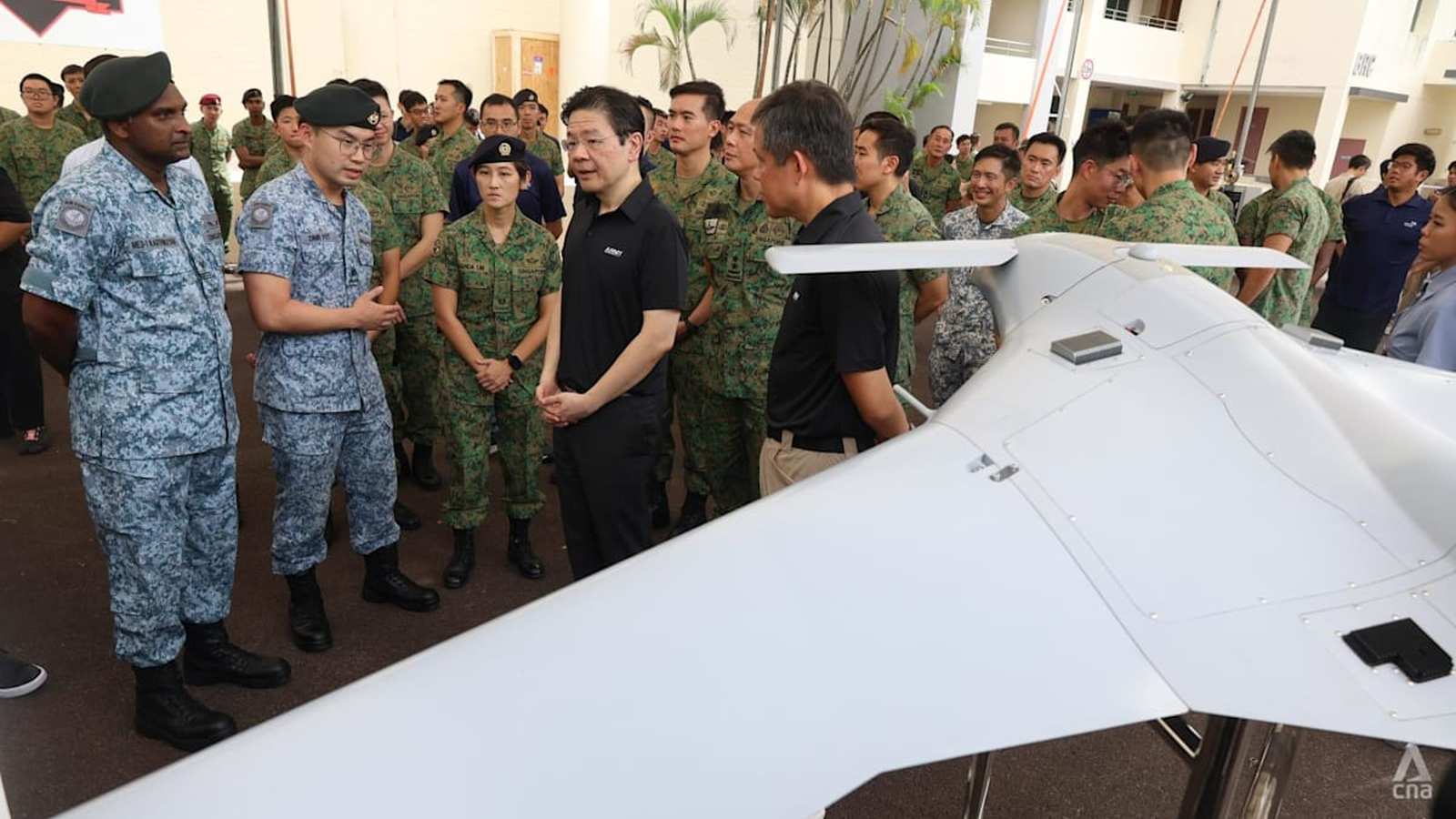
SINGAPORE (Azat TV) – Prime Minister Lawrence Wong issued a stern assessment of national security on April 9, 2026, warning that the traditional advantage of expensive, high-tech military assets is being eroded by the proliferation of low-cost drone swarms. During a visit to the 6th Singapore Division at Mandai Hill Camp, the Prime Minister emphasized that as global order becomes increasingly unpredictable, Singapore must fundamentally rethink its defense posture to counter asymmetric threats.
The Economic Challenge of Modern Warfare
The core of the Prime Minister’s concern lies in the cost-exchange ratio inherent in modern conflict. While Singapore maintains advanced interceptor systems, these high-value assets are increasingly vulnerable to swarms of inexpensive, mass-produced unmanned aerial vehicles. Prime Minister Wong noted that defending against such swarms is not merely a technical challenge but an economic one, as the cost of replacing sophisticated platforms far outweighs the cost of the attacking drones.
Integrating Smart Nation Tech into Defense
To address these emerging threats, the Singapore Armed Forces (SAF) are accelerating the integration of artificial intelligence and cross-domain operations. The Prime Minister observed demonstrations of how intelligence, artillery, and the Digital and Intelligence Service (DIS) are synchronizing to shorten the ‘kill chain.’ By leveraging ‘Smart Nation’ technologies, the military is testing concepts like ‘one-to-many’ control, where a single operator manages up to 200 drones, utilizing AI for self-synchronization and autonomous target classification.
Building Resilience in a Volatile Global Order
The shift in military doctrine is being driven by observations of recent conflicts in Ukraine and Iran, which have provided critical data for the Defence Science and Technology Agency (DSTA). According to officials, these lessons are being rapidly translated into operational concepts, with soldiers participating in advanced competency training to adapt to urban complexity and data-heavy environments. The government remains focused on ensuring that supply chains and military capabilities remain resilient enough to deter potential aggressors in a world where force and coercion are increasingly common.
The strategic pivot highlighted by Prime Minister Wong indicates a fundamental transition in Singapore’s defense doctrine, moving away from a reliance on singular, high-cost platforms toward a decentralized, AI-integrated network capable of neutralizing asymmetric threats through superior data processing and operational speed.