
Quick Read
- Over 200,000 protesters gathered in Prague to oppose the policies of Prime Minister Andrej Babiš.
- The rally was triggered by concerns over a potential ‘foreign agent’ law and the government’s refusal to lift Babiš’s immunity in a fraud case.
- Demonstrators accused the government of undermining democratic institutions and shifting the country toward an illiberal, pro-Russian foreign policy.
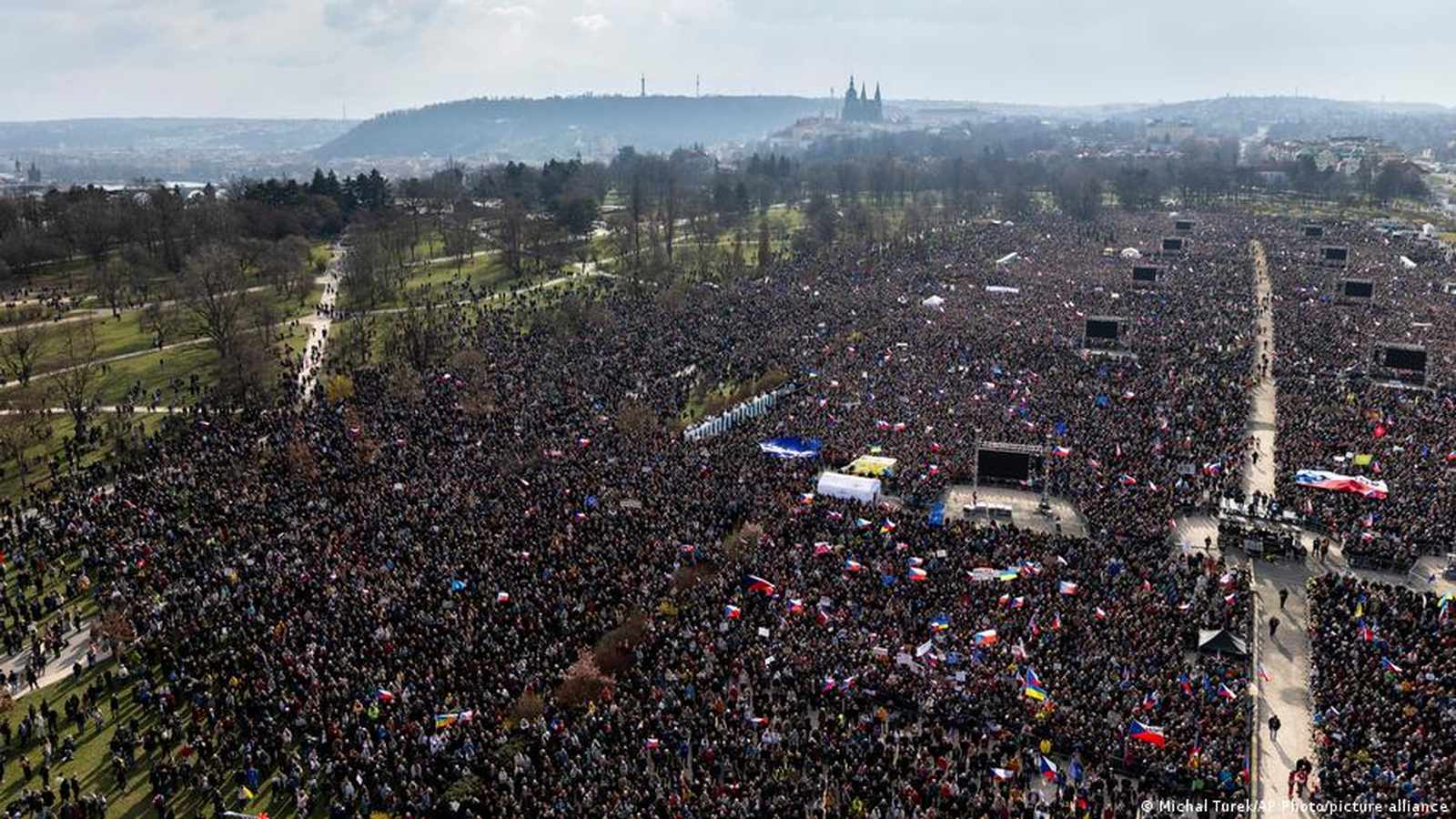
PRAGUE (Azat TV) – More than 200,000 protesters converged on Prague’s historic Letná Plain on Saturday, March 21, 2026, in a massive display of public dissent against the newly formed coalition government led by Prime Minister Andrej Babiš. The demonstration, organized by the Million Moments for Democracy movement, represents the largest show of civil resistance in the Czech Republic since 2019, signaling deep-seated anxiety over the nation’s political trajectory.
Stakes for Czech Democracy and Policy
The rally was sparked by a series of controversial legislative and administrative moves by the Babiš administration, which returned to power in December 2025. Protesters expressed alarm over a proposed “foreign agent” law that critics fear could be weaponized to suppress civil society and NGOs. According to organizers, the government’s recent refusal to lift Babiš’s parliamentary immunity in a 2 million dollar EU subsidy fraud case—effectively delaying his trial until 2029—has fueled public perception of a two-tiered justice system.
Speakers at the event, including former Academy of Sciences head Václav Pačes, warned that the current administration is steering the country toward an illiberal model, drawing parallels to the political climates in Hungary and Slovakia. The crowd explicitly denounced what they described as a pro-Russian tilt in foreign policy, citing the government’s rejection of key EU environmental and migration mandates, as well as its hesitation regarding aid to Ukraine.
Escalating Tensions and Government Response
The coalition, comprised of Babiš’s ANO party and right-wing partners including the Freedom and Direct Democracy (SPD) and the Motorists for Themselves party, has remained largely defiant in the face of the protests. Petr Macinka, chairman of the Motorists party, dismissed the demonstrators as groups unwilling to accept the results of the 2025 parliamentary elections. Meanwhile, reports from DW and Reuters indicate that the government is also considering changes to the funding structures of public media, a move that critics argue would centralize state control over information.
While the protest remained largely peaceful, police detained one individual for firing an airsoft gun near the rally site. The scale of the turnout, which many observers compare to the historic 1989 Velvet Revolution gatherings at the same location, underscores a growing polarization between the populist government and a significant portion of the electorate committed to Western integration and democratic institutional integrity.
The Broader Cultural Climate
As the political crisis unfolds, the city of Prague continues its cultural life, with the 18th edition of the Bulgarian Film Festival set to open at Kino Lucerna on March 25. The festival, which features films exploring themes of individual dignity and resistance against corrupt systems, provides a distinct contrast to the ongoing national debate, highlighting the enduring focus on personal integrity within the Czech capital’s intellectual circles.
The massive turnout in Prague reflects a critical juncture for the Czech Republic, where the clash between populist governance and civic institutionalism is testing the resilience of the country’s post-communist democratic framework.