
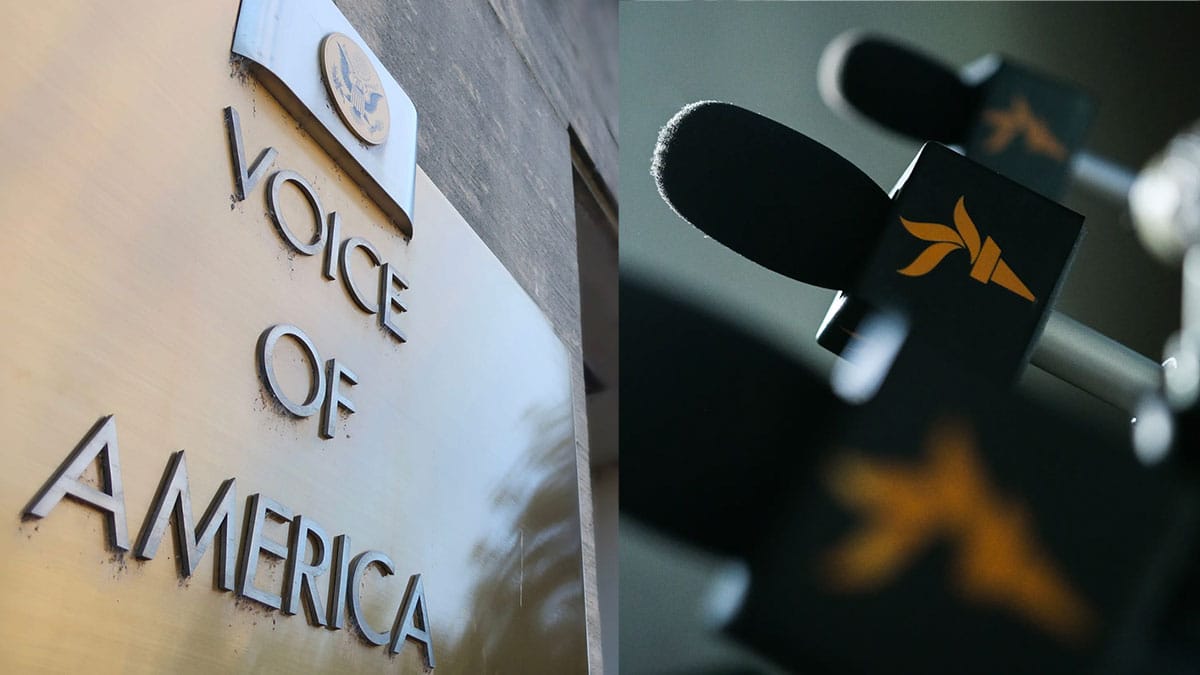
RFE/RL and Voice of America Face Funding Cuts, Raising Concerns for Global Media Freedom
Key Takeaways:
- USAGM informs RFE/RL of the termination of its federal grant agreement.
- RFE/RL President Stephen Capus calls the potential defunding a “massive gift to America’s enemies.”
- Capus highlights the reliance of nearly 50 million people in closed societies on RFE/RL for accurate news.
- White House cites “radical propaganda” as the reason for cutting funding to “Voice of America.”
- Voice of America Director Michael Abramowitz states the agency can no longer fulfill its vital mission due to the funding cuts.
- Concerns arise over the impact on global news access and the strengthening of autocratic regimes.
RFE/RL and Voice of America Face Funding Cuts, Raising Concerns for Global Media Freedom
Radio Free Europe/Radio Liberty (RFE/RL) and Voice of America (VOA), both critical sources of independent news and information, are facing potential funding cuts that have sparked global concern for media freedom. RFE/RL has been informed by the U.S. Agency for Global Media (USAGM) that its federal grant agreement is being terminated, while the White House has labeled VOA as a purveyor of “radical propaganda,” suggesting an imminent reduction in its funding.
RFE/RL President and CEO Stephen Capus has decried the potential defunding of his organization as a “massive gift to America’s enemies.” This sentiment is echoed by Voice of America Director Michael Abramowitz, who stated in a Facebook post on Saturday that for the first time in 83 years, the Voice of America is being silenced. He reported that he and the entire staff of 1,300 people had been placed on leave, adding, “The Voice of America can no longer fulfill its vital mission. That mission is especially critical today as America’s adversaries, like Iran, China and Russia, spend billions of dollars to create false stories to discredit the United States.”
A Lifeline for Closed Societies: RFE/RL’s Crucial Role
For 75 years, RFE/RL has served as a vital lifeline for nearly 50 million individuals in 23 countries, including Russia, Ukraine, Iran, Afghanistan, and the republics of Central Asia and the Caucasus. In these regions, where governments often tightly control information, RFE/RL provides unbiased, accurate news and information through radio, internet, television, and mobile platforms. The organization’s work is crucial in holding power to account and ensuring citizens have access to a diversity of perspectives, a cornerstone of democratic societies.
The White House Justification: “Radical Propaganda” and Broader Implications
The White House’s justification for the funding cuts to both RFE/RL and VOA centers on the assertion that taxpayer money should not fund what it deems “radical propaganda.” This stance, following an order reportedly signed by the U.S. President to cease operations of seven agencies, including USAGM, indicates a broader shift in the administration’s approach to government-funded media outlets. The directive has already led to some VOA radio stations broadcasting in local languages to halt news programming and play music instead, according to listeners. Furthermore, reports suggest that even senior editors at VOA have been instructed to stop working, leading staff to anticipate a cessation of news coverage worldwide.
Implications for Global Information Access and Geopolitical Stability
The potential defunding of RFE/RL and the operational disruption at VOA raise serious concerns about the future of independent journalism and the dissemination of a US perspective in regions with limited press freedom. As RFE/RL President Capus aptly stated, the demise of RFE/RL would be celebrated by autocratic leaders. Director Abramowitz’s statement about VOA’s inability to fulfill its mission further underscores the potential weakening of America’s ability to counter disinformation from adversaries like Iran, China, and Russia. In an increasingly interconnected world, where access to unbiased information and diverse perspectives is crucial for informed decision-making and holding governments accountable, the weakening of both RFE/RL and VOA could have far-reaching geopolitical consequences. This situation also underscores the delicate balance between national interests and the promotion of democratic values through international broadcasting.
The simultaneous challenges faced by RFE/RL and Voice of America highlight a critical moment for US engagement in international media. The potential defunding and operational disruptions could significantly impact global media freedom and the ability of these organizations to provide vital news and information in regions with restricted media environments. The strong condemnation from RFE/RL’s president and the stark warning from VOA’s director underscore the gravity of the situation and the potential ramifications for international relations and the fight against authoritarianism. The international community will be closely watching to see how these decisions impact the landscape of global news and the ability of individuals in restricted environments to access unbiased reporting and diverse perspectives.