
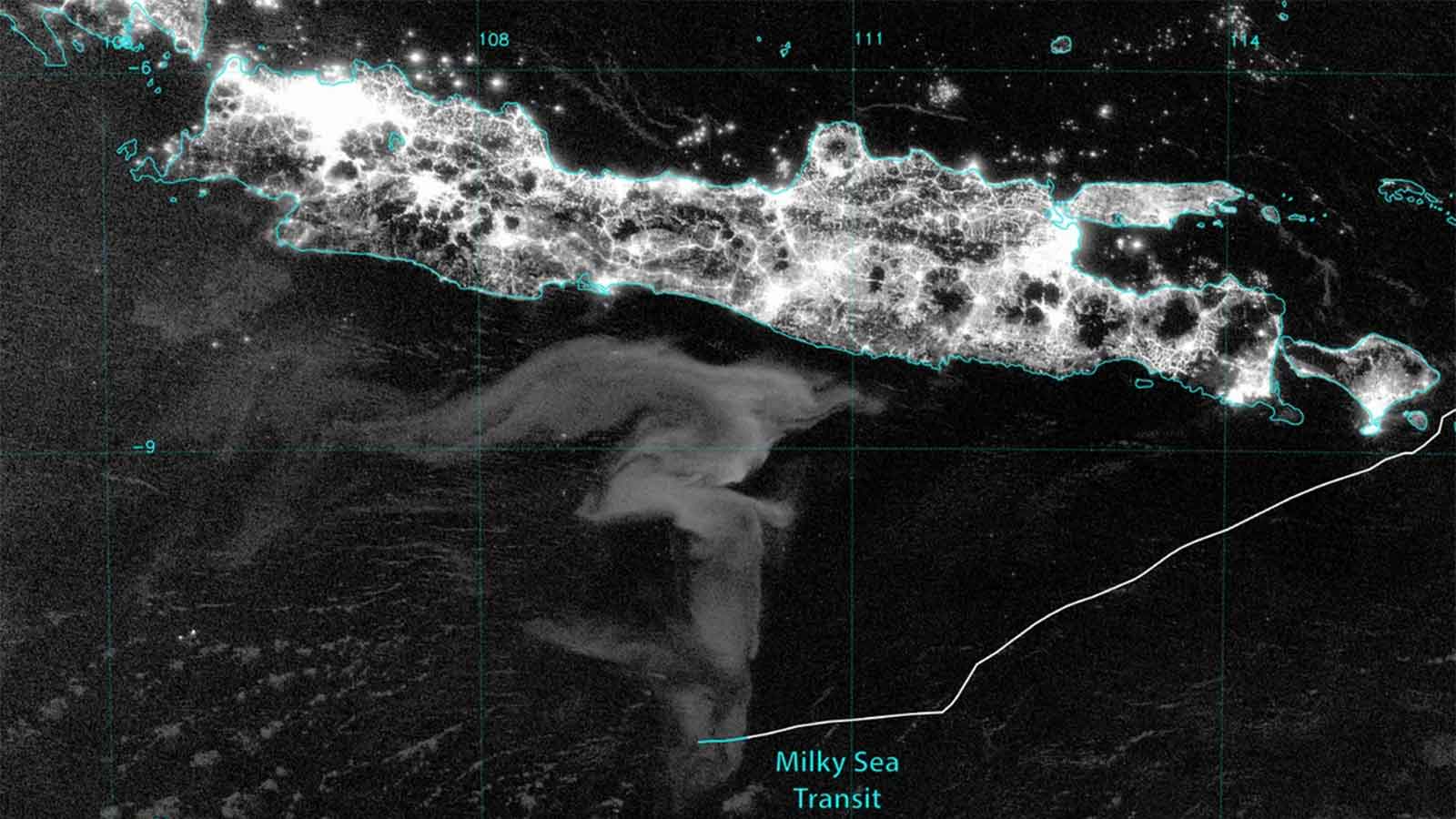
- Milky seas are rare bioluminescent events where the ocean glows brightly at night.
- These events can span up to 100,000 square kilometers and last for months.
- Scientists suspect luminous bacteria, Vibrio harveyi, cause the glow.
- A new database compiles 400 years of sightings to predict future occurrences.
- Satellite technology is being used to study and locate milky seas.
What Are Milky Seas?
Milky seas are a rare nocturnal phenomenon where vast areas of the ocean emit a steady, bright glow. Sailors have described the glow as similar to the light emitted by glow-in-the-dark stars, bright enough to read by. These events can stretch over 100,000 square kilometers and last for months, with some even visible from space.
Historical Accounts and Folklore
For centuries, sailors have reported encountering milky seas, often describing them with awe and mystery. One notable account comes from Captain Kingman of the American clipper ship Shooting Star, who in 1854 described the ocean as ‘a plain covered with snow’ with a sky ‘as black as if a storm was raging.’ These vivid descriptions have cemented milky seas in maritime folklore, but scientific understanding remains limited due to their rarity and remote locations.
The Science Behind the Glow
Scientists believe the glow is caused by luminous bacteria, specifically Vibrio harveyi, which colonize algae on the ocean’s surface. When the bacteria reach a population density of about 100 million cells per milliliter, they emit a steady glow. Unlike bioluminescent dinoflagellates, which flash when disturbed, these bacteria glow continuously. Researchers theorize that the glow may attract fish, which then consume the bacteria, providing a new habitat for them in the fish’s gut.
Challenges in Studying Milky Seas
Milky seas are notoriously difficult to study due to their unpredictability and occurrence in remote regions, primarily the Indian Ocean and waters off Indonesia. Only one research vessel has ever encountered a milky sea, in 1985, and collected samples confirming the presence of Vibrio harveyi. The lack of data has hindered scientific understanding, prompting researchers to seek new methods for studying these events.
A New Database for Prediction
To address the data gap, researchers at Colorado State University have compiled a database of milky sea sightings over the last 400 years. The database includes eyewitness accounts from sailors, submissions to the Marine Observer Journal, and contemporary satellite data. This is the first comprehensive collection of data on milky seas in 30 years. The database reveals that sightings are statistically linked to climate phenomena like the Indian Ocean Dipole and El Niño Southern Oscillation, which influence global weather patterns.
Satellite Technology and Future Research
Satellites equipped with advanced sensors, such as the Day/Night Band, are now being used to detect milky seas from space. These instruments can measure light levels 100 million times fainter than daylight, making it possible to monitor vast ocean areas for bioluminescent events. Researchers hope to use this technology to guide research vessels to milky seas in real-time, allowing for direct sampling and analysis.
Implications for Earth Systems
Understanding milky seas could provide insights into broader Earth systems, including the role of bacteria in the global carbon cycle. The regions where milky seas occur are biologically diverse and economically important for fishing. By studying these events, scientists may uncover connections between microscopic processes and large-scale environmental changes.
Milky seas remain one of the ocean’s most enigmatic phenomena, blending folklore with scientific mystery. With the help of historical records, satellite technology, and a new database, researchers are closer than ever to unraveling the secrets of these glowing waters. As studies continue, milky seas may reveal new insights into the complex interactions between biology, chemistry, and climate in the Earth’s oceans.