
Quick Read
- Singapore’s Land Transport Authority (LTA) initiated a system reset for bus arrival time predictions.
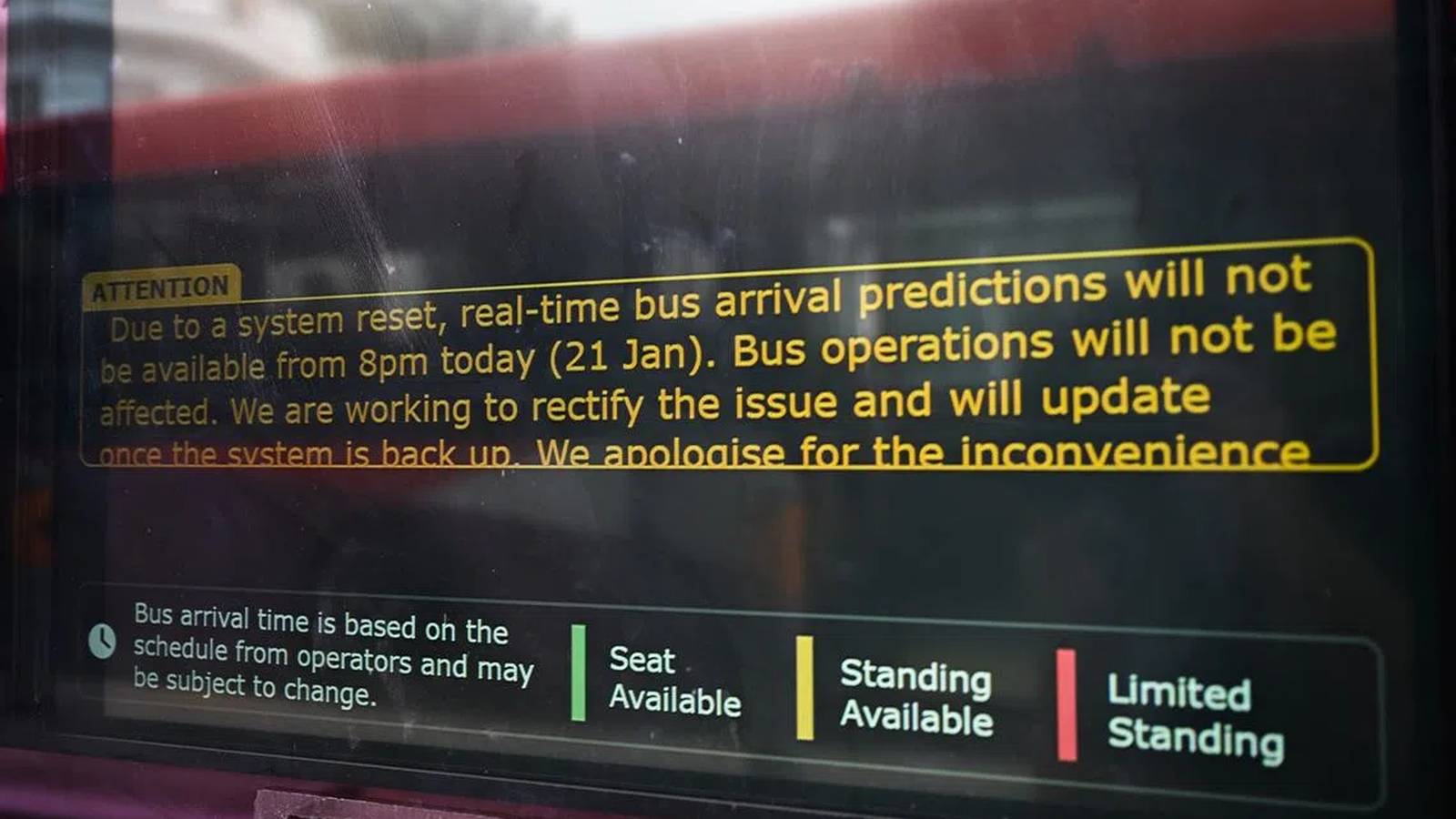
- The reset began at 8 PM on January 21, causing predictions to be temporarily unavailable on all platforms.
- The issue stemmed from an intermittent transmission problem with on-board systems on some buses.
- Commuters reported significant delays and confusion due to inaccurate timings, affecting daily routines.
- Bus operations themselves remain unaffected, with services running at usual frequencies despite the system reboot.
Singapore’s Land Transport Authority (LTA) initiated a comprehensive reset of its bus arrival time prediction system at 8 PM on January 21, rendering real-time bus arrival information temporarily unavailable across all platforms. This critical measure was undertaken to rectify persistent inaccuracies in bus timings and address extended wait times that have significantly impacted commuters in recent days. The system’s reboot means passengers cannot access expected arrival times via bus stop displays or mobile applications, a disruption the LTA has stated will persist through the morning of January 22, as reported by The Straits Times.
The root cause of the widespread disruption has been identified as a technical issue involving an intermittent transmission problem with the on-board systems of some buses. This malfunction led to missing bus arrival predictions for a “small proportion of buses,” according to the LTA. The system, which relies on data relayed by equipment installed on each bus to generate arrival estimates, then disseminates these predictions through various channels, including electronic displays at bus stops and interchanges, the official MyTransport.SG app, and numerous third-party applications integrated via LTA DataMall. While the prediction system undergoes this crucial reset, the LTA has assured the public that actual bus operations remain unaffected, with all services continuing to run at their scheduled frequencies.
The LTA first detected anomalies in the system on January 10, with more widespread inaccuracies emerging throughout the subsequent week, culminating in the decision for a full system reset. This deterioration in service reliability has led to considerable frustration and inconvenience for daily commuters who depend on accurate real-time information for their travel planning. Mr. Jerald Tan, a 28-year-old finance professional, recounted an incident on January 21 where he was delayed by 20 minutes for work. His bus timing app initially indicated a 12-minute wait, but upon reaching his bus stop, the display board showed his bus was 15 minutes away, and another bus, predicted to arrive in eight minutes, appeared just a minute later. Such discrepancies underscore the unpredictable nature of the issue and its direct impact on personal schedules.
Another affected commuter, Ms. Syafiqah, 25, experienced similar challenges on the evening of January 20. Faced with an estimated 30-minute wait for her bus to a dinner appointment, she opted to use a bicycle-sharing service to reach the MRT station, fearing she would otherwise miss her appointment. These experiences highlight the extent to which commuters rely on real-time data to make informed decisions about their journeys. However, not all experiences were negative. Ms. Alissa Lean, also 25, reported a pleasant surprise when a double-decker bus on her usual route arrived in two minutes, significantly earlier than the five minutes her app predicted for a single-decker. While a welcome anomaly, such instances further illustrated the system’s erratic behavior.
In response to the mounting commuter concerns, the LTA issued an apology for the inconvenience caused by the technical issue. It affirmed that its engineers and system contractors are working in close collaboration with bus operators to swiftly resolve the problem. During the period of system recalibration, commuters are advised to consult the SimplyGo website or the individual public transport operators’ websites for information regarding the planned frequencies of bus services. This alternative, while not offering real-time tracking, provides a baseline for service expectations.
Prior to the reset, checks by The Straits Times on January 21 revealed that the inaccuracies were not uniformly distributed across all services or bus stops. For instance, at a specific bus stop on Braddell Road, while most services displayed accurate estimated arrival times that matched operator websites, Service 93 showed a nearly 40-minute wait on the MyTransport.SG app, contrasting sharply with the 11 to 15 minutes listed on the operator’s website. Subsequent timings for this service were unavailable, suggesting a localized or service-specific component to the issue. The LTA has been contacted for further clarification on the scope of affected services and whether the problem was geographically contained.
The incident underscores the critical importance of reliable real-time information in the functioning of a modern, efficient public transport network, especially in a densely populated urban environment like Singapore. As cities increasingly lean on smart technologies to manage essential services, the seamless operation of digital systems that provide accurate and timely data becomes paramount for maintaining public trust and ensuring the smooth flow of daily life.