
Quick Read
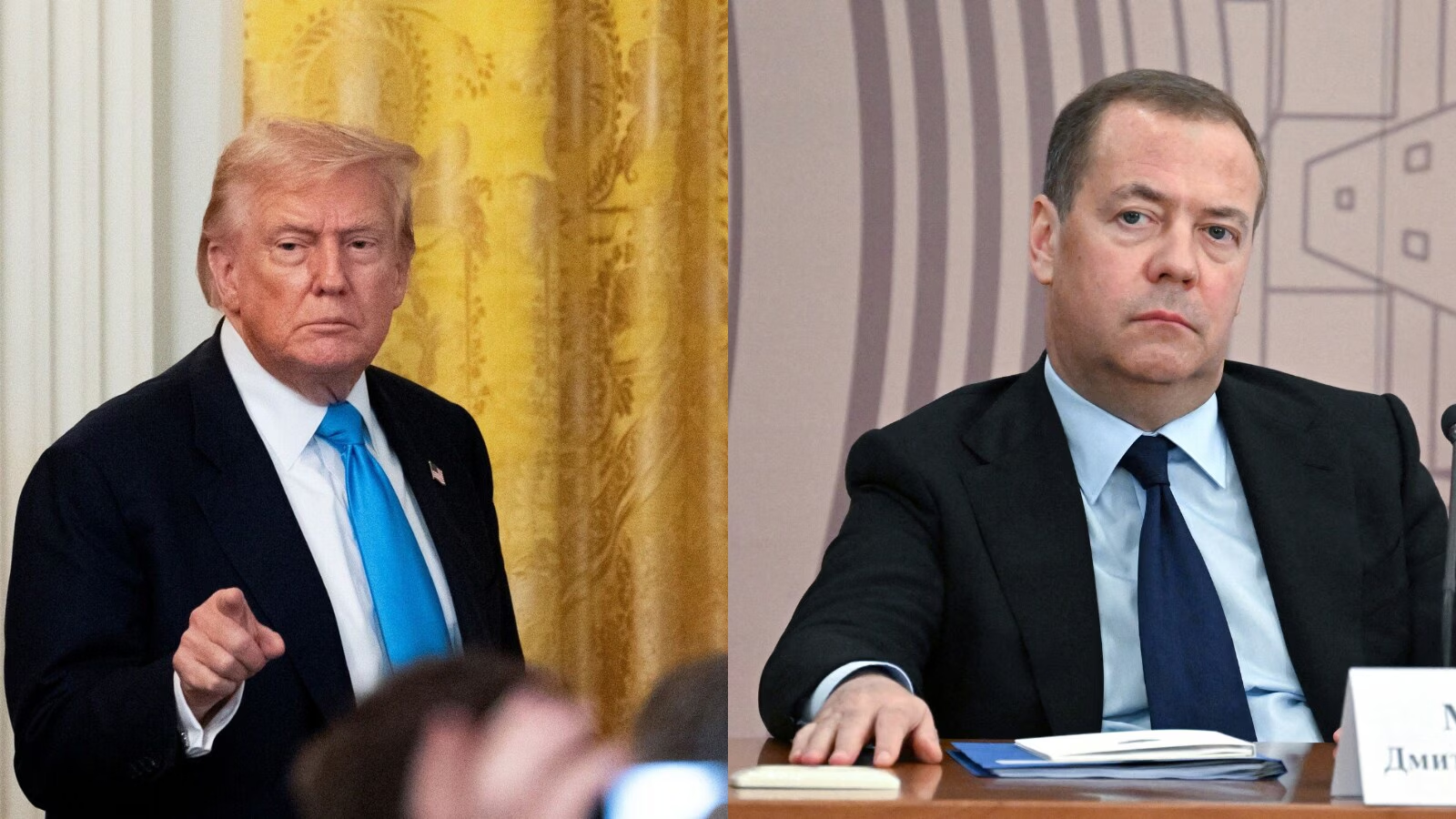
- President Donald Trump announced the repositioning of two nuclear submarines in response to provocative statements by Russia’s Dmitry Medvedev.
- The move follows Medvedev’s remarks referencing Russia’s Cold War-era ‘Dead Hand’ nuclear retaliation system.
- Tensions between the U.S. and Russia continue to rise amid the ongoing war in Ukraine.
- Trump has criticized Russia’s actions in Ukraine and expressed frustration over stalled peace talks.
In a move that has further heightened global tensions, President Donald Trump announced on Friday, August 1, 2025, that he has ordered the deployment of two U.S. nuclear submarines to strategic locations. The decision comes in response to what Trump described as “highly provocative statements” by former Russian President Dmitry Medvedev, who now serves as Deputy Chairman of Russia’s Security Council. This exchange adds a new layer of complexity to the already fraught relationship between the United States and Russia amidst the ongoing war in Ukraine.
Escalation of Tensions
The confrontation began earlier this week when Medvedev criticized Trump’s ultimatum to Russian President Vladimir Putin. Trump had demanded that Russia take steps toward peace in Ukraine within 10 days, shortening his earlier timeline of 50 days. Medvedev, in a post on the social media platform X (formerly Twitter), lashed out, calling Trump’s ultimatum “a threat and a step towards war.” He added that the United States should not underestimate Russia’s nuclear capabilities, referencing the Soviet-era “Dead Hand” system—a Cold War-era automatic nuclear retaliation mechanism.
Medvedev’s remarks triggered a swift response from Trump. In a post on Truth Social, Trump stated, “I have ordered two Nuclear Submarines to be positioned in the appropriate regions, just in case these foolish and inflammatory statements are more than just that. Words are very important and can often lead to unintended consequences. I hope this will not be one of those instances.” However, he did not clarify whether the submarines in question were nuclear-powered or nuclear-armed, leaving room for speculation.
Trump’s Frustration with Russia
Trump’s decision to reposition the submarines also reflects his growing frustration with Russia’s conduct in the Ukraine conflict. Despite his campaign promise to broker a ceasefire in Ukraine within 24 hours of assuming office, Trump has faced significant obstacles in achieving this goal. He has repeatedly criticized Russian attacks on Ukrainian civilians, calling them “disgusting.” During a White House briefing last month, Trump recounted a conversation with his wife, Melania, saying, “I go home. I tell the First Lady, ‘You know, I spoke to Vladimir today. We had a wonderful conversation.’ She said, ‘Oh, really? Another city was just hit.’”
Putin, for his part, has shown little interest in Trump’s ultimatums. Speaking to journalists on Friday, the Russian President said he sought a “lasting and stable peace” in Ukraine but gave no indication of willingness to make concessions. Meanwhile, attempts at peace talks between Russian and Ukrainian officials have repeatedly stalled, with the most recent round in Istanbul ending without progress.
Strategic Implications of Submarine Deployment
The deployment of nuclear submarines underscores the gravity of the situation. While the Pentagon has not confirmed Trump’s announcement, the move is seen as a significant escalation in rhetoric and military posturing. According to The Guardian, the United States typically avoids publicizing the movements of its nuclear-capable submarines due to their strategic importance and the secrecy surrounding their operations.
The U.S. submarine fleet is entirely nuclear-powered, but not all vessels are equipped with nuclear missiles. Trump’s lack of specificity on this point has led to widespread speculation. As Politico notes, the mere mention of nuclear submarines evokes memories of Cold War-era brinkmanship, raising concerns about the potential for miscalculation.
Medvedev’s Role in the Kremlin
Dmitry Medvedev, once seen as a reformist during his presidency from 2008 to 2012, has become a vocal critic of the West in recent years. Now serving as Deputy Chairman of Russia’s Security Council, Medvedev frequently uses social media to issue aggressive statements, often targeting Western leaders. His latest comments about Trump and the “Dead Hand” system reflect this combative approach.
However, Medvedev’s actual influence within the Kremlin is a subject of debate. As CNN points out, Medvedev acts more as an “attack dog” for Putin than as a decision-maker. Nevertheless, his rhetoric has significant implications, particularly when it prompts responses like Trump’s recent announcement.
The Broader Context
This exchange between Trump and Medvedev comes at a time of escalating global instability. The war in Ukraine has entered its second year, with no end in sight. Both sides have suffered heavy casualties, and the international community remains deeply divided on how to address the conflict. Trump’s decision to deploy nuclear submarines adds a new dimension to the crisis, raising questions about the potential for further escalation.
*As the world watches this unfolding drama, the stakes could not be higher. The interplay of rhetoric, military posturing, and diplomatic maneuvering will shape not only the future of U.S.-Russia relations but also the broader trajectory of global security.*