


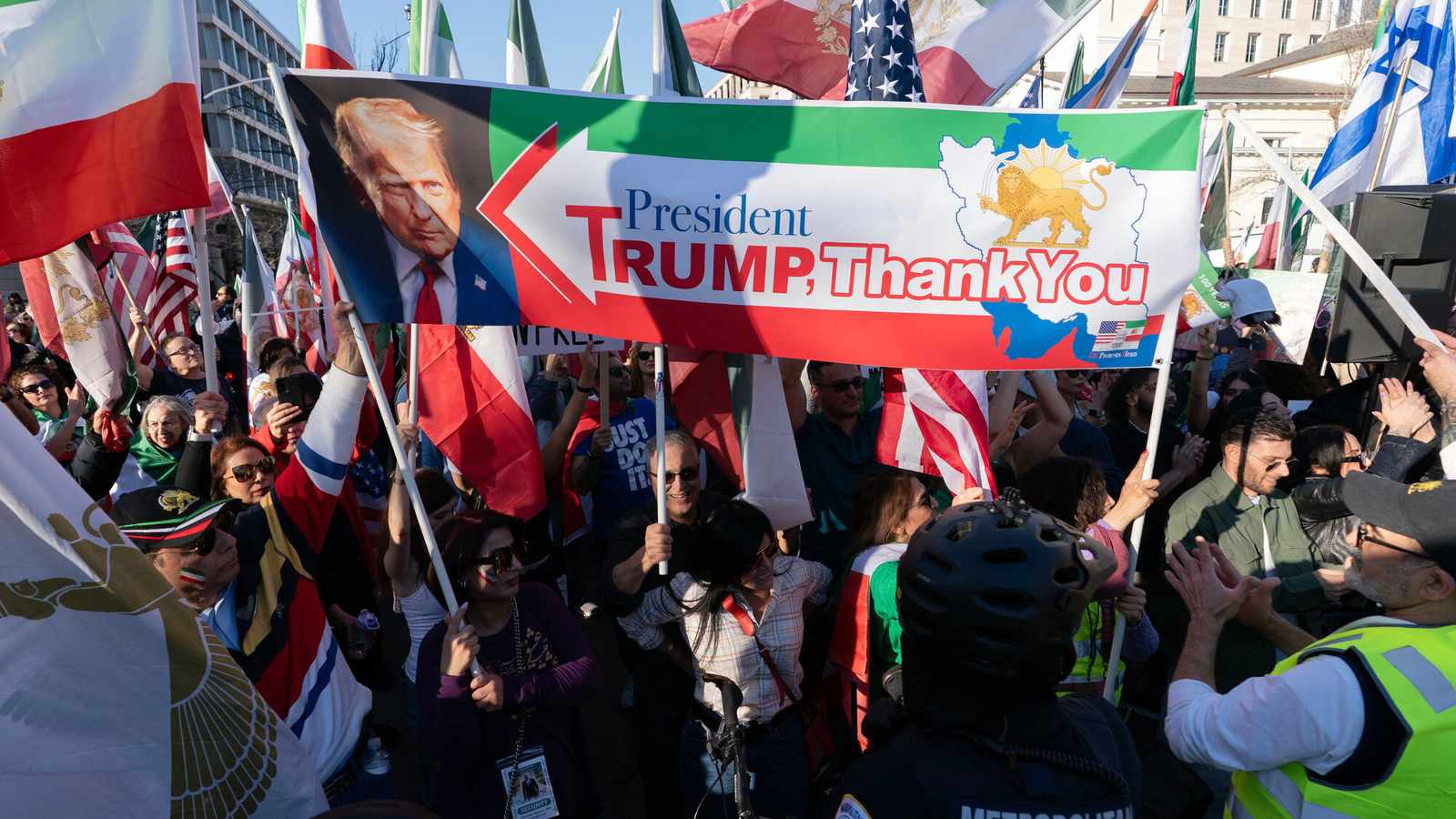
WASHINGTON (Azat TV) – President Donald Trump is reportedly considering a significant escalation in the ongoing conflict with Iran, exploring the possibility of providing weapons and intelligence to armed groups within the Islamic Republic, including Kurdish factions. This potential shift in strategy, reported by the Wall Street Journal, emerges as the United States and Israel are engaged in a joint military campaign aimed at toppling Iran’s leadership, a move that has already sparked domestic and regional controversy.
While no final decision has been made regarding the provision of weapons or intelligence, the consideration signals a potential broadening of the U.S. approach beyond direct military strikes. The move could empower internal opposition forces, aligning with President Trump’s declared objective to deliver a ‘crushing blow to the terror regime,’ a sentiment echoed by Israeli Prime Minister Benjamin Netanyahu.
Trump’s Potential Escalation in Iran Strategy
The prospect of the U.S. actively supporting armed groups inside Iran represents a marked shift in the current phase of the conflict. According to the Wall Street Journal, President Trump is open to providing support, potentially including weapons and intelligence, to factions willing to take up arms against the Iranian government. Among the groups under consideration are Kurdish factions, which have historically engaged in armed resistance against Tehran.
This deliberation comes amidst an ongoing joint U.S.-Israeli war against Iran’s leadership. The current military campaign has seen coordinated strikes targeting top Iranian leaders, including Supreme Leader Ayatollah Ali Khamenei, and other strategic assets. Prime Minister Netanyahu, who has long advocated for a confrontational stance against Iran, views the U.S. involvement as crucial for achieving Israel’s ‘existential battle’ against what it perceives as an existential threat, citing Iran’s support for anti-Israeli militias, its ballistic missile arsenal, and its nuclear program.
Public Opinion and the Iran Conflict
Despite the strategic alignment between President Trump and Prime Minister Netanyahu, the ongoing military action has faced significant disapproval within the United States. Recent polls indicate a strong public reluctance for a prolonged conflict or the deployment of U.S. ground troops. A Reuters/Ipsos poll revealed that just 27% of Americans supported the initial strikes, with 43% disapproving. More than half of Republicans supported the attack, but 42% stated they would be less likely to back the war if U.S. troops were killed or injured, and 45% if gas and oil prices increased.
Further underscoring this sentiment, a CNN poll conducted by SSRS found that 59% of Americans disapproved of Trump’s decision to initiate military action in Iran. The poll, conducted on February 28 and March 1, also showed that a majority, 56%, believe a long-term military conflict between the U.S. and Iran is likely. Crucially, only 12% would favor sending U.S. ground troops into Iran, with 60% opposing such a move. Public disapproval spanned across major demographic subgroups, including men and women, various racial groups, and all age categories, despite strong Republican support for the initial military action.
Netanyahu’s Gamble and Regional Implications
Prime Minister Netanyahu has, throughout his career, balanced a strong partnership with the U.S. and a resolute stance against Iran. His success in enlisting the U.S. in this joint war is seen by some as a significant diplomatic achievement, potentially leading to the shared goal of toppling the Iranian government. Netanyahu stated on Sunday that U.S. involvement ‘allows us to do what I have been hoping to do for 40 years – to deliver a crushing blow to the terror regime.’
However, analysts like Ofer Shelah, a research fellow at the Institute for National Security Studies, warn that a protracted conflict could strain U.S.-Israel ties, with a ‘large part of the American public’ potentially viewing it as Israel dragging the U.S. into a Middle East war. The conflict has already resulted in the deaths of at least six U.S. troops, disrupted regional travel, and caused oil prices to surge, raising concerns about economic impacts on American consumers. Questions also persist about the long-term aims of the war, including who or what would replace Iran’s leadership and the roles of Israel and the U.S. in any post-conflict scenario. Aaron David Miller, a former Middle East adviser, suggested that Netanyahu, facing elections in the fall, might view the war as a means to divert attention from past failures and solidify his image as a wartime leader, while President Trump could de-escalate if the situation deteriorates.
The consideration of arming internal Iranian groups represents a significant strategic pivot, signaling a potential shift from conventional military engagement to a more complex, indirect approach that could further entangle the U.S. in Iran’s internal dynamics, despite widespread public apprehension about deeper military involvement.