


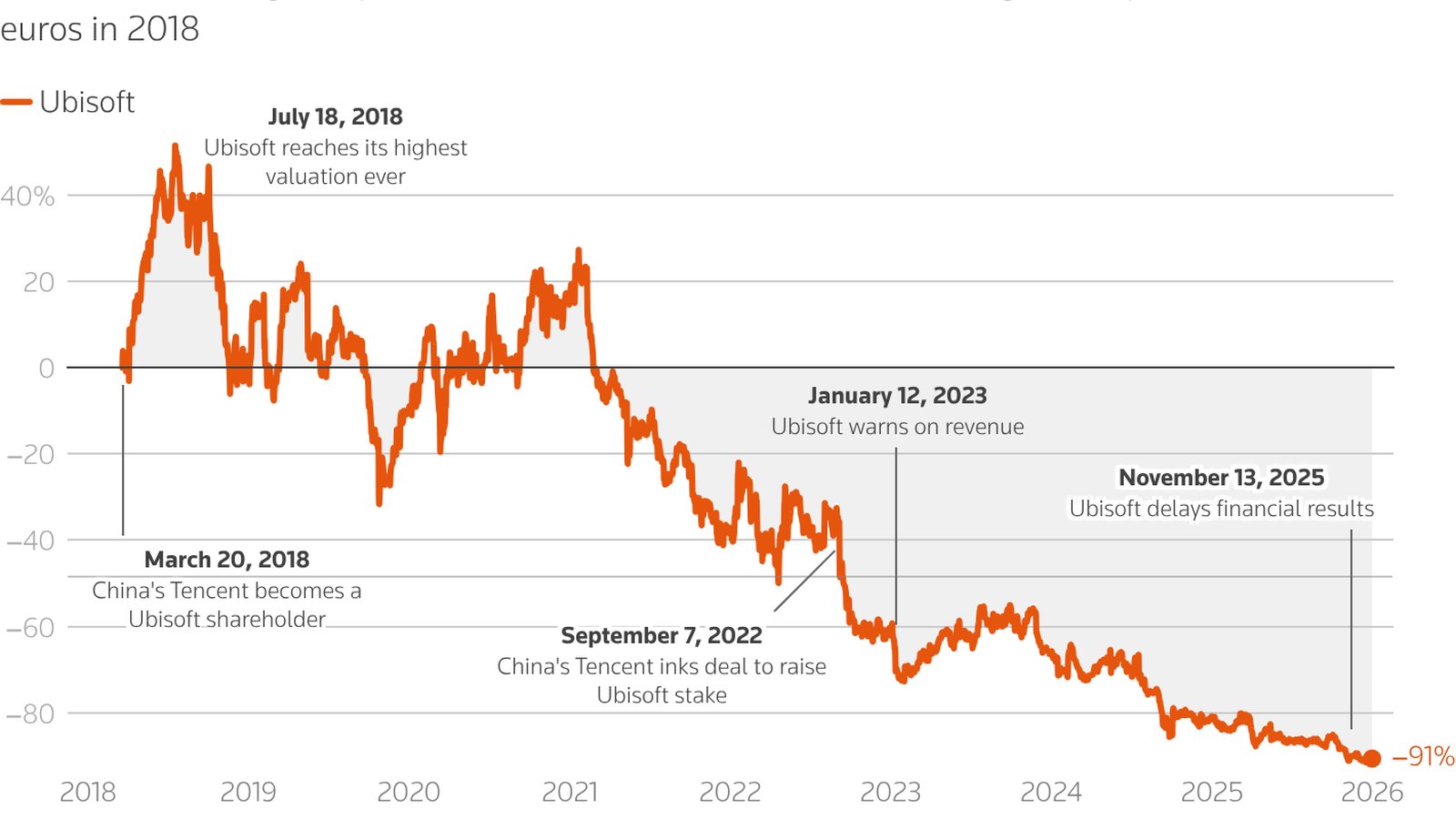
Ubisoft, the renowned French video game publisher behind iconic franchises like Assassin’s Creed and Far Cry, has seen its shares plummet to their lowest value since 2011, following a sweeping corporate reorganization that includes the cancellation of six games, significant employee layoffs, and the closure of a development studio. This drastic market reaction underscores a profound lack of investor confidence in the company’s current strategic direction and its ability to navigate an increasingly competitive and challenging gaming landscape.
Drastic Market Downturn Signals Investor Distrust
The immediate aftermath of Ubisoft’s announcements saw its stock value nosedive, with shares dropping to approximately 4.29 euros each. Just the day prior, the lowest recorded value stood at 6.6 euros, marking a sharp decline. Over a mere five-day period, the company’s stock lost an alarming 36.6% of its value. Looking at a broader five-year horizon, the picture becomes even more stark, with shares having depreciated by a staggering 94.94%. This precipitous fall reflects a market that is not only reacting to immediate news but also re-evaluating Ubisoft’s long-term viability and growth prospects.
Such a significant drop to a 13-year low is a strong indicator of deep-seated concerns among shareholders. It suggests that the market views the announced reorganization not as a confident step towards recovery, but as a reactive measure to underlying systemic issues. Investors are clearly signaling their skepticism about the company’s ability to execute its new strategy effectively and deliver profitable titles in the near future.
Reorganization Efforts Lead to Game Cancellations and Studio Closure
The primary catalyst for this market turmoil is Ubisoft’s extensive corporate restructuring, which has involved several painful but decisive actions. Central to these efforts is the cancellation of six previously announced games, a move that represents a significant write-off of development costs and lost future revenue potential. While details on the specific titles remain sparse, the decision to scrap multiple projects sends a clear message about a re-evaluation of the company’s development pipeline and resource allocation.
In addition to game cancellations, the reorganization has led to the firing of several dozen employees across various departments. This downsizing is a common, albeit difficult, aspect of corporate restructuring aimed at reducing operational costs and streamlining workflows. Furthermore, the company has closed its Halifax studio, which was primarily focused on developing mobile titles for established franchises such as Tom Clancy’s Rainbow Six and Assassin’s Creed. The closure of a dedicated studio underscores a shift in priorities, potentially away from certain mobile initiatives or a consolidation of mobile development into other existing studios.
Strategic Implications for a Gaming Giant
The decision to cancel six games is particularly impactful for a company of Ubisoft’s stature. Each canceled project represents years of investment in creative talent, technology, and marketing, now rendered moot. This move often signals a re-focusing on core intellectual properties or a strategic pivot towards different genres or platforms. However, it also raises questions about internal project management and the vetting process for new titles. For developers within the company, such cancellations can be demoralizing, potentially impacting morale and creative output.
The closure of the Halifax studio and the associated layoffs highlight a strategic consolidation. While painful for the affected employees, these actions are typically undertaken to reduce overheads and concentrate talent in more strategic locations or on higher-priority projects. For a company that has faced criticism for its expansive catalog and sometimes perceived lack of innovation across its many studios, a more streamlined approach could, in theory, lead to better-focused and higher-quality releases in the long term. However, the immediate market reaction indicates that investors are more focused on the short-term financial implications and the perceived instability.
Ubisoft’s Challenging Road Ahead
This restructuring comes at a critical time for Ubisoft, which has faced its share of challenges over the past few years. The company shipped fewer games in 2025 than in any other year since 1988, a stark indicator of a slowdown in its production cycle. Moreover, Ubisoft has frequently been criticized by players and critics alike for its perceived reliance on established formulas, particularly within its open-world franchises, often leading to a sense of stagnation rather than innovation. This historical context makes the current crisis even more pronounced, as it suggests that the company is struggling not just with specific projects but with its broader creative and business model.
The market’s reaction suggests that investors are not merely concerned about the immediate financial hit from the cancellations and layoffs, but are also questioning the underlying strategy that led to these issues. While reorganization is often a necessary step for struggling companies, the severity of the stock drop indicates that shareholders are seeking more than just cost-cutting; they are looking for a clear, compelling vision for the future that can restore confidence and drive sustainable growth. The coming months will be crucial for Ubisoft to demonstrate that these painful decisions are part of a coherent plan to revitalize its offerings and financial performance.
The dramatic decline in Ubisoft’s stock value, hitting a 13-year low, underscores the immense pressure on the company to adapt and innovate. This extensive reorganization, marked by significant project cancellations and workforce reductions, represents a critical juncture for the gaming giant, signaling a desperate attempt to regain market relevance and investor trust amidst long-standing criticisms regarding its creative output and business strategy.