
Quick Read
- Ukraine claims it critically damaged a Russian Kilo-class submarine at Novorossiysk using a Sub Sea Baby underwater drone.
- Satellite images confirm damage to the port’s quay but show no clear evidence of harm to the submarine.
- Russia denies any damage to its vessels and released edited footage showing the submarine intact.
- Independent analysts say the blast occurred near the submarine but did not visibly affect it.
- The incident highlights the psychological and technological dimensions of drone warfare in the Ukraine conflict.
Ukraine Targets Russian Submarine With Underwater Drone: What Do the Satellite Images Reveal?
In the shadowy depths of the Black Sea, where ships often move unseen and strategies unfold below the surface, Ukraine may have rewritten the rules of naval warfare. On a crisp morning in December 2025, Kyiv announced it had achieved a historic first: a successful underwater drone strike against a Russian Kilo-class submarine docked at the Novorossiysk naval base. The claim, coming amid intense fighting and stalled negotiations on land, quickly reverberated through military circles and global newsrooms.
But as with so much in this grinding war, the truth is layered, elusive—and contested.
Satellite Evidence: Port Damaged, Submarine Status Unclear
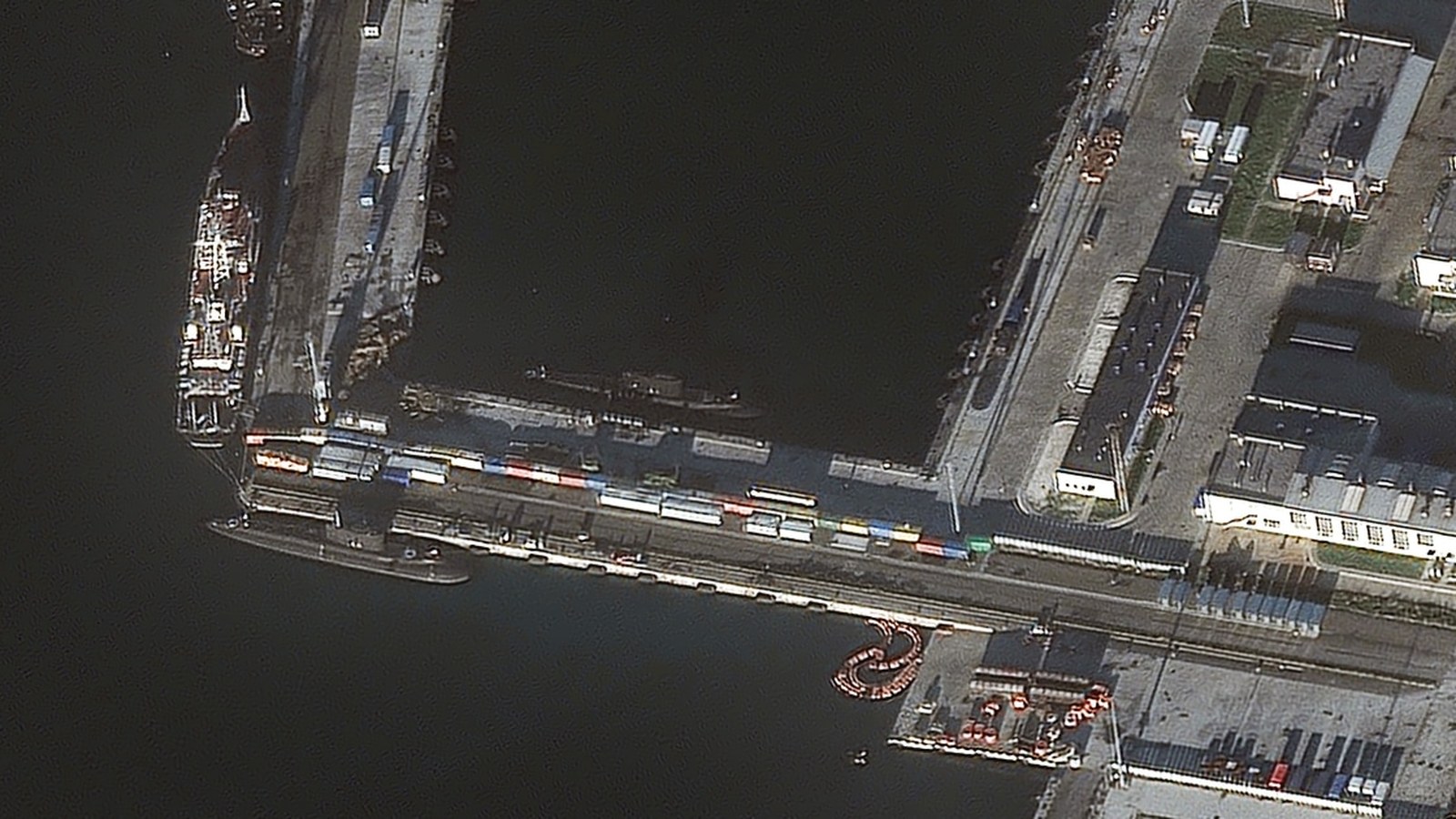
Within hours, satellite images released by the Colorado-based firm Vantor began circulating online. The photos showed clear, fresh damage to a section of the quay at Novorossiysk, Russia’s key Black Sea Fleet port since Ukrainian attacks forced a retreat from Crimea’s Sevastopol. Just beside the blast site, a Kilo-class submarine—equipped with Kalibr cruise missile launchers—sat seemingly untouched, with three more submarines also visible in the port.
Independent analysts, including those at The War Zone (TWZ), scrutinized the images. Their verdict: the explosion had occurred about 20 meters from the stern of the submarine, damaging the pier but leaving the vessel’s visible structure intact. Notably, the satellite imagery showed no signs of emergency containment, salvage operations, or booms—standard responses to catastrophic damage at sea.
Ukraine’s Security Service (SBU), however, doubled down. They released dramatic footage from the Ukrainian-made Sub Sea Baby drone, capturing a tranquil port moments before a massive explosion sent water and debris skyward. The SBU claimed the submarine had suffered “critical damage” and was effectively put out of action—an assertion that, if true, would mark the first-ever destruction of a submarine by an uncrewed underwater vehicle.
Russia’s Denial and the War of Narratives
Moscow’s response was swift and categorical. State news agencies quoted the Black Sea Fleet, insisting, “None of the ships or submarines stationed in the bay of the Novorossiysk naval base, nor their crews, were damaged as a result of the sabotage and are on duty as normal.” The Russian Defense Ministry published video footage purportedly showing the submarine in perfect condition, though the stern—the area nearest the blast—was conspicuously absent from view, and the video itself was heavily edited.
Russian naval monitoring channels echoed the official line, reporting no serious damage and no injuries. Other vessels previously moored near the explosion site had moved, but the submarine at the epicenter remained in position. For many observers, the lack of emergency measures around the submarine suggested that, at least visually, the vessel had not sustained disabling damage.
Technological Leap or Psychological Warfare?
Regardless of the physical toll, the attack represents a leap in Ukraine’s drone capabilities. Both sides have deployed drones extensively—on land, in the air, and increasingly at sea. This war, now nearing its fourth year, has seen drones used on an unprecedented scale, redefining the boundaries of conventional conflict.
At the heart of Ukraine’s drone program are operations like the one in June 2025, when over a hundred small drones were smuggled to the perimeters of four Russian air bases—one as far as 2,500 miles from Ukraine’s borders—damaging or destroying dozens of aircraft. More recently, Ukrainian naval drones targeted two Russian oil tankers in the Black Sea, demonstrating reach and ingenuity.
Yet, as Benjamin Jensen of the Center for Strategic and International Studies points out, the strategic impact remains limited. “The attack will not have a significant impact on Russia’s war in Ukraine, which focuses more on seizing terrain in Eastern Ukraine and punishing Ukrainian cities and infrastructure with nightly drone and missile attacks,” Jensen said. “The four missiles that won’t be shot tonight from the Kilo pale in comparison to the hundreds of drones launched at Ukrainian cities.”
The Fog of War: What Do We Really Know?
As 2025 closes, the Novorossiysk incident stands as a microcosm of this war’s blurred realities. Ukraine’s claim—backed by dramatic video and a confident official narrative—has not been independently verified. Satellite images, cited by NBC News and TVP World, confirm blast damage to the port but offer no conclusive proof that the submarine itself is out of action. Russia’s denial, supported by selective footage and the absence of visible emergency response, muddies the waters further.
Meanwhile, the attack’s psychological effect cannot be underestimated. For Ukraine, the strike is a bold statement: even as ground offensives stall, its technological ingenuity can still reach deep into Russian territory, threatening prized assets and undermining Moscow’s sense of security. For Russia, the incident is a test of narrative control—an opportunity to project resilience and minimize embarrassment.
Ultimately, the Novorossiysk submarine attack reveals both the possibilities and the limitations of drone warfare in modern conflict. It demonstrates how technology can shift tactics and perceptions, but it also shows that, in the absence of clear evidence, the truth remains submerged—just like the vessels at the heart of the story.
While Ukraine’s underwater drone strike signals a new era in naval warfare and psychological operations, the satellite images leave critical questions unanswered. The lack of visible damage to the submarine tempers the narrative of a decisive blow, reminding us that in today’s wars, information and perception can be as powerful—and as ambiguous—as any weapon.