
Quick Read
- Violet Affleck, 19, addressed the UN about COVID-19’s impact on youth.
- She called for clean air to be recognized as a human right.
- Violet criticized the push for a return to normalcy and the neglect of long COVID risks.
- She is a Yale freshman and public health advocate with personal experience of post-viral illness.
- Her speech drew parallels to the campaign against indoor smoking.
Violet Affleck’s United Nations Address: A Call to Action
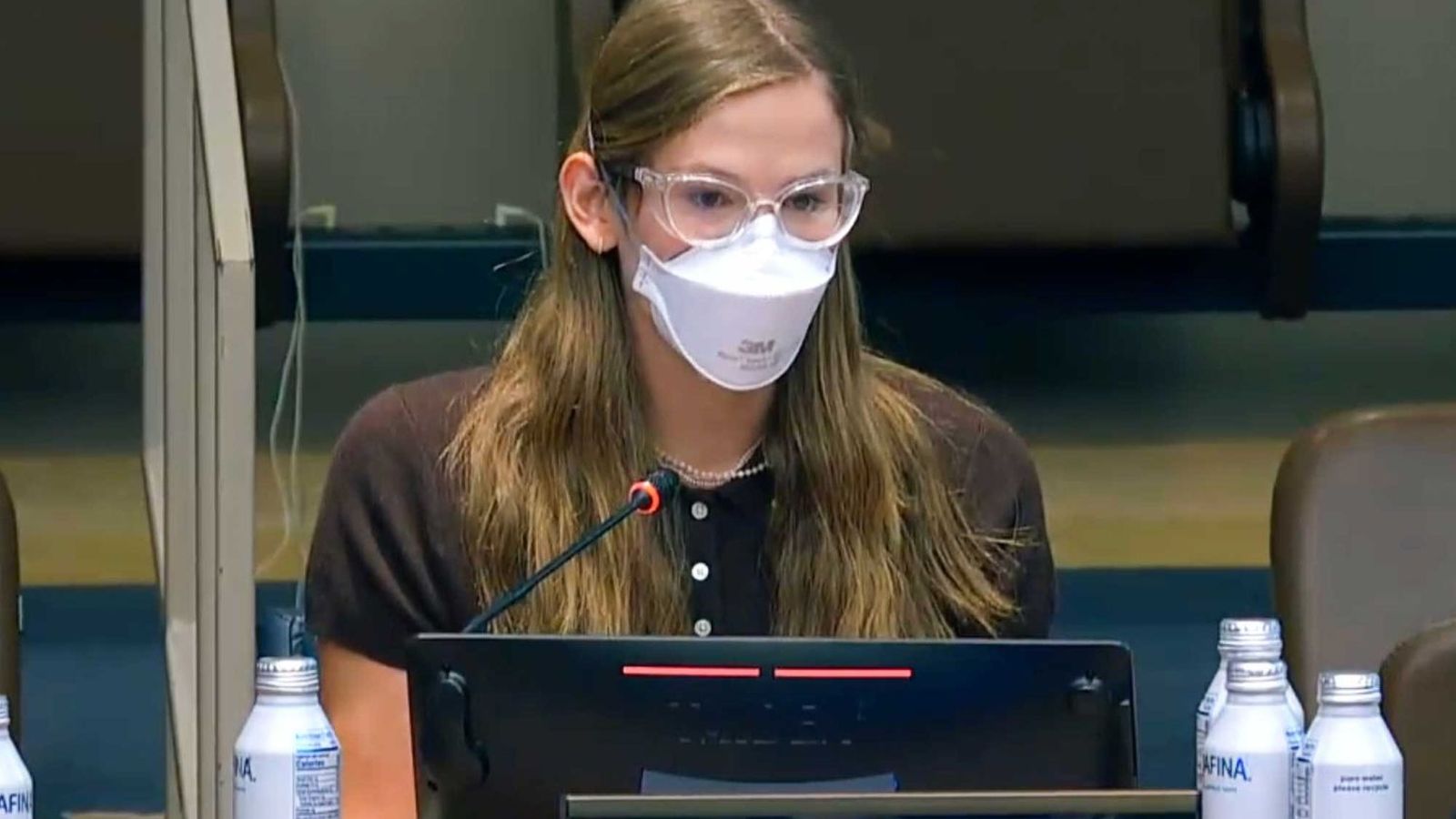
On a brisk September morning in New York, the United Nations General Assembly hall felt electric. Seated among seasoned diplomats and health officials was a new kind of advocate: Violet Affleck. At just 19, the Yale University freshman and daughter of Hollywood icons Ben Affleck and Jennifer Garner strode to the podium with a clear sense of purpose. Her face partially obscured by a K95 mask, Violet’s presence was a visual reminder of the pandemic that continues to shape our world—even as much of society rushes to move on.
What unfolded was not just another speech. It was a plea, a warning, and a blueprint for a future that refuses to accept preventable suffering. As People and The Mirror reported, Violet’s words cut through the usual diplomatic caution: “We are told by leaders across the board that we are the future. But when it comes to the ongoing pandemic, our present is being stolen right in front of our eyes.”
Youthful Resolve Meets Pandemic Fatigue
Violet’s speech did not shy away from uncomfortable truths. She criticized what she called “the relentless beat of back to normal”—a phrase that has become a mantra for pandemic-weary societies. Yet, as Violet pointed out, the return to normalcy has come at a price. “Young people lacked both real choice in the matter and information about what was being chosen for us,” she said, her frustration evident.
She spoke directly to the lived experiences of her generation: the anxiety of daily life, the lingering fear of long COVID, and the persistent sense that adults are making decisions without considering the long-term consequences. “Every subsequent infection increases the risk of long movement and places people who already have it in greater danger.” Violet cited Dr. Akiko Iwasaki, a leading immunologist, noting that “the whole population is the control group, and after only five years, long COVID has surpassed asthma as the most common chronic illness in children five and under.”
Her message resonated with many in the room, particularly when she described her fear for “children who will not know a world without debilitating pain and exhaustion, who cannot trust their bodies to play, explore, and imagine.”
Clean Air: From Luxury to Human Right
Perhaps the most striking aspect of Violet’s address was her demand to recognize filtered air as a human right, as intuitively necessary as clean water. She drew a compelling parallel to the decades-long fight against indoor smoking—a public health victory that now seems obvious in hindsight.
“Many of you fought the long and hard battle against indoor smoking. My only memory of that era at almost 20 years old is being confused as a child about the no smoking signs on planes. ‘Who would do that? That’s gross,’” she recalled, earning laughter from the audience. Her analogy underscored how quickly public health advances can shift from controversial to common sense.
Violet’s vision goes beyond masks and mandates. She called for the creation of clean air infrastructure so ubiquitous, so obviously necessary, that future generations will take it for granted. “We can recognize filtered air as a human right, as intuitively as we do filtered water. We can create clean air infrastructure that is so ubiquitous and so obviously necessary, so that tomorrow’s children don’t even know why we need it.”
Personal Stakes and Public Health Advocacy
Violet’s activism is not new. In July 2024, she addressed the Los Angeles County Board of Supervisors, advocating for mask availability and high-quality free testing while opposing mask bans. During that appearance, she revealed a personal connection to the issue: “I contracted a post-viral condition in 2019. I’m OK now, but I saw first-hand that medicine does not always have answers to the consequences of even minor viruses. The COVID-19 pandemic has thrown that into sharper relief.”
At Yale, Violet has continued her advocacy, recently publishing an academic paper on the Los Angeles County wildfires and their impact on public health. Her approach is data-driven, but her passion is unmistakably personal. She is part of a generation that feels uniquely vulnerable—and uniquely responsible—for the world they are inheriting.
Her speech also highlighted the lasting impact of long COVID. According to the UK’s National Health Service, long COVID is diagnosed when symptoms last longer than 12 weeks, ranging from fatigue and memory problems to chest pain and hair loss. As Violet noted, “long COVID has surpassed asthma as the most common chronic illness in children five and under.”
Global Reaction and the Road Ahead
Violet Affleck’s address quickly spread across social media, sparking debate among policymakers, scientists, and the public. Her call for clean air as a human right has been echoed by health advocates and environmentalists, while others question the feasibility of large-scale infrastructure changes.
Yet, for many, her speech was a breath of fresh air—an unfiltered critique of complacency and a reminder of what is at stake. As The Mirror reported, Violet’s voice “captured the frustration and hope of a generation that refuses to be silent.”
As the world navigates the ongoing challenges of COVID-19 and prepares for future public health crises, voices like Violet’s are likely to become more prominent. Her message is clear: the time for action is now, and the cost of inaction will be borne by the youngest among us.
Violet Affleck’s speech stands as a vivid reminder that true progress often begins with those willing to challenge the status quo. Her call to recognize clean air as a fundamental right reframes the COVID-19 debate—not just as a medical crisis, but as a generational reckoning over whose future is being shaped, and by whom.