
Chinese Astronauts Complete Six-Month Space Mission
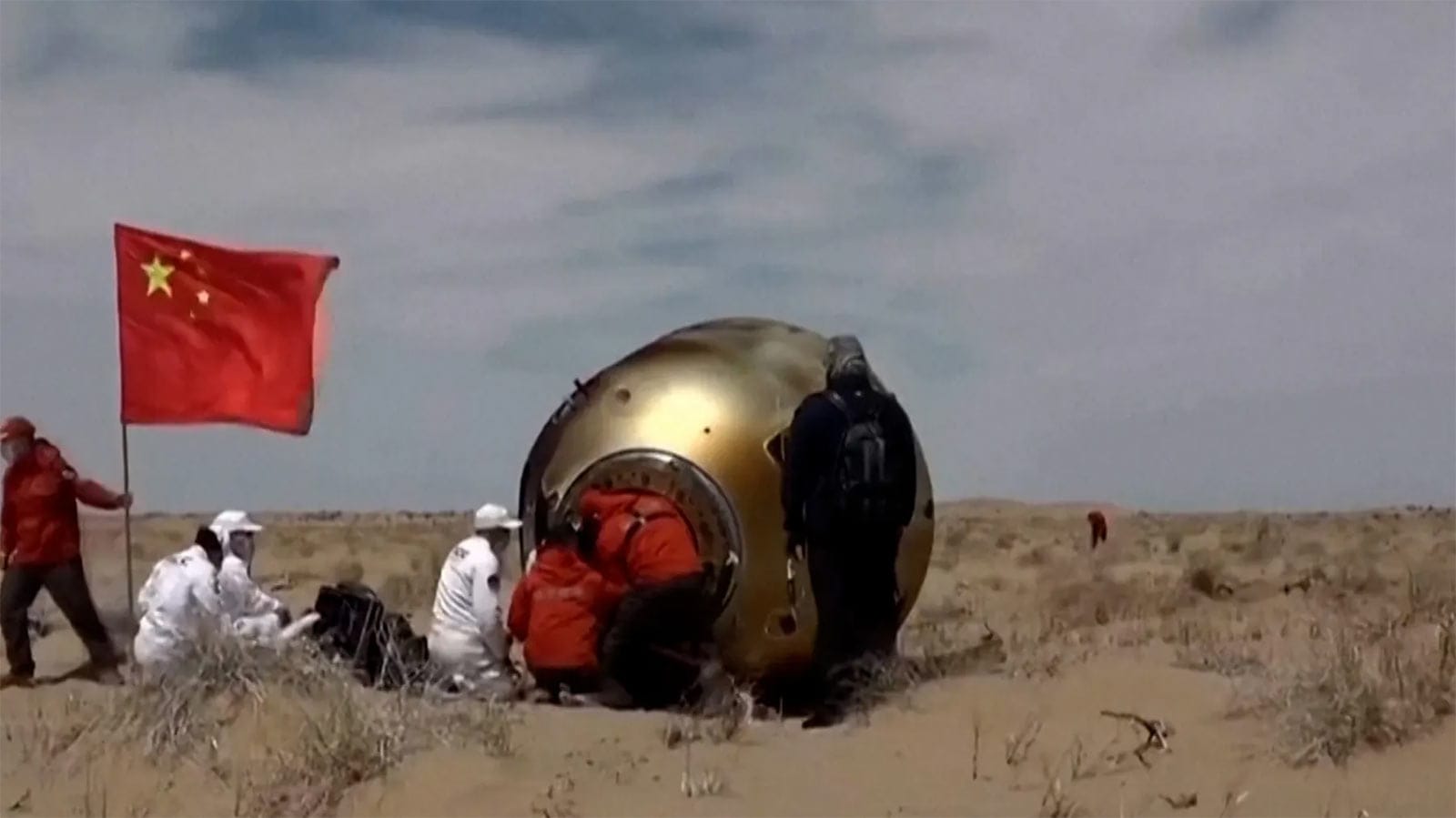
Three Chinese astronauts safely returned to Earth on Wednesday after completing a six-month mission aboard the Tiangong space station. The landing took place in Dongfeng, located in China’s northern Inner Mongolia region, on the edge of the Gobi Desert. The astronauts, Cai Xuzhe, Song Lingdong, and Wang Haoze, were greeted with celebrations as they concluded their extended stay in orbit.
Landing Delayed Due to Weather Conditions
The return was initially scheduled for Tuesday but was postponed by a day due to adverse weather conditions, including strong winds and low visibility in the landing area. This region is known for its sandstorms during this time of year, which added complexity to the mission’s final phase. Despite the delay, the landing module descended smoothly, aided by a red-and-white parachute, ensuring the crew’s safe arrival.
Highlights of the Mission
The astronauts were launched to the Tiangong space station in October 2023 aboard the Shenzhou-19 spacecraft. During their six-month stay, they conducted numerous scientific experiments and contributed to the station’s development. Notably, Cai Xuzhe and Song Lingdong carried out a record-breaking nine-hour spacewalk, the longest in history, according to China’s space agency.
The mission also involved turning over control of the space station to a new crew that arrived aboard the Shenzhou-20 spacecraft earlier this week. The new crew brought additional equipment to support experiments in space life sciences, microgravity physics, and advanced technologies for the station.
China’s Growing Presence in Space Exploration
The Tiangong space station, also known as the “Heavenly Palace,” represents a significant milestone in China’s space ambitions. The station was developed entirely by China after the country was excluded from the International Space Station (ISS) due to U.S. national security concerns. This exclusion has driven China to establish itself as a major player in space exploration, with the Tiangong station serving as a platform for scientific research and technological innovation.
China’s space program, which is managed by the People’s Liberation Army, has made rapid advancements in recent years. In addition to the Tiangong station, the program has successfully landed an explorer on Mars and deployed a rover on the far side of the moon. The country has also announced plans to send astronauts to the moon by 2030, further solidifying its position in the global space race.
Scientific Contributions and Future Goals
During their mission, the three astronauts conducted a range of experiments aimed at advancing our understanding of space life sciences and microgravity physics. These experiments are expected to contribute valuable insights to both China’s space program and the broader scientific community.
Looking ahead, the Tiangong space station will continue to serve as a hub for international collaboration and cutting-edge research. With its growing capabilities, China aims to use the station to address key questions about the universe and develop technologies that could benefit life on Earth.
As China’s space program continues to expand, the successful return of the Shenzhou-19 crew marks another step forward in the country’s journey toward becoming a global leader in space exploration.
Source: Associated Press