
Quick Read
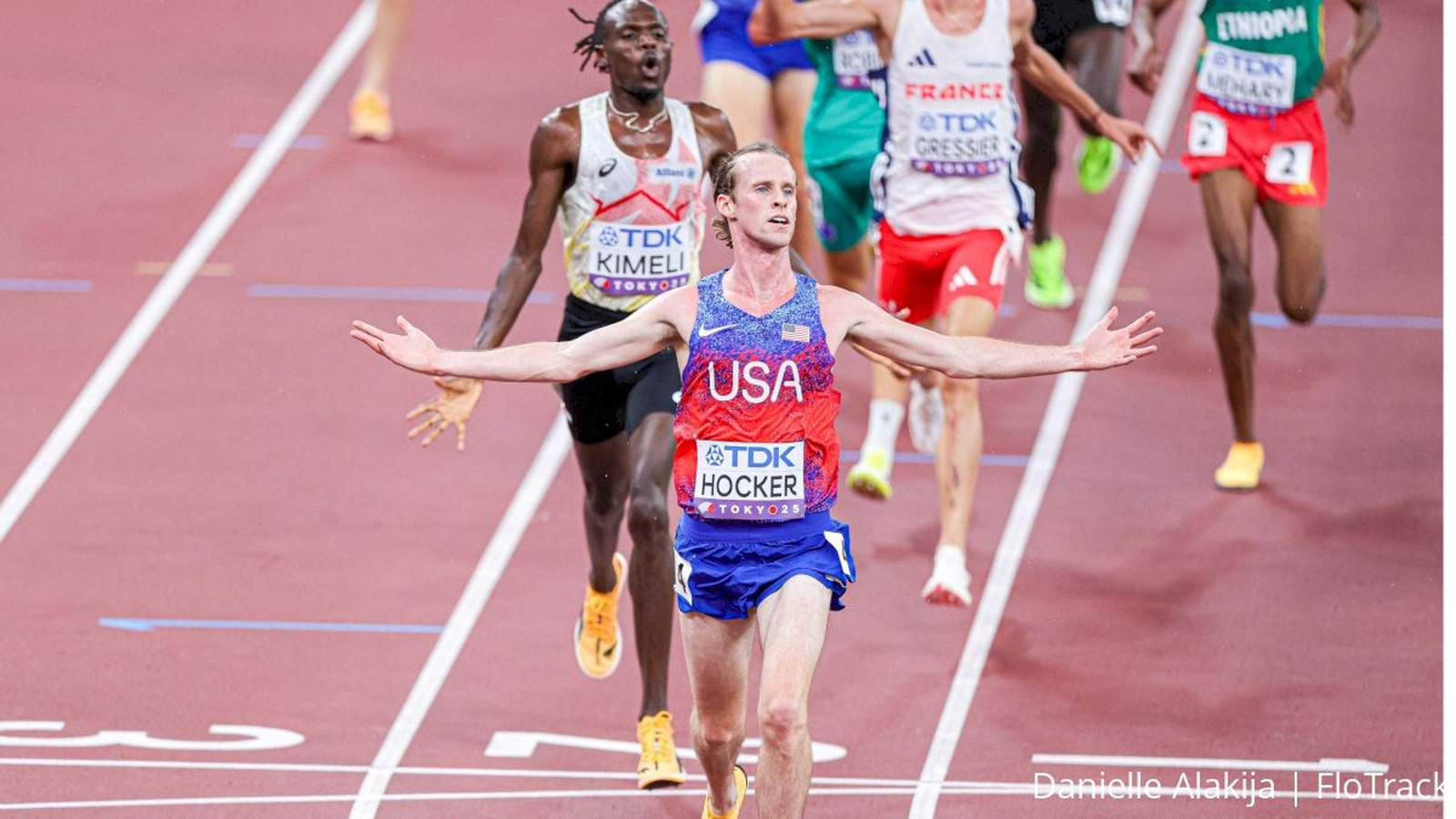
- Cole Hocker won gold in the 5000m at the 2025 World Championships in Tokyo.
- He surged from 12th place on the final lap, finishing in 12:58.30.
- Hocker is the first American to win 5K gold since Bernard Lagat in 2007.
- Belgium’s Isaac Kimeli and France’s Jimmy Gressier completed the podium.
- Hocker rebounded after being disqualified in the 1500m earlier in the meet.
Cole Hocker’s Redemption: From Disqualification to World Champion
On September 21, 2025, the Japan National Stadium in Tokyo witnessed a moment that will echo through American track and field history for years to come. Cole Hocker, the reigning Olympic 1500-meter champion, transformed bitter disappointment into stunning victory, powering through the field to capture his first-ever world title in the men’s 5000 meters. It was a race that not only showcased his legendary finishing kick but also ended an 18-year drought for American men in the event at the World Athletics Championships.
Six days before his triumph, Hocker’s journey seemed to have hit a wall. In the semi-finals of the 1500 meters—his specialty—he was disqualified for jostling while trying to break free in a crowded last stretch. The incident, which left him without a shot at a world medal in his preferred event, could have easily derailed his championship hopes. But instead, it became the spark for an extraordinary comeback.
The Race: Tactical Battles and a Legendary Kick
Hocker’s approach to the 5K was strategic from the start. As the gun sounded, he surged to the front, flanked by fellow Americans Grant Fisher and Nico Young. The trio sought to establish a brisk tempo, wary of the tactical traps that often define championship distance races. Fisher, himself a two-time Olympic bronze medalist, assumed pacing duties, intent on keeping the field honest.
For eight laps, Fisher’s steady push kept the race from settling, but the pack remained tight. Ethiopia’s rising star Biniam Mehary and Olympic bronze medalist Hagos Gebrhiwet lingered close, ready to pounce. With three laps to go, Norway’s Jakob Ingebrigtsen—four-time world record holder and double Olympic champion—briefly took the lead, though the field refused to splinter.
As the bell rang for the final lap, Hocker found himself in 12th place. For most, it would have seemed an impossible task. But those familiar with Hocker’s racing style knew what was coming: his signature kick. Over the last 400 meters, he unleashed a breathtaking 52.5-second split, weaving past 11 competitors. With 125 meters remaining, he overtook Belgium’s Isaac Kimeli, who had been the top qualifier and was running a season’s best. Hocker soared past the finish line in 12:58.30, a time that not only secured gold but also cemented his place among the sport’s elite.
Historic Gold and Global Context
Hocker’s victory was not just personal redemption—it was historic for U.S. distance running. He became the first American since Bernard Lagat in 2007 to win world championship gold in the 5000 meters. As Reuters and NBC Sports reported, his win was the only medal for the U.S. in events from 800 meters up to the marathon at these championships—a stark reminder of how rare such moments have become.
Behind Hocker, the podium reflected the depth and diversity of global distance running. Kimeli, the Belgian 10K road national record holder, claimed silver in 12:58.78, his first world championship medal after years of steady progression. France’s Jimmy Gressier, who had already won the 10K gold earlier in the week, added bronze with a 12:59.33 finish—another milestone in his rapidly growing résumé.
The final results read like a roll call of the sport’s current and future stars. Nico Young, just 22, finished sixth in 13:00.07 after a strong showing in the 10K. Grant Fisher, despite breaking the indoor world record for 3K earlier in the year, placed eighth. Ingebrigtsen, battling a recurring Achilles injury, managed tenth—a testament to the unpredictable nature of championship racing.
From Setback to Strength: Hocker’s Mental Game
“Coming off how the 1500m went, all those days in between, whatever it was, four or five days, I just isolated myself, surrounded myself with my family and just told myself that I wanted to end this championship on my terms,” Hocker told NBC’s Lewis Johnson after the race. The disappointment from the disqualification became a driving force. Rather than let frustration fester, Hocker channeled his energy into preparation, focus, and, ultimately, execution when it mattered most.
His ability to rebound from adversity is not new. At the U.S. Championships earlier in the year, Hocker barely made the team in the 1500 meters, squeezing into third in a crowded finish. Later, he toppled both Fisher and Young in a tactical 5K, showing that, when the race comes down to smarts and grit, he is a force to be reckoned with.
“I knew I had the strongest kick in this field, and it was just a matter of getting there,” Hocker said. His confidence—rooted in experience and self-awareness—allowed him to seize the moment when opportunity finally arrived.
A New Chapter for American Distance Running
With his Tokyo triumph, Hocker joins a rarefied group: only four American men have won the 1500-meter Olympic title, and now just two—Lagat and Hocker—have captured world gold in the 5K. His feat echoes not just personal glory but the promise of a new era for American distance running. As FloTrack and Runner’s World noted, Hocker’s win broke a streak of American medal shutouts in global distance events dating back to 2005.
For Hocker, the journey is far from over. He remains vocal about the tactical nature of championship racing and the importance of seizing every opportunity. “Don’t let it go slow if I’m in the race,” he once told reporters—words that now ring truer than ever.
His Tokyo run stands as both a lesson and an inspiration: setbacks are inevitable, but redemption is always possible with resilience, strategy, and a touch of brilliance.
Hocker’s victory in Tokyo didn’t just rewrite the record books—it redefined what’s possible for U.S. distance athletes. In a sport where one lap can change everything, his story is a powerful reminder that the greatest champions are forged not just by talent, but by the will to rise after every fall.