


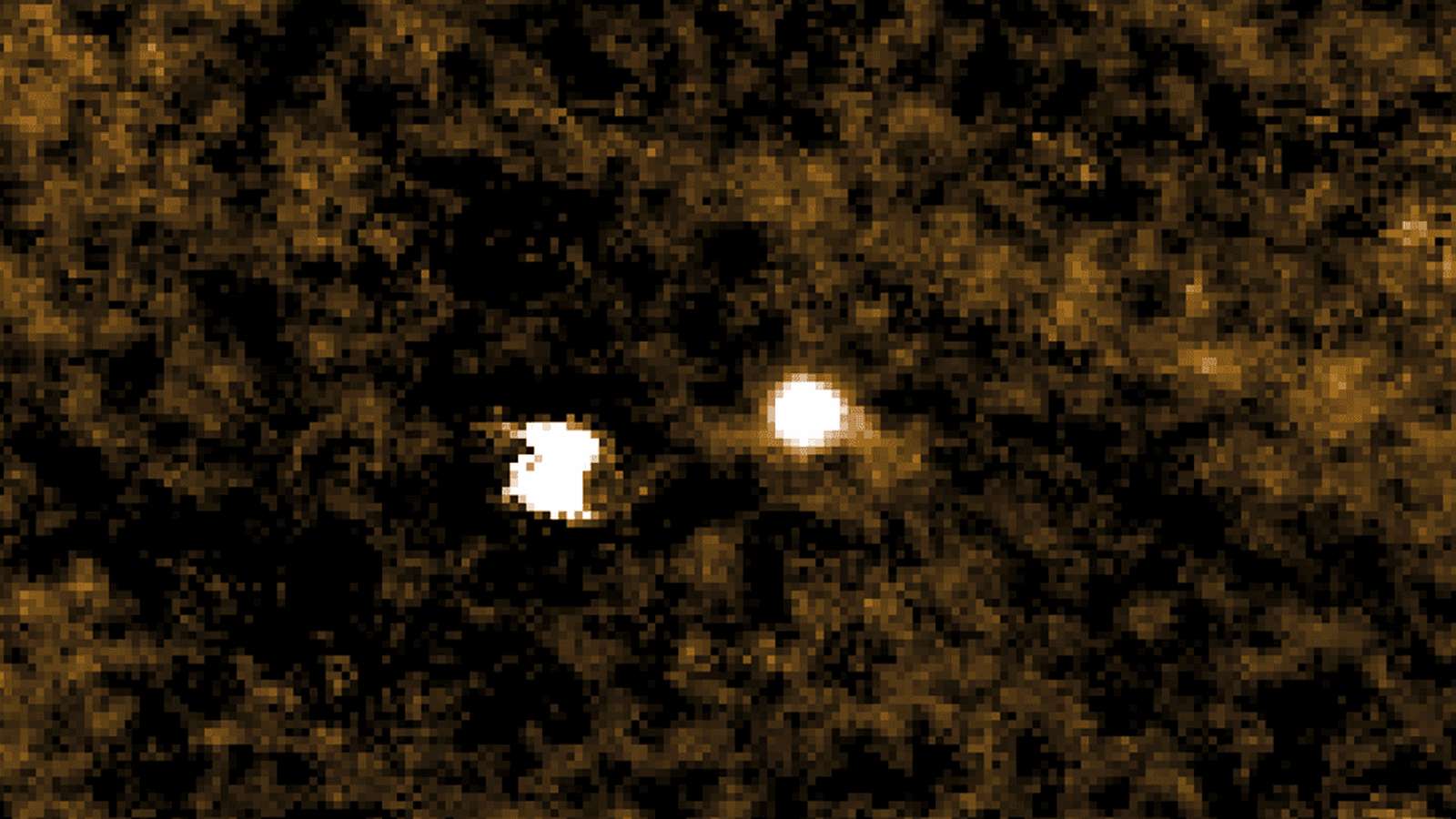
When comet 3I/ATLAS swept through the inner solar system in late 2025, it carried with it the intrigue and promise reserved for only the rarest of cosmic visitors. Astronomers quickly realized they were witnessing history: 3I/ATLAS was just the third confirmed interstellar object—after ‘Oumuamua and 2I/Borisov—to enter our celestial neighborhood, as reported by Space.com.
Unlike the enigmatic, cigar-shaped ‘Oumuamua, which left scientists puzzling over its true nature, 3I/ATLAS exhibited unmistakable cometary behavior. Its nucleus was unelongated and it developed a bright coma, surrounded by the classic halo of dust and gas. Yet, the comet wasn’t content to simply blend in with the crowd. It revealed a remarkable and rare phenomenon—a sun-facing ‘anti-tail’ stretching up to a million kilometers, with jets that seemed to wobble rhythmically every 7 hours and 45 minutes as the comet approached the sun. For researchers, this was a first: never before had such wobbling jets been observed in an interstellar comet’s anti-tail.
Most comets display tails that point away from the sun, sculpted by solar wind and radiation. But the anti-tail of 3I/ATLAS pointed toward the sun, a feature seen only occasionally in native solar system comets. The jets in this anti-tail, observed to wobble like the hands of a cosmic clock, were a vivid demonstration of the dynamic forces at play as the comet’s volatile ices vaporized under the sun’s heat, ejecting gas and dust in powerful, asymmetric bursts.
As scientists tracked 3I/ATLAS’s progress, another question loomed: could this interstellar traveler bear messages from distant civilizations? The Breakthrough Listen project seized the opportunity to search for technosignatures—narrowband radio signals that could indicate artificial communication—during the comet’s closest approach to Earth, which occurred on December 19, 2025, at a distance of 1.7 AU (about 167 million miles), according to IFLScience.
Employing the Green Bank Telescope with four receivers covering frequencies from 1 to 12 GHz, Breakthrough Listen’s instruments were sensitive enough to detect transmitters with an effective isotropic radiated power as low as 0.1 W—far exceeding previous technosignature searches. The team identified nine events worth deeper inspection, but ultimately, all were traced to known sources of terrestrial radio-frequency interference. As a result, no credible narrowband signals were detected emanating from 3I/ATLAS. Like previous searches conducted on other interstellar objects, the data reinforced the conclusion: as far as our current technology allows us to tell, 3I/ATLAS is a natural astrophysical object, not a probe or beacon sent by alien intelligence.
Beyond the quest for technosignatures, scientists took the opportunity to analyze the physics of the comet itself. As 3I/ATLAS drew closer to the sun, its volatile ices sublimated, driving dust and gas into space. This asymmetric outgassing imparted non-gravitational accelerations (NGAs) to the nucleus, detectable through careful astrometric measurements. By comparing the measured NGAs with estimates of the mass loss rate, researchers could refine their understanding of the comet’s composition and structure.
Interestingly, these findings help contextualize the nature of interstellar objects. While 3I/ATLAS shares many characteristics with solar system comets, its journey from another star system provides a rare glimpse into the diversity of small bodies that populate the galaxy. Its passage, marked by peculiar jets and a sunward tail, offers scientists new data points for comparing the behavior of native and interstellar comets.
The observation campaign for 3I/ATLAS was unprecedented in its scope and sensitivity. The comet’s unique features—its wobbling anti-tail and the absence of artificial signals—add to the growing catalog of interstellar visitors, each one a messenger from the distant reaches of our galaxy. As telescopes and detection methods improve, the scientific community remains hopeful that future interstellar objects will yield even more secrets, perhaps one day including signs of extraterrestrial technology.
For now, 3I/ATLAS’s journey stands as a testament to the power of international collaboration and the relentless curiosity that drives human exploration. It reminds us that while the search for alien life continues, the natural wonders of the universe are themselves extraordinary—each comet, each jet, each tail telling a story written in the language of physics and time.
3I/ATLAS’s passage through the solar system was not just a fleeting astronomical event; it was a scientific milestone, blending the thrill of discovery with the rigorous process of elimination that defines modern science. The absence of technosignatures is itself a finding, sharpening our understanding of interstellar objects and setting a higher standard for future searches. In a universe filled with mysteries, each confirmed fact is a stepping stone toward deeper knowledge and, perhaps one day, a truly epochal discovery.