
Quick Read
- ESA’s Mars orbiters recorded a 278% increase in electron density in the Martian atmosphere during the May 2024 solar superstorm.
- Researchers utilized a radio occultation technique, beaming signals between two spacecraft to analyze atmospheric density changes.
- The data provides new insights into how solar activity continuously strips away the Martian atmosphere and impacts future communication planning.
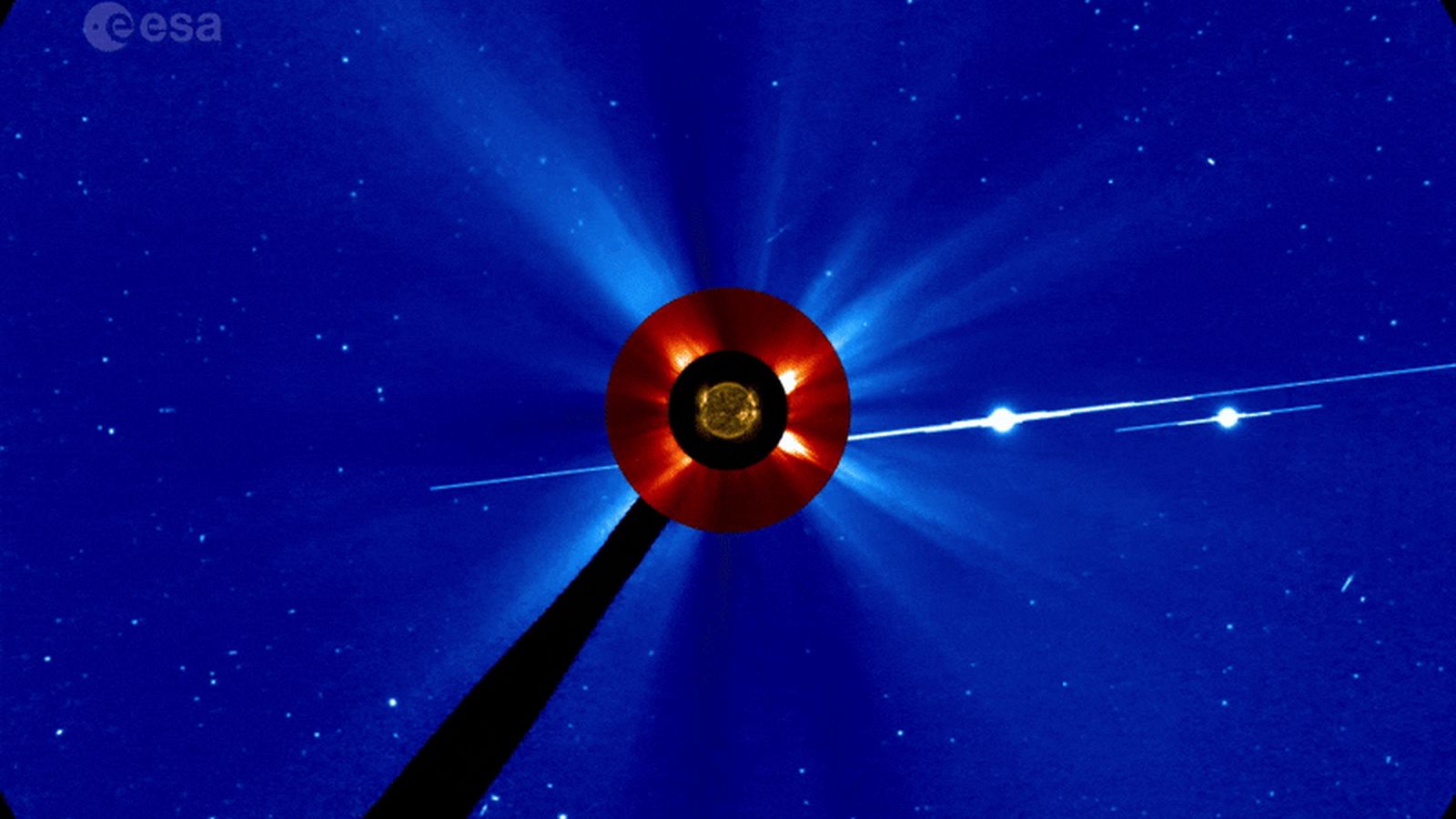
A massive solar superstorm that swept through the inner solar system in May 2024 did more than create spectacular auroras on Earth; it significantly disrupted the upper atmosphere of Mars, according to new research published in Nature Communications. Data retrieved by the European Space Agency’s (ESA) Mars Express and the ExoMars Trace Gas Orbiter (TGO) confirm that the Red Planet experienced an unprecedented surge in atmospheric electron density as it was bombarded by high-energy particles and radiation.
Understanding the Impact of Solar Activity on Mars
The May 2024 event, noted as the largest solar storm to hit Earth in over two decades, provided scientists with a rare opportunity to study how solar activity impacts planets lacking a global magnetic field. According to ESA researchers, the storm caused a 45% increase in electron density at an altitude of 110 km and a staggering 278% increase at 130 km. This influx of charged particles occurred shortly after the storm’s initial radiation flare reached the planet.
“The impact was remarkable: Mars’s upper atmosphere was flooded by electrons,” said Jacob Parrott, an ESA Research Fellow and the study’s lead author. The energetic particles effectively stripped neutral atoms of their electrons, creating a temporary, highly charged layer in the Martian ionosphere. Both the Mars Express and the TGO experienced minor computer errors during the event, though engineers confirmed the spacecraft were built with radiation-resistant components and recovered quickly.
Pioneering Radio Occultation Techniques
To measure these changes, the team utilized a specialized technique known as radio occultation. By beaming radio signals between the two orbiters as they moved across the Martian horizon, scientists were able to detect how the atmosphere refracted the signals. This allowed the team to map the electron density at specific altitudes with high precision. While this method is standard for Earth-based observations, applying it between two orbiting spacecraft at Mars represents a significant advancement in planetary science.
Implications for Future Space Exploration
The findings offer critical context for understanding how Mars lost its ancient water and atmosphere over billions of years. By observing how the current solar wind strips particles from the planet, researchers hope to better model the long-term evolution of the Martian climate. Furthermore, the study highlights the practical challenges of space weather for future robotic and human missions. Increased electron density in the upper atmosphere can disrupt radar and communication signals, potentially complicating surface exploration.
The study underscores that while Earth is largely shielded by its magnetosphere, Mars remains highly exposed to solar volatility, proving that space weather forecasting will be a necessary component of mission planning for future exploration of the Red Planet.