


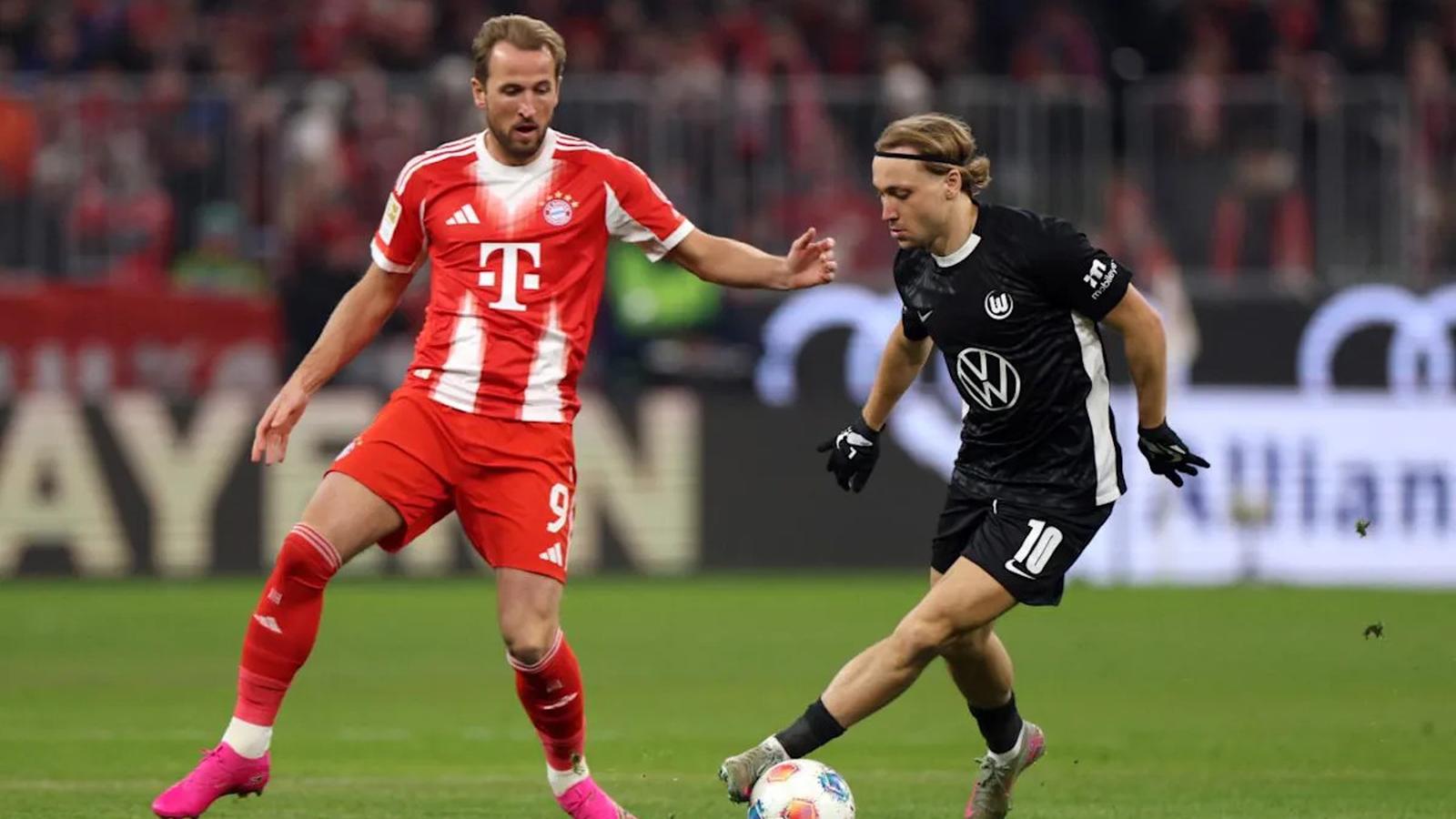
Harry Kane, the talismanic England captain, isn’t just playing football; he’s orchestrating a masterclass in career reinvention and goal-scoring prowess at Bayern Munich. As of January 2026, his move to the German giants has not only seen him shatter records but also inadvertently highlighted the narrow perspective of some long-standing critics. Fresh off a spectacular 8-1 demolition of Wolfsburg, where Kane himself netted, his journey continues to challenge the conventional wisdom, especially that of former England international Michael Owen, who appears increasingly out of touch with modern football’s global landscape.
The recent thrashing of Wolfsburg, a dominant 8-1 victory for Bayern, saw Kane reach an astonishing 20 Bundesliga goals in just 16 matches. This achievement isn’t merely a statistic; it’s a testament to his immediate and profound impact on the German top flight. Bayern’s performance, particularly a ruthless second-half display, extended their lead at the summit to a commanding 11 points, solidifying their position as the team to beat. As Kane himself reflected in a post-match interview with Bundesliga YouTube, “We were ruthless in our attacks to score as many goals as we did and extend our lead to 11 points was important.” His teammate Luis Díaz, who also shone brightly, received special praise from Kane, highlighting the collective strength and synergy within the squad.
Michael Owen’s Persistent Premier League Bias Under Scrutiny
For months, Michael Owen has been vocal about his perceived disappointment regarding Kane’s transfer, often framing it as a missed opportunity for the striker to cement his legacy in the Premier League. Speaking to Goal, Owen’s comments have been characterized as “outrageously bitter” by some, suggesting a deep-seated bias towards English football. His arguments largely revolve around three main assertions, each of which unravels under closer examination of Kane’s current trajectory.
Owen’s first assertion posited that Kane never genuinely desired a move to Bayern Munich, suggesting he settled for a less glamorous option after other major clubs like Manchester United, Manchester City, Real Madrid, or Barcelona were out of reach. He painted a picture where Bayern was a fallback, not a primary choice. This narrative, however, conveniently ignores the reality of top-tier football transfers. Bayern Munich is not a provincial team; it’s a perennial European powerhouse, one of the most successful clubs globally. To suggest Kane would consider them outside his ‘top half-a-dozen’ destinations reveals a profound misunderstanding of the club’s stature. Furthermore, the notion that Kane only moved because Erling Haaland was at City or Robert Lewandowski at Barcelona is flawed. Negotiations between Kane and Bayern reportedly began as far back as the 2021/22 season, well before these other high-profile moves materialized. Kane clearly had Bayern on his radar, recognizing the immense opportunity it presented.
Is Kane ‘Dead Money’? His Unstoppable Form Says Otherwise
Owen’s second, and perhaps most perplexing, claim is that signing Kane now constitutes “dead money” because of his age. “You are buying for the here and now and how many years are you going to get? One, two, three, four?” Owen mused. This assessment defies all current evidence. At 32 years old, Kane is in the prime of his career, consistently demonstrating that age is merely a number when talent and dedication converge. His playstyle, which relies more on intelligent movement, clinical finishing, and exceptional passing rather than explosive pace, is built for longevity. Legendary figures like Robert Lewandowski, Cristiano Ronaldo, and Lionel Messi have all maintained elite performance well into their mid-thirties, proving that top strikers can defy conventional aging curves. To label Kane as ‘dead money’ just as he’s hitting a 20-goal mark in half a season, still on course to challenge Lewandowski’s all-time Bundesliga single-season record of 41 goals from 2020-21, seems utterly disconnected from reality. Even Barcelona, despite their financial constraints, seriously considered Kane as a replacement for Lewandowski, backing off only due to economic hurdles, not doubts about Kane’s on-field capabilities.
Bundesliga Glory vs. Premier League Records: A Matter of Perspective
Finally, Owen expressed a deep-seated desire for Kane to have remained in the Premier League to chase Alan Shearer’s goal-scoring record, lamenting that a Bundesliga title ‘would have held a lot more weight’ in England. “I was very vocal about it at the time, I would love to have seen him stay in the Premier League… he would have been on a Bosman,” Owen stated, implying Kane gave away his leverage too cheaply. This perspective, however, misses the fundamental ambition of many top footballers: winning major trophies. For a player of Kane’s caliber, who spent years at Tottenham without silverware, a Bundesliga title and the chance to challenge for the UEFA Champions League undoubtedly outweigh the individual accolade of a domestic league goal-scoring record. As Bavarian Football Works aptly points out, “To a footballer like Kane, a Bundesliga title means 100x more than Alan Shearer’s goalscoring record.” The allure of team glory, especially the UEFA Champions League, which remains one of the most coveted prizes in club football, is a powerful motivator. Kane’s move wasn’t about avoiding a record; it was about elevating his career to a new dimension of success.
His path out of the Premier League was not a retreat but a calculated ascent. With Manchester City already boasting Haaland, and moves to rivals like Chelsea or Arsenal unthinkable for a Spurs legend, the options within England for immediate, consistent trophy contention were limited. Manchester United, as Owen himself admitted, was struggling. Kane chose a club where winning is not just an aspiration but an expectation, and he is thriving in that environment. His success in Germany is not just a personal triumph but a powerful statement against insular footballing views.
Harry Kane’s commanding performance at Bayern Munich, particularly his rapid accumulation of goals and the team’s dominant league position, serves as a compelling rebuttal to the criticisms leveled by figures like Michael Owen. His decision to move has demonstrably enhanced his career, proving that a player’s legacy is defined not just by domestic records, but by the pursuit and attainment of major collective honors on the grandest stages of European football.