
Quick Read
- Honor Win and Win RT are the first mainstream smartphones with 10,000mAh batteries.
- Both feature a 6.83-inch OLED display with a record 185Hz refresh rate and up to 6,000 nits brightness.
- Active cooling fans, flagship Snapdragon chips, and robust camera setups make these phones gaming powerhouses.
In the relentless race for smartphone innovation, Honor has thrown down the gauntlet with the launch of the Honor Win and Honor Win RT—two devices that rewrite the rulebook for gaming phones in 2025. If you thought battery life, display smoothness, and thermal control had reached their peak, think again. These new models don’t just push boundaries—they break records.
Let’s start with the headline: the Honor Win series is the first mainstream smartphone line to pack a monstrous 10,000mAh silicon-carbon battery. That’s not a typo. For context, most flagship phones still hover between 4,500 and 5,500mAh, making this a leap worthy of a marathon runner. According to PhoneArena and GadgetMatch, this battery promises up to 16.4 hours of non-stop gaming and days of regular use. Charging won’t slow you down either, with support for 100W wired charging and, on the standard Win model, 80W wireless charging—a rare feat in the gaming category.
Of course, raw energy is only part of the story. Honor has gone all-in on display technology, giving both models a 6.83-inch flat LTPS OLED panel with a 1.5K (2800 x 1272 pixels) resolution. But the real showstopper is the 185Hz refresh rate—shattering the previous industry highs set by rivals like OnePlus (165Hz) and leaving typical 120Hz screens far behind. Coupled with a staggering 480Hz touch sampling rate and 5,920Hz PWM dimming, this means ultra-smooth visuals and responsive input, whether you’re locked in a competitive match or scrolling through your feed. The peak brightness of 6,000 nits and HDR10+ support ensure visibility even under direct sunlight.
Performance-wise, the Honor Win pulls ahead with Qualcomm’s latest Snapdragon 8 Elite Gen 5 chip, paired with Adreno 840 GPU, up to 16GB LPDDR5X RAM, and UFS 4.1 storage. The Win RT, meanwhile, is no slouch—running last year’s Snapdragon 8 Elite and Adreno 830, which still deliver top-tier gaming and multitasking. Both phones run Android 16-based MagicOS 10, with features like Wi-Fi 7, Bluetooth 6.0, infrared, NFC, and dual SIM 5G. No microSD card slot here, but with up to 1TB internal storage, few will miss it.
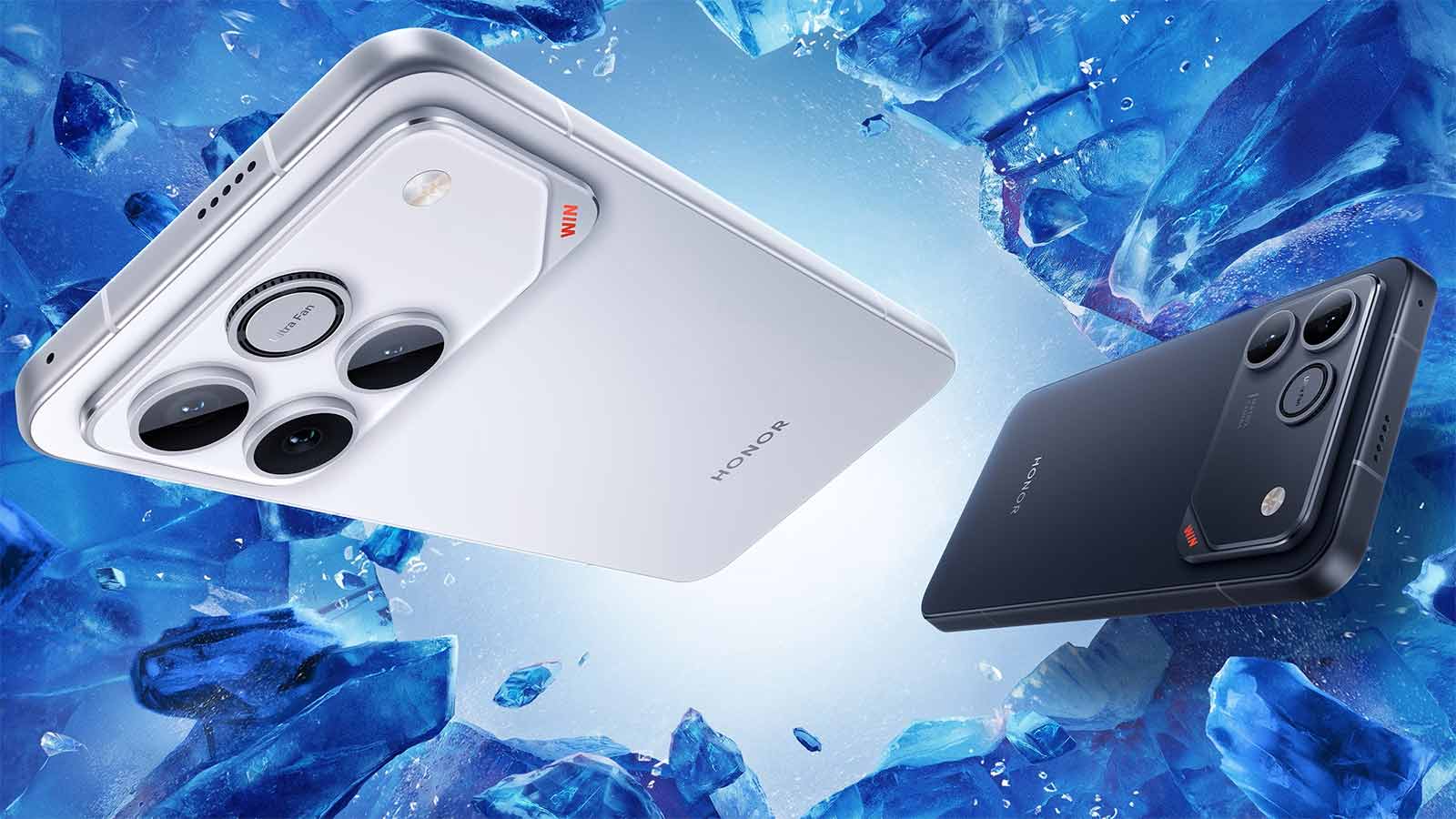
Gaming phones live and die by their cooling systems, and Honor’s new active cooling fan system is a standout. Housed in the rear camera module, the industry’s smallest and fastest fan spins up to 25,000 RPM, drawing in cold air and keeping temperatures up to 7ºC lower during intense sessions. An aerospace-grade thermal gel and vapor chamber boost dissipation by 200%, according to Huawei Central. The result? Sustained peak performance without the thermal throttling that plagues lesser devices.
The camera setup is equally impressive for a gaming phone. Both models feature a 50MP front camera for high-quality selfies and streaming. The Honor Win sports a triple rear system: 50MP main (Sony LYT-700 sensor, OIS), 50MP telephoto (3x optical zoom, up to 100x digital), and 12MP ultra-wide (112° FoV). The Win RT drops the telephoto for a dual setup, but keeps the same main and ultra-wide sensors. Both phones offer robust video and photo options, not just for gamers but for content creators on the go.
Durability hasn’t been ignored. The devices are just 8.3mm thick, with a metal frame and glass-fibre back, and carry IP68, IP69, and IP69K ratings—meaning they can withstand dust, water, and even high-pressure jets. Security is handled by an in-display ultrasonic fingerprint scanner, with recognition speeds down to 0.14 seconds.
Sound is also a priority, with Honor’s AI Surround Subwoofer and 1216 dual speaker setup, offering enhanced in-game audio cues and immersive playback. The company touts up to 300% better game footstep detection and 280% skill accuracy—details that could make the difference in competitive play.
Pricing is aggressive, especially considering the specs. The Honor Win starts at $570 for 12GB RAM and 256GB storage, scaling up to $755 for 16GB/1TB. The Win RT begins at $385 for the base configuration, topping out at $570 for the maxed-out version. Both are available in black, white, and blue finishes, with evocative names like Fast Black and Not Afraid of Blue. As usual, China gets first dibs, with global availability still unconfirmed—a familiar frustration for international fans.
Looking at the broader landscape, the Honor Win series isn’t just about raw numbers; it’s a strategic play to capture the growing market of mobile gamers who demand uncompromising power, endurance, and style. Rival devices, from RedMagic’s flamboyant gaming phones to Xiaomi’s camera-centric flagships, have set high standards. Yet Honor’s blend of battery innovation, cooling tech, and display prowess positions it as a genuine contender for the throne.
Still, questions remain. Will the massive battery and cooling translate into real-world longevity and performance? Will Honor bring these devices to global markets, or will they remain an enviable exclusive? And how will competitors respond now that the bar has been raised so dramatically?
Honor’s Win series is more than a technical showcase—it’s a statement of intent. By addressing the core pain points of gamers and power users (battery life, heat, display smoothness), Honor has delivered a phone that’s not just future-proof, but present-dominant. If global expansion follows, this could be a defining moment for the brand—and for what we expect from a smartphone in 2025.
Sources: PhoneArena, GadgetMatch, Huawei Central, ProPakistani.