
Quick Read
- Montreal’s Jacques-Cartier Bridge was fully closed early Wednesday due to smoke from a four-alarm fire.
- The fire engulfed a vacant, historic industrial building on De Lorimier Avenue, starting late Tuesday.
- Over 120 firefighters were deployed, adopting a defensive strategy due to structural collapse risks.
- No injuries have been reported from the incident.
- Traffic was diverted to the Victoria Bridge and Louis-Hippolyte-La Fontaine Tunnel, causing significant congestion.
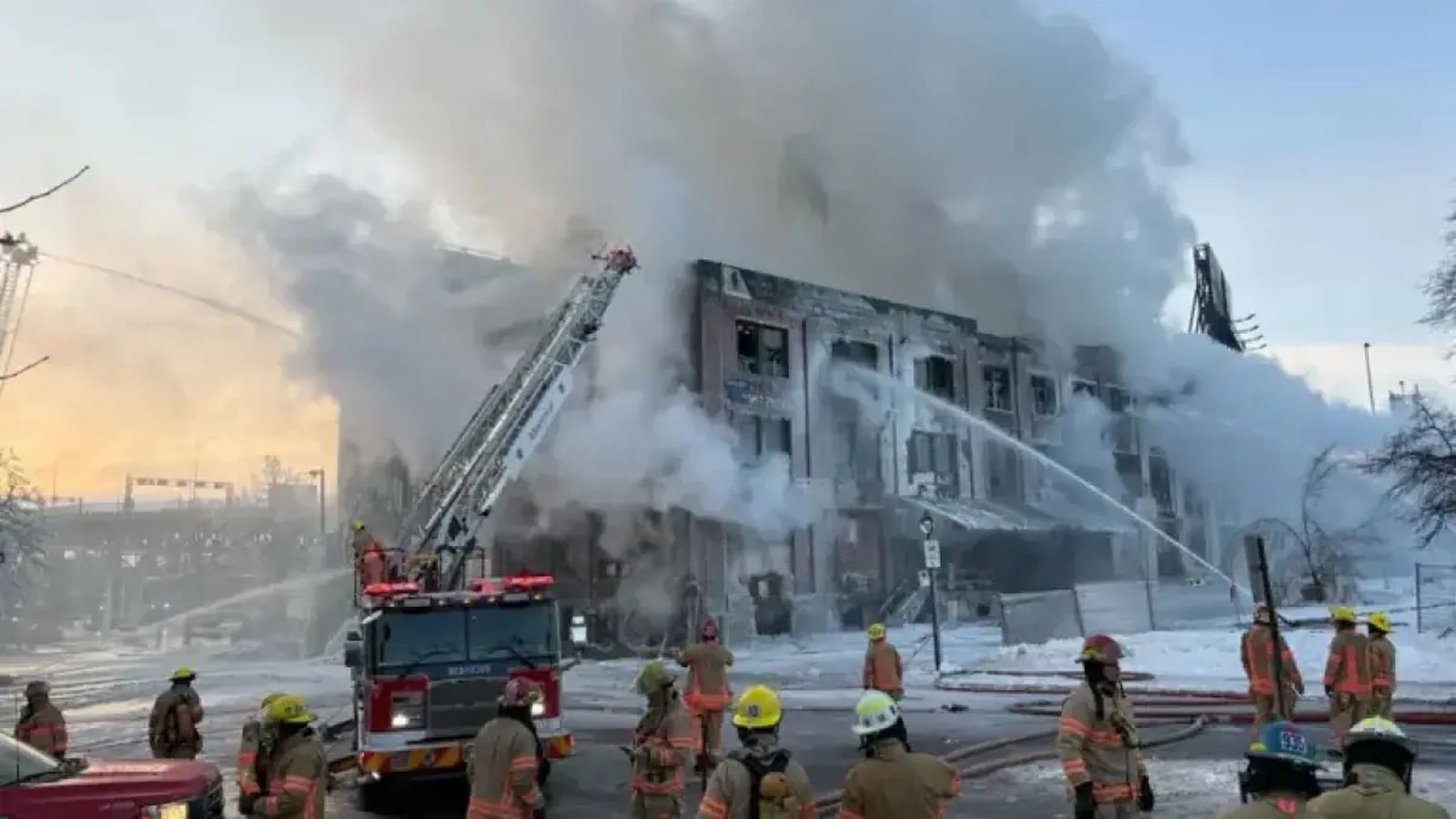
The Jacques-Cartier Bridge, a vital artery for commuters in Montreal, was fully closed early Wednesday morning, January 21, 2026, forcing significant traffic diversions and disrupting thousands of daily journeys. The closure was necessitated by thick, acrid smoke billowing from a ferocious four-alarm fire that engulfed a vacant, historically significant industrial building on De Lorimier Avenue. The blaze, which ignited late Tuesday night, escalated rapidly, prompting an extensive emergency response and raising concerns about urban infrastructure resilience in the face of such incidents.
Four-Alarm Blaze Engulfs Historic Structure
The inferno began around 11:30 p.m. on Tuesday, January 20, on the first floor of an abandoned industrial structure located at the intersection of De Lorimier Avenue and Logan Street. The building, a century-old landmark constructed in 1910, quickly succumbed to the flames. Éric Lafrance, a spokesperson for the Montreal fire department, confirmed that the blaze rapidly intensified to a four-alarm fire, indicating a major incident requiring substantial resources.
By 2:30 a.m. on Wednesday, the northbound lanes of the Jacques-Cartier Bridge leading into Montreal were already closed as a precautionary measure. The situation deteriorated further by 6:00 a.m., when flames were visibly piercing through the roof, a clear sign that the interior structure had likely collapsed. The sheer volume of smoke and the potential for falling debris from the intense heat forced authorities to make the critical decision to fully close the bridge in both directions by 6:15 a.m., just as the morning rush hour was beginning to build.
The building itself carries a rich history, having originally served as the operational base for Joseph Barsalou’s soap manufacturing business. Its ownership changed hands in 1935 when it was acquired by Procter & Gamble, a global consumer goods giant. Later, in 1943, it was purchased by Familex, a pharmaceutical company, which maintained operations there for four decades before the building eventually fell into disuse and remained vacant for several years. This historical significance adds another layer of complexity to the firefighting efforts, as urban planners and heritage enthusiasts often lament the loss of such structures.
Firefighters Battle Dangerous Conditions
More than 120 firefighters were deployed to the scene, battling the extensive blaze under challenging conditions. The intensity of the fire and the age of the structure presented immediate dangers, including the risk of structural collapse. As a result, fire officials adopted a defensive strategy, focusing on containing the fire from the exterior and preventing its spread to adjacent properties. ‘We’re in defense mode,’ Lafrance stated, emphasizing the priority of firefighter safety and preventing further escalation.
Applying water from outside the building is a common tactic when the structural integrity is compromised, or when entry is deemed too hazardous. This approach, while effective for containment, often means the fire can burn for longer within the core of the structure, producing more smoke. The sheer scale of the operation underscores the significant resources required to manage such an urban industrial fire, particularly one involving an older, potentially unstable building.
The primary concern for emergency services remained the safety of the public and the responding personnel. Despite the dramatic nature of the incident and the extensive damage to the building, authorities confirmed that no injuries have been reported. This outcome is a testament to the swift response and coordinated efforts of the Montreal fire department and other emergency services, who acted quickly to secure the area and ensure public safety.
Widespread Commuter Disruption Across Montreal
The closure of the Jacques-Cartier Bridge, one of Montreal’s most heavily trafficked crossings, immediately sent ripples through the city’s transportation network. Commuters attempting to cross the St. Lawrence River faced significant delays and were forced to seek alternative routes. Traffic was rerouted to other major crossings, including the Victoria Bridge and the Louis-Hippolyte-La Fontaine Tunnel, both of which experienced a dramatic increase in volume and subsequent congestion.
The sudden disruption highlighted the delicate balance of urban infrastructure and the critical role that major arteries like the Jacques-Cartier Bridge play in the daily lives of Montrealers. While road traffic faced substantial hurdles, public transport services, including the Metro, REM (Réseau express métropolitain), and suburban trains, continued to operate smoothly. This provided a crucial alternative for many commuters, mitigating what could have been an even more severe transportation crisis.
Authorities advised residents to plan for extended travel times and to consider using public transit where possible. The incident served as a stark reminder of the vulnerability of urban transportation systems to unexpected events and the importance of having robust contingency plans and alternative routes in place. The economic impact of such a closure, even for a short period, can be substantial, affecting productivity and daily commerce.
A Century of History Threatened
The fire in the former Barsalou soap factory not only caused immediate logistical challenges but also brought into focus the fate of Montreal’s aging industrial heritage. These buildings, often located in dense urban areas, represent a tangible link to the city’s past, reflecting its industrial development and economic evolution. However, their age, often neglected maintenance, and vacant status can make them susceptible to fires, vandalism, or structural decay.
The cause of the fire remains unknown, and investigations will likely commence once the fire is fully extinguished and the site is deemed safe. Such investigations are critical for understanding how these incidents occur and for informing future fire prevention strategies, especially concerning vacant or derelict properties. The incident underscores the ongoing challenges faced by urban planners and municipal authorities in managing and preserving historical industrial buildings, balancing heritage conservation with public safety and urban development needs.
The incident at the former Barsalou factory on De Lorimier Avenue serves as a potent reminder of the inherent vulnerabilities associated with abandoned industrial heritage in urban centers, where their historical value often clashes with the practical challenges of maintenance, security, and fire safety, inevitably impacting critical infrastructure like the Jacques-Cartier Bridge.