


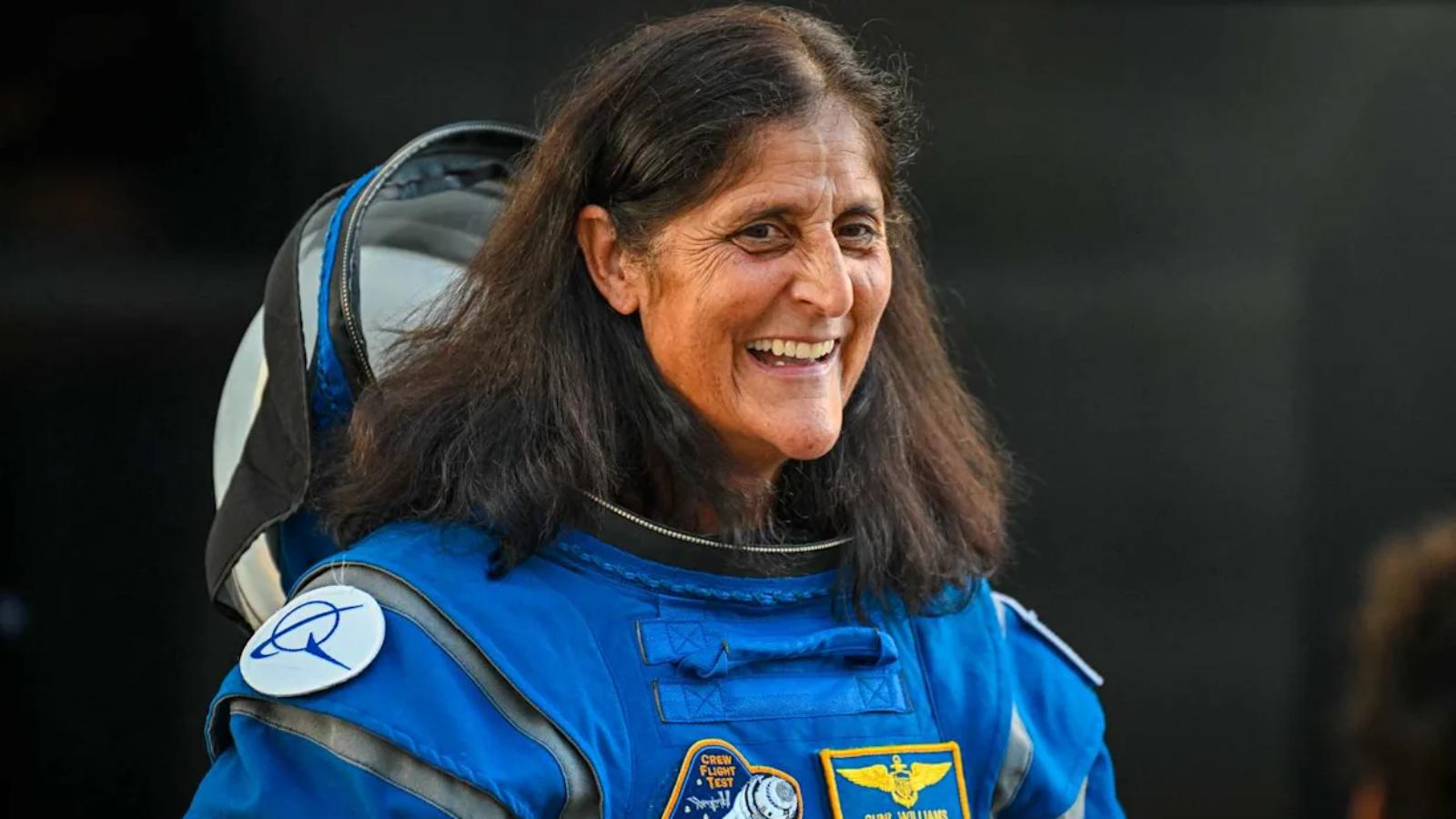
Suni Williams, a revered NASA astronaut and U.S. Navy captain, officially retired from the agency on December 27, 2025, concluding a distinguished 27-year career that saw her set multiple spaceflight records, including the most spacewalk time by a woman. Her departure comes less than a year after an unexpectedly extended stay aboard the International Space Station (ISS) during the inaugural crewed flight of Boeing’s Starliner spacecraft, marking the end of an era for one of America’s most accomplished space explorers.
A native of Needham, Massachusetts, Williams brought a formidable background to her space career. She earned a bachelor’s degree in physical science from the United States Naval Academy and a master’s degree in engineering management from the Florida Institute of Technology. Before joining NASA, Williams was a decorated U.S. Navy captain and test pilot, accumulating over 4,000 flight hours across 40 different aircraft. Her selection as a NASA astronaut in 1998 set her on a path to become one of the most experienced and respected figures in human spaceflight.
A Career Defined by Exploration and Records
Williams’s career at NASA was marked by three significant missions to the International Space Station, showcasing her exceptional skills and resilience. Her first journey into space began in December 2006, aboard the Space Shuttle Discovery as part of the STS-116 crew. During this mission, she served as a flight engineer for Expeditions 14 and 15, completing what was then a record-breaking four spacewalks. These early spacewalks demonstrated her proficiency in complex extravehicular activities, laying the groundwork for future achievements.
In 2012, Williams embarked on her second long-duration mission, launching from the Baikonur Cosmodrome in Kazakhstan for a 127-day stay aboard the ISS. She served as a member of Expeditions 32 and 33, notably taking command of the space station for Expedition 33. During this period, she performed an additional three spacewalks, undertaking critical repairs to a station radiator and replacing components essential for the station’s power systems. Across her career, Williams logged a total of 608 days in space, a remarkable feat that places her second only to Peggy Whitson among NASA astronauts for cumulative time spent off-Earth.
Among her numerous accolades, Williams holds a particularly impressive record: the most cumulative spacewalk time by any woman. In January 2025, she surpassed Peggy Whitson’s previous record, accumulating 62 hours and 6 minutes across nine spacewalks. This achievement places her fourth on the all-time cumulative spacewalk duration list, a testament to her endurance and technical expertise in the challenging environment of open space. Furthermore, she etched her name in history as the first person to run a marathon in space, an extraordinary demonstration of human capability and determination aboard the orbital outpost.
The Starliner Mission: An Unplanned Odyssey
Williams’s most recent mission, and ultimately her last with NASA, was the highly anticipated debut crewed flight test of Boeing’s Starliner capsule. This mission was a critical part of NASA’s Commercial Crew Program, which aims to diversify access to the International Space Station by contracting private companies to develop and operate their own spacecraft. SpaceX had already been successfully making routine trips to the ISS with its Dragon capsule since 2020, making the Starliner’s entry into service a significant milestone for Boeing.
In June 2024, Williams and fellow astronaut Butch Wilmore launched aboard the Starliner atop a United Launch Alliance Atlas V rocket from NASA’s Kennedy Space Center in Florida. The mission, initially planned to last about 10 days, was designed to test the spacecraft’s capabilities and certify it for regular crew transportation. However, the mission quickly encountered a series of unforeseen challenges that would ultimately extend their stay far beyond expectations.
Upon reaching the ISS, engineers discovered multiple helium leaks and problems with the Starliner’s propulsion system. These technical issues raised serious concerns about the spacecraft’s safety for a crewed return. After extensive evaluation, NASA ultimately determined that the troubled Starliner capsule was not safe enough to bring Williams and Wilmore back to Earth. In September 2024, the empty Starliner undocked from the ISS and made its way back for a parachute-assisted landing in the New Mexico desert, leaving the two astronauts in orbit.
Instead of launching an emergency mission to retrieve them, NASA opted to keep Williams and Wilmore at the station for several additional months, integrating them into Expeditions 71 and 72. During this extended period, which lasted 286 days, Williams even took command of Expedition 72. Despite the unplanned duration, both astronauts consistently pushed back against media narratives, including claims by President Donald Trump, that they were ‘stuck’ in space. They maintained that they were fully prepared and trained for a long-duration mission, understanding it was a possibility when flying on a test spacecraft like Starliner. Their unwavering professionalism under pressure earned widespread admiration.
Their prolonged stay concluded in March 2025 when they returned to Earth aboard a SpaceX Crew-9 Dragon capsule, making a water landing off the coast of Florida. This return via a different commercial spacecraft underscored the complexities and interdependencies within modern spaceflight. Wilmore had announced his own retirement from NASA just four months later, in August 2025, bringing an end to the active NASA careers of both Starliner pioneers.
A Legacy of Inspiration and Service
Williams’s retirement prompted an outpouring of praise from NASA leadership and colleagues, highlighting her profound impact on the agency and the future of space exploration. NASA Administrator Jared Isaacman commended her as a ‘trailblazer in human spaceflight,’ acknowledging her role in shaping exploration through her leadership on the space station and her contributions to commercial missions in low-Earth orbit. Vanessa Wyche, director of NASA’s Johnson Space Center, applauded Williams for being ‘a pioneering leader,’ while Scott Tingle, chief of the Astronaut Office, described her as ‘incredibly sharp, and an all-around great friend and colleague.’
In her own statement, Williams reflected on her career with deep gratitude and passion. She described her 27 years at NASA as an ‘incredible honor’ and expressed profound appreciation for the ‘wonderful love and support’ she received from her colleagues. ‘Anyone who knows me knows that space is my absolute favorite place to be,’ Williams said, emphasizing her awe for the International Space Station, its people, engineering, and science. She voiced hope that the foundation laid by her generation of explorers would make the ‘bold steps’ toward the Moon and Mars a little easier for those who follow.
Beyond her iconic spaceflights, Williams held numerous critical roles within NASA. She served as deputy chief of NASA’s Astronaut Office after her first flight and later as the director of Operations in Star City, Russia, following her second mission. Most recently, she played a vital role in establishing a helicopter training platform, an initiative designed to prepare future astronauts for the unique challenges of Moon landings. These diverse contributions underscore her commitment not only to flying in space but also to advancing the capabilities and safety of human spaceflight as a whole.
Williams’s retirement, alongside that of her Starliner crewmate Butch Wilmore, comes at a pivotal moment for human spaceflight. The burgeoning commercial space industry, exemplified by companies like SpaceX and Axiom Space, is opening new avenues for space travel, even for retired government astronauts. As USA Today reported, figures like Peggy Whitson have already returned to the ISS on private missions after their NASA retirements. Williams herself had hinted at considering a ‘next chapter of life’ in an interview with People magazine in September 2025, suggesting that her passion for space might yet lead her to new ventures beyond the civil sector.
The departure of Suni Williams from NASA marks a significant transition, symbolizing both the closing of an era for traditional government-led space exploration and the complex dawn of commercial spaceflight. Her unparalleled resilience during the Starliner mission’s unforeseen challenges, coupled with her record-setting spacewalks, underscores the invaluable human element in pushing the boundaries of what’s possible, even as new private ventures navigate their own developmental hurdles. Williams’s legacy will undoubtedly continue to inspire future generations to look beyond Earth, irrespective of the vehicles that carry them.