


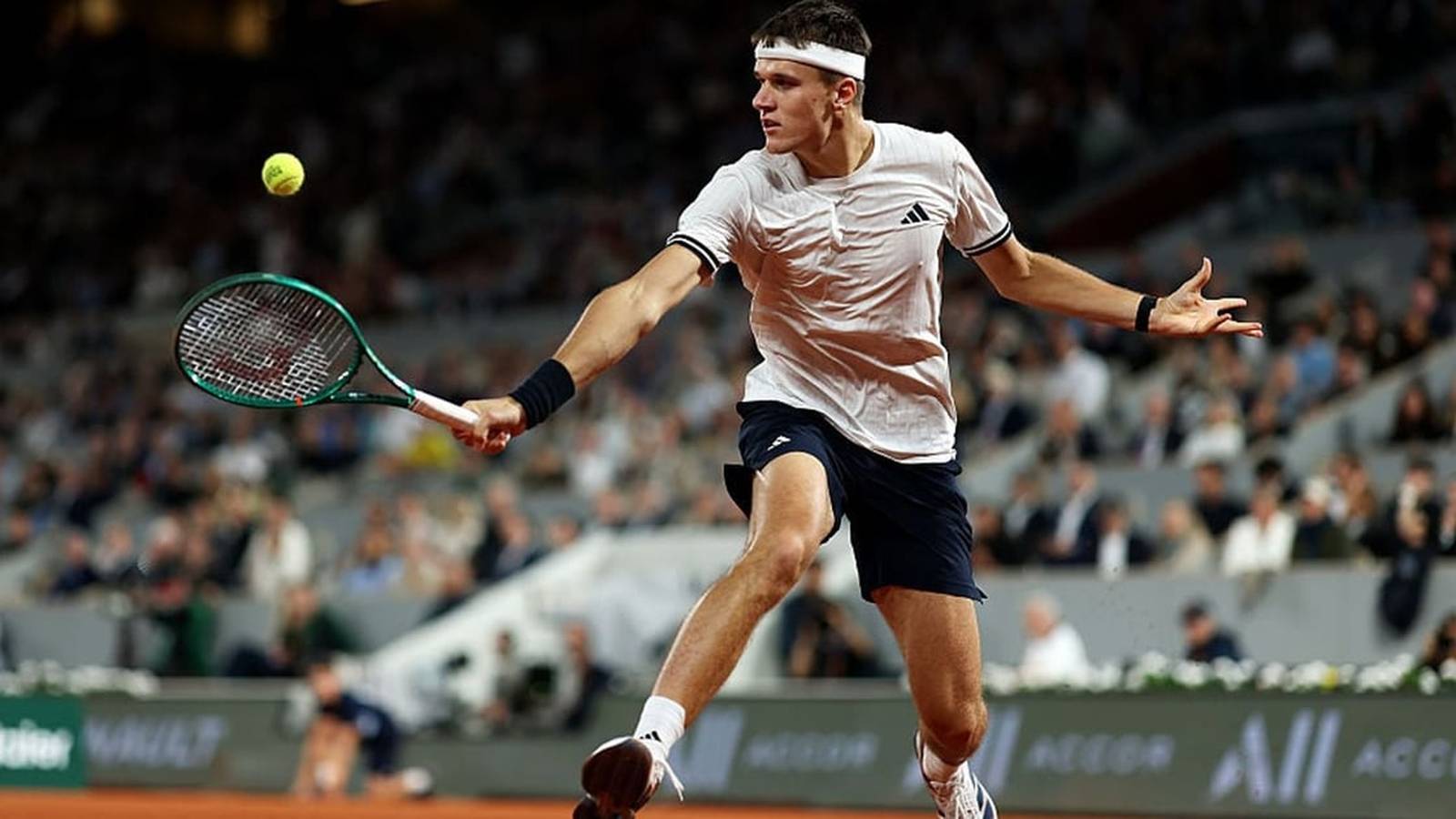
A Breakthrough Performance on Philippe-Chatrier
The 2026 French Open has reached a critical juncture, with the men’s singles bracket narrowing to its final four contenders. On Tuesday, June 2, Czech sensation Jakub Menšík cemented his status as a legitimate threat on the ATP Tour, securing a high-stakes victory against Brazil’s João Fonseca in the quarterfinals at Roland Garros. Menšík, currently ranked 27th in the world, dominated the early stages of the match, leveraging his superior serve and tactical consistency to establish a two-set lead.
The match, held during the tournament’s prestigious night session on Court Philippe-Chatrier, highlighted the generational shift currently taking place in professional tennis. Both Menšík and Fonseca, aged 20 and 19 respectively, entered the court as rising stars, yet it was the Czech player’s ability to remain composed under pressure that defined the contest. Despite a brief surge of momentum from Fonseca in the third set, Menšík’s defensive resilience proved too much for the Brazilian to overcome consistently.
Tactical Analysis and Match Dynamics
The tactical battle centered on the juxtaposition of styles: Fonseca’s explosive, high-velocity forehand against Menšík’s high-percentage serving game. According to match data, Menšík utilized his service motion to dictate points, frequently relying on aces to escape deuce situations. While Fonseca managed to break Menšík in the third set, the Czech player’s ability to stabilize his game—demonstrated by his proficiency in serve-and-volley transitions—allowed him to neutralize his opponent’s offensive threats.
Menšík’s progression into the semifinals marks a career-defining achievement. Prior to his breakout performance at the Australian Open in January, the young athlete had never progressed beyond the second week of a Grand Slam. His current trajectory suggests a significant advancement in both his physical conditioning and mental fortitude, essential attributes for navigating the grueling five-set format of clay-court tennis.
The Path to the Final
With this victory, Menšík advances to face No. 2 seed Alexander Zverev, who secured his own spot in the semifinals following a clinical straight-sets win over Rafael Jodar. The upcoming match against Zverev represents a formidable test, as the German veteran brings extensive experience in major tournament stages. For Menšík, the objective remains clear: maintain the structural integrity of his game while managing the heightened expectations that accompany a deep run in Paris.
The tournament has also served as a backdrop for the growing public profile of the sport’s emerging stars. Off-court, interest in Menšík’s personal life has mirrored his rise in the rankings, with social media engagement surrounding his camp—including the presence of partner Josefina Catino—underscoring the increasing media interest in the new generation of ATP players. However, as the competition intensifies, the primary focus for the Czech camp remains the tactical preparation required for the semifinal clash, where Menšík will look to continue his improbable ascent to the top of the sport.
The strategic maturity displayed by Menšík throughout this quarterfinal encounter suggests that his success is the result of a refined floor-level consistency rather than mere flashes of brilliance. By outlasting an aggressive but volatile opponent like Fonseca, Menšík has proven that he possesses the psychological discipline required for elite-level competition. As he pivots toward his encounter with Zverev, the primary challenge will be adjusting to the increased pace and defensive depth of a top-tier seed, a hurdle that will truly define his ceiling as a perennial Grand Slam contender.