


The $14.7 Million Renovation Failure
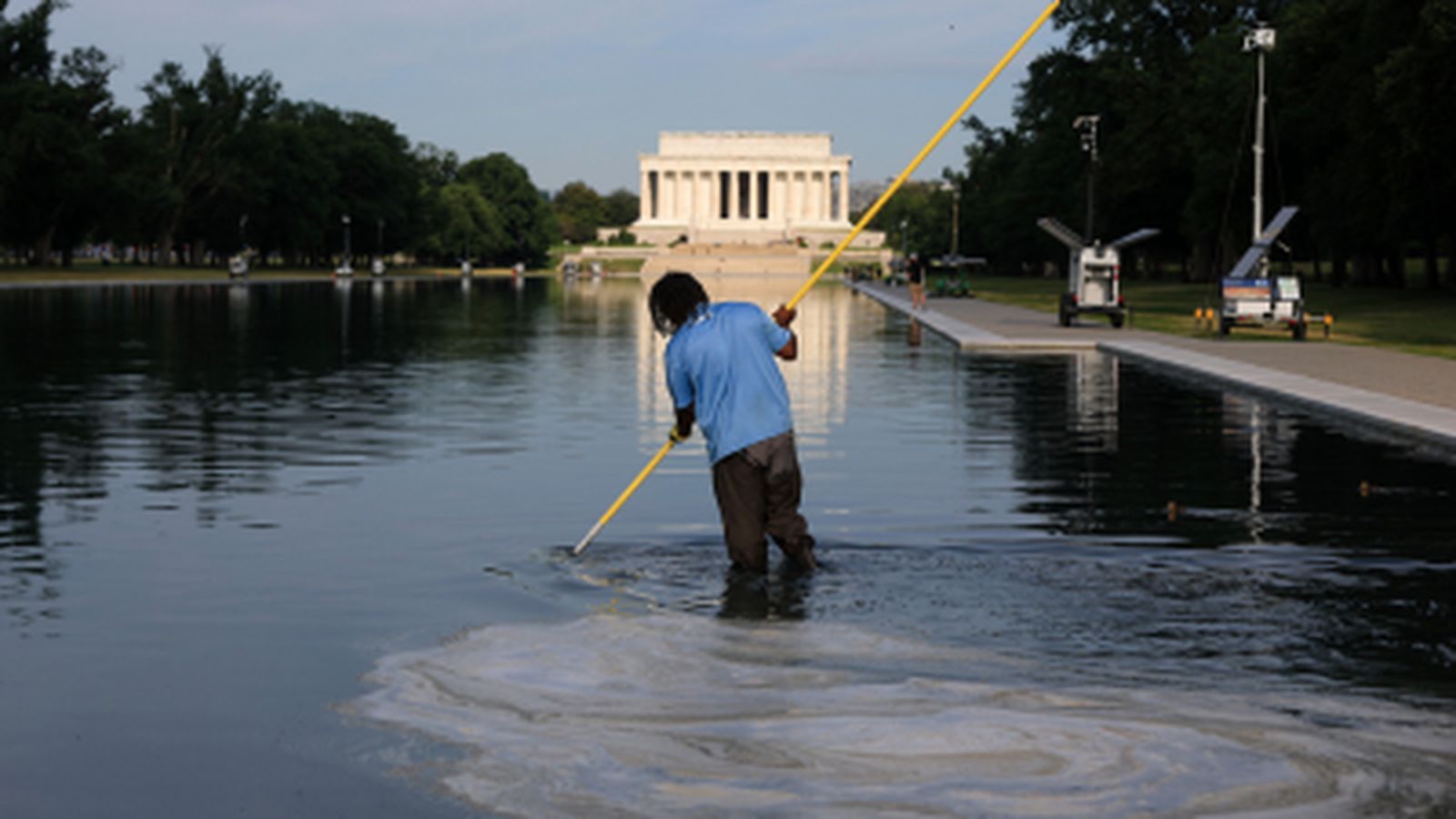
The Lincoln Memorial Reflecting Pool in Washington, D.C., is currently the center of a high-stakes controversy following the widespread peeling of its newly installed $14.7 million blue polyurea lining. The project, intended to modernize the century-old landmark in time for the nation’s 250th anniversary, has instead become a source of intense political and technical debate.
President Donald Trump has repeatedly attributed the damage to intentional vandalism, claiming that individuals used sharp instruments to cut the lining and introduced chemicals to spur algae growth. During a June 22 press event, the President described a “300-foot slit” through the liner, asserting that the damage was the result of deliberate sabotage.
The Department of the Interior has supported this narrative, citing a court filing from Frank Lands, Deputy Director of Operations for the National Park Service (NPS), which mentions damage to sealant and the disposal of approximately 70 fence post tops into the water. The White House has linked this to several arrests, though official details regarding the specific charges remain limited.
Technical and Environmental Perspectives
Conversely, experts in pool construction and waterproof coatings suggest that the failure may stem from structural and environmental factors rather than human interference. Steve Goodale, a swimming pool consultant, noted that improper surface preparation, moisture control, and chemical incompatibility are common causes for such systems to fail. Other specialists have pointed to the use of hydrogen peroxide—an agent used by the NPS to treat algae—as a potential contributor to the degradation of the pool’s synthetic coating.
Water quality experts, including Professor Steven Chapra of Tufts University, have also challenged the administration’s focus on vandalism. Chapra highlighted that the pool’s design—shallow, unshaded, and lacking water circulation—creates an ideal environment for algae, particularly when combined with a dark blue bottom that retains heat. He argued that these conditions, rather than illicit chemical dumping, likely explain the persistent algae issues.
Institutional Oversight and Future Outlook
The contract for the project, awarded on a no-bid basis to Atlantic Industrial Coatings, is now facing increased scrutiny. With the NPS planning to drain the pool after the July 4th celebrations to assess the underlying concrete and the extent of the lining damage, the focus is shifting toward the efficacy of the original renovation plan. Critics argue that the rush to meet a holiday deadline may have compromised necessary engineering standards, leaving a national monument in a state of visible disrepair.