
Quick Read
- Nativity scenes in US churches are increasingly used to comment on immigration and social justice.
- Displays depicting the Holy Family as refugees or targeted by ICE agents have sparked controversy and debate.
- The Vatican maintains the Nativity as a symbol of hope, focusing on tradition and messages of peace.
- Some faith leaders embrace political interpretations, while others call for unity and compassion.
- These evolving displays reflect broader tensions in society about faith, identity, and belonging.
Nativity Scenes: Where Faith Meets Protest
This December, the quiet serenity of the Nativity scene—Mary, Joseph, and the infant Jesus gathered in humble awe—has become a canvas for controversy and conversation across the United States and beyond. Once a simple symbol of hope and renewal, the Christmas creche now finds itself at the crossroads of faith, politics, and social justice, reflecting the tensions and aspirations of a deeply divided society.
Political Parables: The Holy Family as Refugees
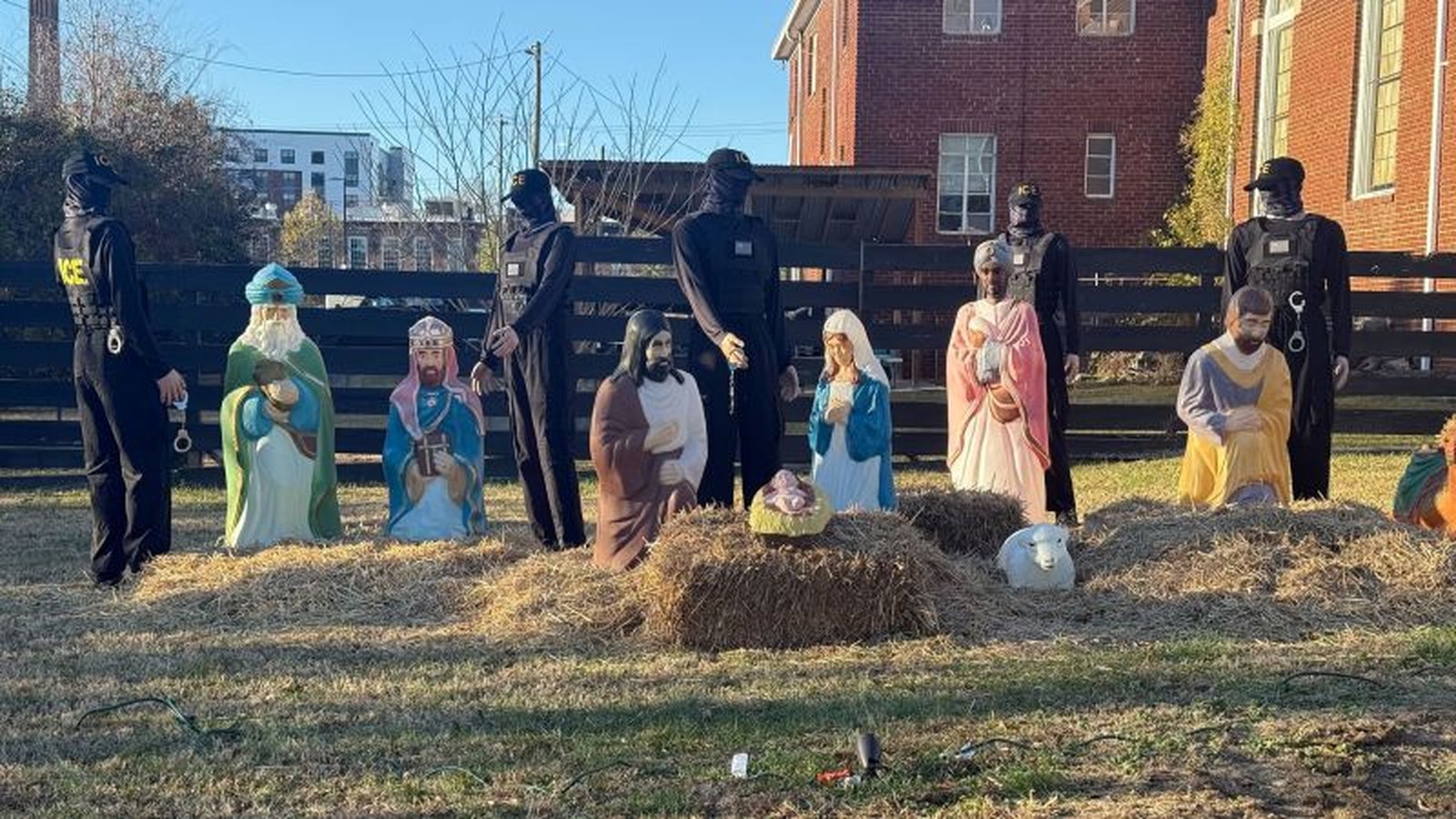
Outside Missiongathering Church in Charlotte, North Carolina, the traditional Nativity tableau has been dramatically reimagined. Alongside the familiar holy figures, tall men in black, their faces obscured and vests labeled ‘ICE’—the acronym for Immigration and Customs Enforcement—loom over the Holy Family, handcuffs in hand. It’s a jarring image, one meant to disturb. Pastor Andrew Shipley, who helped create the display in partnership with a local art collective, explains that discomfort is the point. “It’s supposed to be disturbing because what’s happening in our city is disturbing,” Shipley told CNN. “To me, the story of the Nativity is the story of God coming into the world through humble folks; state violence was visited upon them, and they had to flee as refugees to Egypt.”
The message is clear: the ancient story of Jesus, Mary, and Joseph fleeing Herod’s violence resonates with the plight of today’s migrants and asylum seekers. The allusion is not without controversy. Shortly after the installation, a man stormed onto the church grounds, toppling the ICE effigies in outrage, labeling the scene “disgusting.” Yet Shipley remains undeterred, viewing the display as a “faithful Biblical witness”—a parable for our times, even if it unsettles some believers.
From Charlotte to Dallas: A National Conversation
Charlotte is not alone. In Dallas, the Oak Lawn United Methodist Church drew attention with a Nativity scene depicting the Holy Family as modern-day immigrants behind a barbed wire fence. Signs around the display read, “Holy is the refugee” and “Holy are the profiled and patrolled.” Associate Pastor Isabel Marquez described the installation as an intentional reflection of current realities: “It is a way to say what is a reality happening here for many people.” Inside the church, another message asks: “ICE was here. Where are Mary, Joseph, and Jesus?” This bold commentary, set against the backdrop of a rainbow-painted stairway—recently at the center of a local political dispute—invites passersby to consider the intersection of faith, identity, and justice.
Opinions are divided. Some locals praise the church for its courage in addressing urgent social issues, while others call the display “a bit bold” or question its appropriateness. Yet, as Sean Garman, a nearby resident, told Fox 4 News: “I think it is a really good commentary on the political issues at hand right now at the border and immigrants being arrested without due process.”
Tradition and Tension: The Vatican’s Message of Hope
While American churches grapple with the political implications of the Nativity, the Vatican continues to emphasize the creche as a universal sign of hope. This year, Pope Leo XIV invited Catholics to reflect on the deeper meaning behind Nativity scenes and Christmas trees. At a ceremony in St. Peter’s Square, the Pope called the Nativity and tree “signs of faith and hope,” urging believers to “eliminate hatred from our hearts.” The Vatican’s 2025 Nativity scene, crafted by artists from a diocese near the Amalfi coast, features local agricultural offerings—tomatoes, walnuts, spring onions, and artichokes—symbolizing both tradition and community.
The Pope’s message, reported by the US Conference of Catholic Bishops and Vatican News, is clear: let the tenderness of the Christ child “illuminate our lives” and inspire peace and fraternity. The Christmas tree, an 82-foot Norway spruce, will later be repurposed for charity, its essential oils extracted and wood donated. In this way, the Vatican links ancient ritual to contemporary acts of generosity and environmental stewardship.
Divided Pulpits, Divided Society
The use of the Nativity as a platform for social commentary is not without detractors. In Massachusetts, the Archdiocese of Boston requested that St. Susanna’s Catholic Church remove a Nativity scene featuring a sign proclaiming “ICE WAS HERE.” The parish pastor, Father Steve Josoma, refused, arguing that the display is consistent with biblical themes. Over the years, St. Susanna’s has used its creche to comment on issues from gun violence to climate change. For Josoma, the controversy is “a reflection of our polarized society.” He told CNN that disagreement does not make the display sacrilegious: “That some do not agree with our message does not render our display sacrilegious or as the cause of any scandal to the faithful.”
Other religious leaders, such as Rev. Dr. Scott Suskovic of Christ Lutheran Church in Charlotte, urge a more measured approach. Suskovic, who has traditionally avoided political sermons, felt compelled to address his congregation about the tension between “the laws of man and the Gospel.” He writes, “We have one foot in the state, but we also have one foot in the Kingdom of God.” For him, the lesson of the Nativity is not in taking sides, but in embracing compassion alongside respect for the law. “If we disagree, let us do so in love,” he reminds his flock.
Nativity as a Mirror: What Do We See?
Historian and Anglican priest Andrew McGowan of Yale’s Berkeley Divinity School points out that the Christmas story is often sanitized—reduced to scenes of comfort and joy, omitting the violence and displacement at its heart. “The parallel being made here is not just that ICE shows up to anybody’s home … it’s specifically the idea of the Holy Family themselves being refugees,” he explains. For McGowan, acknowledging the struggle and suffering embedded in the Nativity narrative can make the story more powerful and relevant. “Being honest about what people are struggling with—as well as being honest about the aspect of struggle and suffering in the ancient story—makes (the Nativity) more powerful and helps us to know why we need to hear the story again.”
From Charlotte to Dallas, from the Vatican to local parishes, the Nativity scene has become a mirror in which society sees its own anxieties, hopes, and divisions reflected. For some, it’s a call to activism; for others, a reminder to seek unity and peace. And for many, it’s a source of comfort in a world still searching for room at the inn.
The evolving use of Nativity scenes—whether as bold protest or as traditional sign of hope—reveals the enduring power of sacred symbols to provoke debate and inspire action. As faith communities wrestle with how best to witness their values in public, the Nativity’s story of vulnerability, refuge, and resilience remains a touchstone, inviting each generation to find new meaning in an ancient tale.