
Quick Read
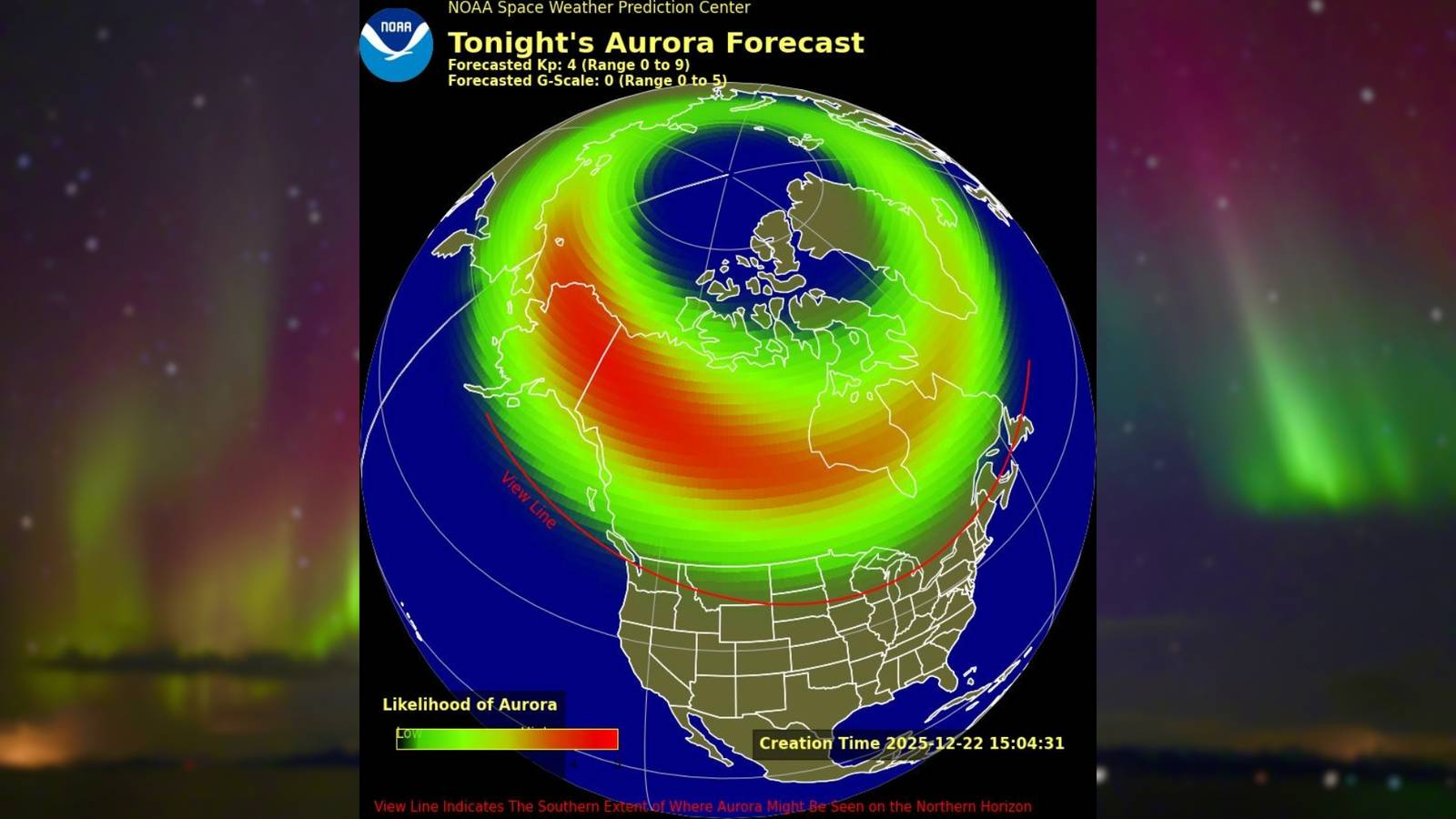
- Northern lights may be visible tonight across 10 US states due to a minor geomagnetic storm.
- Best viewing times are between 10 p.m. and 2 a.m. local time, with the event continuing through December 24.
- Experts recommend seeking dark, north-facing locations and using phone cameras to spot faint auroras.
Geomagnetic Storm Sparks Aurora Chances Across 10 States
Tonight, the northern lights are set to potentially grace the skies above parts of the United States in a rare, festive-season display. Forecasters at the National Oceanic and Atmospheric Administration’s (NOAA) Space Weather Prediction Center have issued a minor geomagnetic storm alert, raising hopes for aurora sightings from Alaska to Idaho and beyond. This atmospheric phenomenon, known as Aurora Borealis, is being driven by a speedy solar wind buffeting Earth’s magnetic field—a result of a recent coronal mass ejection that passed by our planet on December 20, as confirmed by USA Today.
The forecast, echoed by multiple outlets including Space.com and The Economic Times, suggests that the geomagnetic activity may persist through December 24, offering several nights of opportunity for those eager to witness the lights. For many, this could become an unforgettable pre-Christmas spectacle.
Where Can You See the Northern Lights?
Based on the latest NOAA aurora forecast map, the following 10 states are fully or partially positioned above the aurora viewing line tonight:
- Alaska
- Washington
- North Dakota
- Minnesota
- Montana
- Maine
- Michigan
- Wisconsin
- South Dakota
- Idaho
While forecasts are promising, auroras are notoriously unpredictable. Strengthening conditions or exceptionally clear skies could allow the lights to reach even farther south than expected. But as every aurora hunter knows, the experience can be a “nothing burger” if the elements don’t align. The only certainty is uncertainty—making the chase all the more thrilling.
When and How to Watch: Timing and Expert Tips
According to NOAA and as reported by Yahoo News, the optimal window for viewing the northern lights tonight falls between 10 p.m. and 2 a.m. local time. Some forecasts indicate that minor geomagnetic storming (G1 level) could begin as early as 4 p.m. EST (2100 GMT), but the best chance remains during the darkest hours.
To maximize your chances:
- Seek a north-facing vantage point with an unobstructed view of the northern horizon.
- Escape city lights—light pollution is the aurora’s biggest adversary.
- Let your eyes adjust to the dark for at least 30 minutes; night vision is your friend.
- Use your phone’s camera to scan the sky. Even faint auroras invisible to the naked eye can show up in photos.
- Dress warmly and be prepared to wait—patience pays off when chasing celestial wonders.
For real-time updates, download a space weather app such as “My Aurora Forecast & Alerts” or “Space Weather Live,” both available on iOS and Android. These tools provide location-specific forecasts and alert you if conditions improve, giving you a tactical edge in the hunt.
The Science Behind the Show
This week’s auroral activity is fueled by a combination of fast solar wind from an Earth-facing coronal hole and a coronal mass ejection—a massive burst of plasma and magnetic fields from the sun’s corona. As these charged particles collide with Earth’s atmosphere, they energize oxygen and nitrogen molecules, releasing photons that paint the night sky in dazzling shades of green, pink, and sometimes red or purple.
While geomagnetic storms are classified on a scale from G1 (minor) to G5 (extreme), tonight’s event sits at the lower end. Still, even a minor storm can produce dramatic auroral displays if atmospheric conditions cooperate. The unpredictability is part of the magic—no two nights are ever the same.
Holiday Season Astrotourism: A Community Affair
The timing of this auroral forecast couldn’t be better for holiday travelers and families looking to add a cosmic twist to their celebrations. From seasoned photographers to first-time skywatchers, the northern lights inspire awe and connection, drawing communities together under the same shimmering canopy. As Daisy Dobrijevic, space science communicator and passionate aurora chaser, notes: “Part of the fun of aurora hunting is the chase. You won’t want to miss the show when it starts!” (Space.com).
Whether you’re bundled up in Alaska or watching from a farm in Wisconsin, tonight’s forecast is a reminder to look up—and to share the wonder with those around you.
Tonight’s northern lights forecast is a vivid example of how science, nature, and human curiosity converge. The aurora’s unpredictability is its greatest allure: it invites us to step outside, connect with the cosmos, and experience a moment of awe. Even if the skies remain quiet, the chase itself becomes a story worth telling.