
Quick Read
- OpenAI launched AgentKit at DevDay 2025, enabling fast AI agent creation.
- AgentKit offers visual workflow design, connector registry, and safety guardrails.
- Agents can be built and deployed in minutes, even by non-experts.
- Enterprises like Klarna and Ramp report significant efficiency gains.
- AgentKit includes evaluation tools and supports integration with OpenAI’s broader ecosystem.
AgentKit Launches: A New Era for AI Agent Development
In a landmark moment for artificial intelligence, OpenAI has unveiled AgentKit, a comprehensive toolkit designed to empower developers and enterprises to create, deploy, and optimize AI agents with unprecedented speed and simplicity. The announcement, made during OpenAI’s DevDay 2025 in San Francisco, marks a significant shift in how digital workflows are built and managed, moving away from fragmented, time-consuming processes to a streamlined, visual-first approach.
For years, building AI agents meant wrangling disparate tools, custom connectors, and manual coding. Developers had to manage complex orchestration, prompt tuning, and evaluation pipelines, often stretching projects over months. AgentKit changes the narrative, offering a suite of integrated features that cut development time from quarters to sprints. As Sam Altman, OpenAI CEO, summarized during his keynote, “Software used to take months or years to build. You saw that it can take minutes now to build with AI. You don’t need a huge team. You need a good idea, and you can just sort of bring it to reality faster than ever before.” (CNBC)
Core Features: Visual Workflow, Connector Registry, and Guardrails
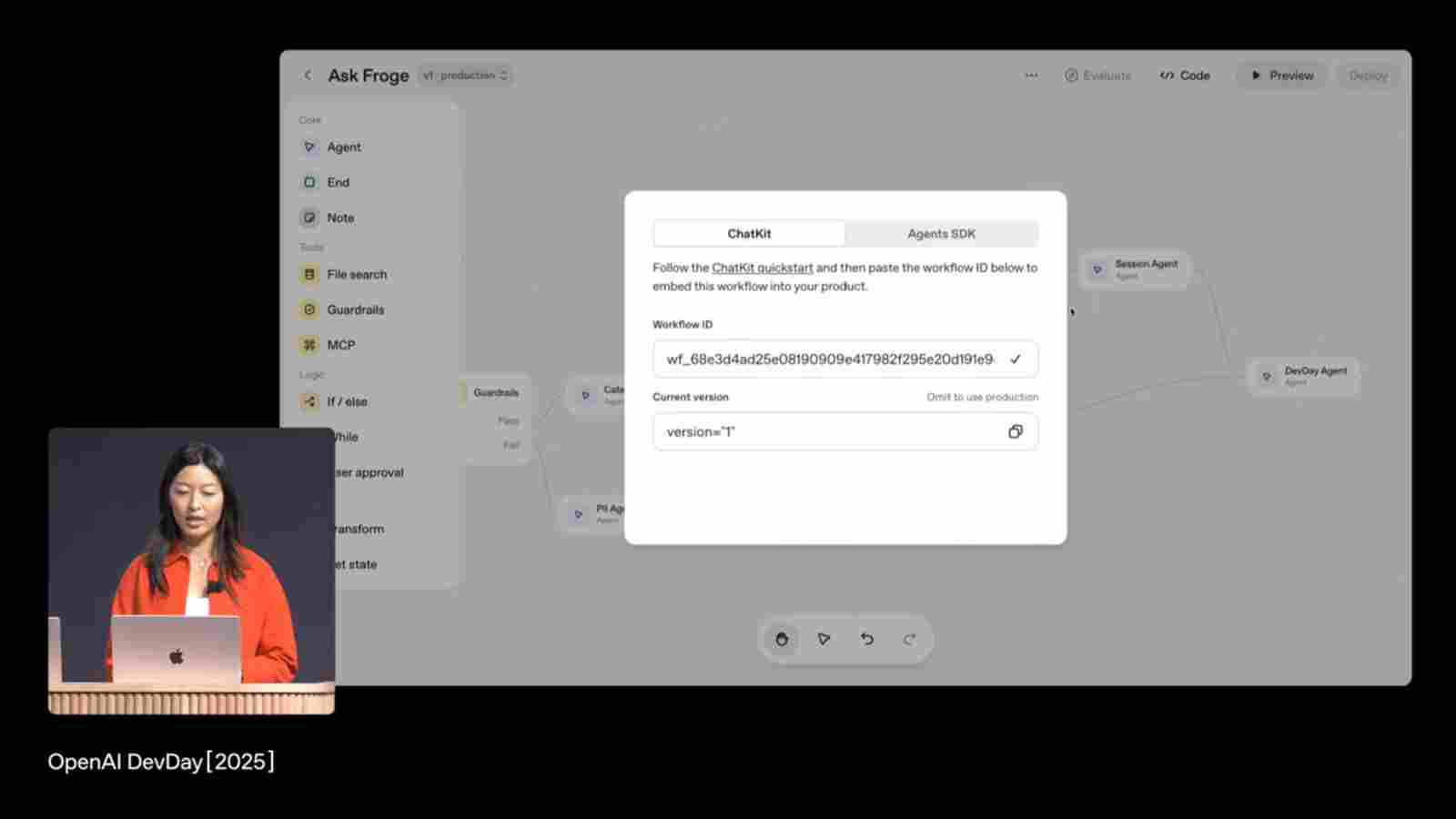
At the heart of AgentKit is the Agent Builder, a visual canvas that allows users to design and version multi-agent workflows with drag-and-drop simplicity. Whether starting from scratch or using prebuilt templates, developers can connect tools, set up custom logic, and preview runs—all within a unified interface. This means product managers, engineers, and legal teams can collaborate in real time, dramatically accelerating iteration cycles.
The Connector Registry centralizes data management, enabling admins to govern how data and tools connect across OpenAI products and third-party services. Enterprises can now consolidate data sources like Dropbox, Google Drive, SharePoint, and Microsoft Teams in a single admin panel, streamlining integration and oversight.
Safety remains a top priority. AgentKit introduces Guardrails, an open-modular safety layer that helps protect agents against unintended or malicious behavior. These guardrails can mask or flag personally identifiable information (PII), detect jailbreaks, and apply other customizable safeguards, supporting responsible AI deployment.
Live Demo: Building Agents in Minutes, Not Months
During the DevDay event, OpenAI’s Christina Huang provided a live demonstration of AgentKit’s capabilities, building an AI agent in just eight minutes—finishing with nearly a minute to spare. The demo showcased how the Agent Builder could convert the event’s schedule into an actionable agentic experience, add guardrails for privacy, and deploy the agent live for attendees to use. Huang emphasized the platform’s flexibility: agents could be further tweaked and refined within the builder, allowing for ongoing optimization and customization. (ZDNET)
This agility isn’t just theoretical. Companies like Ramp and LY Corporation have already slashed development cycles by 70%, going from a blank canvas to a live buyer agent in hours instead of months. Enterprises are leveraging AgentKit to orchestrate complex workflows, integrate with existing systems, and collaborate across teams—all while maintaining clear versioning and safety controls. (OpenAI)
AgentKit in the Real World: From Support to Sales
AgentKit isn’t just for tech giants. Its accessible design is enabling a diverse range of users to innovate. Klarna, for instance, built a support agent that now handles two-thirds of all customer tickets, freeing human staff for higher-value tasks. Clay used AgentKit to scale their sales operations, reporting a tenfold growth in efficiency.
Perhaps most striking is how AgentKit is democratizing app creation. Altman highlighted stories from DevDay, including an 89-year-old Japanese developer who built 11 iPhone apps for seniors and medical students who created patient simulation tools. “Anyone with an idea can build apps for themselves,” Altman noted. The implication is clear: expertise in coding is no longer a barrier to entry—creativity and problem-solving are what matter most.
Integration, Evaluation, and the Road Ahead
AgentKit builds on OpenAI’s Responses API and Agents SDK, which have already seen widespread adoption in research and enterprise settings. With new evaluation features—such as datasets, trace grading, automated prompt optimization, and support for third-party models—developers can measure and improve agent performance more rigorously than ever before.
The platform also integrates seamlessly with other OpenAI offerings. ChatKit allows developers to embed customizable, chat-based agent experiences into their products, maintaining brand identity and unique workflows. The broader Apps SDK, unveiled alongside AgentKit, gives developers access to the full stack within ChatGPT, supporting deep integrations with consumer and enterprise applications.
OpenAI’s approach is one of continuous investment and growth. Altman made it clear that profitability is not the immediate concern; the focus is on building robust tools and fostering innovation. “We are confident we can build a very profitable model,” he said, “but the rational thing to do is to just be willing to run the loss for quite a while.” (CNBC)
Transforming Software Development: The Human Impact
The release of AgentKit signals a broader shift in the software industry. Coding, once the domain of large, specialized teams, is becoming more accessible to individuals and small groups. The tools are designed not just for efficiency but for collaboration, iteration, and creative exploration. As demonstrated at DevDay, developers now have the means to build, test, and deploy sophisticated agents in a matter of minutes.
This democratization of AI agent creation is poised to transform industries ranging from customer support and education to healthcare and logistics. By lowering barriers and simplifying complex workflows, AgentKit empowers anyone with a vision to bring their ideas to life—fast, safely, and at scale.
Looking Forward: Challenges and Opportunities
While the promise of AgentKit is significant, challenges remain. Responsible deployment, data governance, and ethical considerations are crucial, especially as agents become more autonomous and integrated into sensitive workflows. OpenAI’s emphasis on guardrails and evaluation tools reflects an understanding that AI’s impact must be managed thoughtfully and transparently.
For developers and enterprises, the opportunity is clear: leverage AgentKit to unlock new efficiencies, build innovative solutions, and participate in the rapidly evolving landscape of AI-powered automation. With support for third-party models and robust evaluation mechanisms, AgentKit is positioned to become a central hub for agentic workflows in the years ahead.
AgentKit’s arrival marks a turning point—not just in technical capability, but in who gets to participate in building the future. By making agent development faster, safer, and more accessible, OpenAI is inviting a broader spectrum of creators to the table. The story here isn’t just about smarter software; it’s about empowering more people to solve real-world problems with AI.