


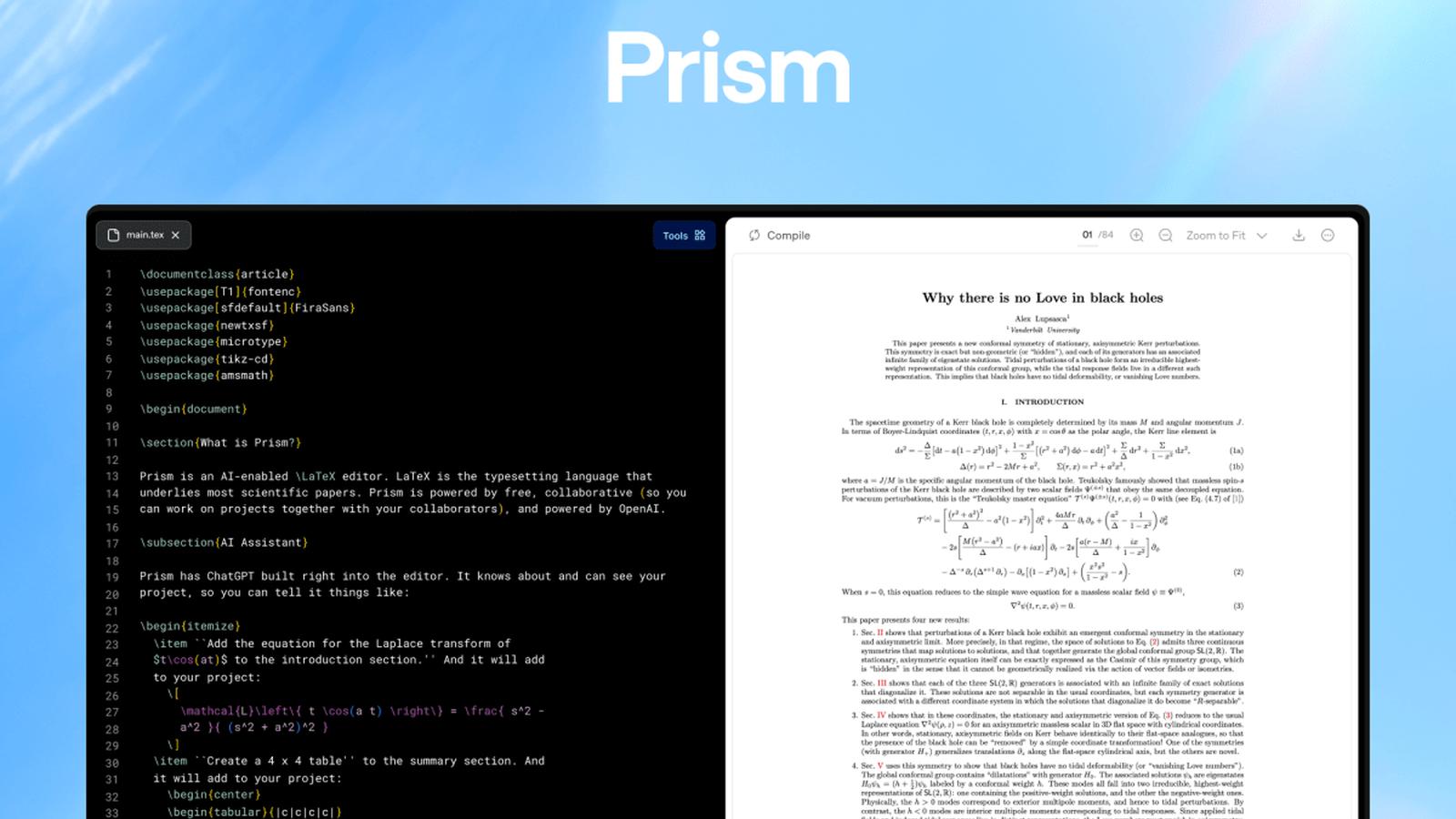
SAN FRANCISCO (Azat TV) – OpenAI officially launched Prism on January 28, 2026, a new, free, AI-native cloud-based workspace specifically designed for scientists to streamline research writing, data synthesis, and collaboration. Powered by the advanced GPT-5.2 architecture, Prism aims to centralize fragmented academic workflows, from drafting papers to managing citations, marking a significant strategic pivot for OpenAI towards domain-specific artificial intelligence applications.
The introduction of Prism represents OpenAI’s ambition to move beyond general-purpose chatbots and offer specialized tools that integrate AI directly into professional workflows. The platform is engineered to automate tedious tasks like LaTeX typesetting, literature citation, and converting raw research into publication-ready papers with GPT-5.2’s precision. Kevin Weil, OpenAI’s Vice President of Science, highlighted the company’s vision, stating, “Our view is that the right response is not to keep AI at arm’s length or let it operate invisibly in the background; it’s to integrate it directly into scientific workflows in ways that preserve accountability and keep researchers in control.”
Unifying the Scientific Workflow
Prism addresses a long-standing challenge in scientific research: the reliance on disparate tools for different stages of paper production. Researchers often switch between word processors, PDF viewers, LaTeX compilers, reference managers, and separate AI chat interfaces. OpenAI’s new platform unifies these elements into a single, cloud-based, LaTeX-native environment.
At its core, Prism integrates GPT-5.2 directly into the project itself, granting the AI model access to the paper’s structure, equations, references, and surrounding context. This deep integration allows for capabilities such as drafting and revising papers with full contextual awareness, exploring ideas, testing hypotheses, and reasoning through complex problems in real-time. During a press demonstration, Prism showcased its ability to convert rough whiteboard sketches into publication-quality diagrams and automatically generate bibliographies by scouring relevant literature, according to MobileAppDaily.
Technology and Strategic Vision
Underpinning Prism’s capabilities is the GPT-5.2 architecture, including its specialized “Thinking” variant, which OpenAI describes as its most capable model yet for mathematical and scientific reasoning. This advanced model allows users to engage in real-time problem-solving and hypothesis testing directly within the workspace. The development of Prism also incorporated the technology from Crixet, a cloud-based LaTeX platform that OpenAI acquired, seamlessly integrating its core functionalities into the new ecosystem.
OpenAI’s strategic intent with Prism is clear: to establish itself as the foundational “operating system” for modern scientific research. The company noted that ChatGPT already processes an average of 8.4 million messages per week on advanced scientific topics, indicating a significant existing demand for AI assistance in this domain. By offering Prism free for all personal ChatGPT account holders, OpenAI aims to rapidly capture market share and make high-quality scientific tools broadly accessible, thereby enabling more researchers across various institutions and career stages to participate fully in the scientific process, as reported by NDTV Profit.
Availability and Human Oversight
Prism is immediately available for free to anyone with a personal ChatGPT account, offering unlimited projects and co-authors without subscription requirements or seat limits. OpenAI has confirmed plans to extend access soon to organizations utilizing ChatGPT Business, Enterprise, and Education plans. This accessible entry point is a bold move to democratize sophisticated research tools.
Despite the powerful automation offered, OpenAI emphasizes the critical role of human oversight. Kevin Weil reiterated this during the launch, stating, “None of this absolves the scientist of the responsibility to verify that their references are correct, but it can certainly speed up the process.” The platform is designed to assist and accelerate, not to replace, human ingenuity and verification in the research process. It features a “Research Window” that maintains the full context of a project, preventing the “memory loss” common in earlier large language models, ensuring researchers remain in control and accountable for the output.
The launch of Prism signals a crucial evolution in AI’s application, moving from generalized assistance to highly specialized, workflow-integrated tools. By making such advanced capabilities freely available to individual researchers, OpenAI is not only enhancing productivity but also potentially lowering barriers to entry for scientific publishing, fostering a more collaborative and efficient global research landscape.