


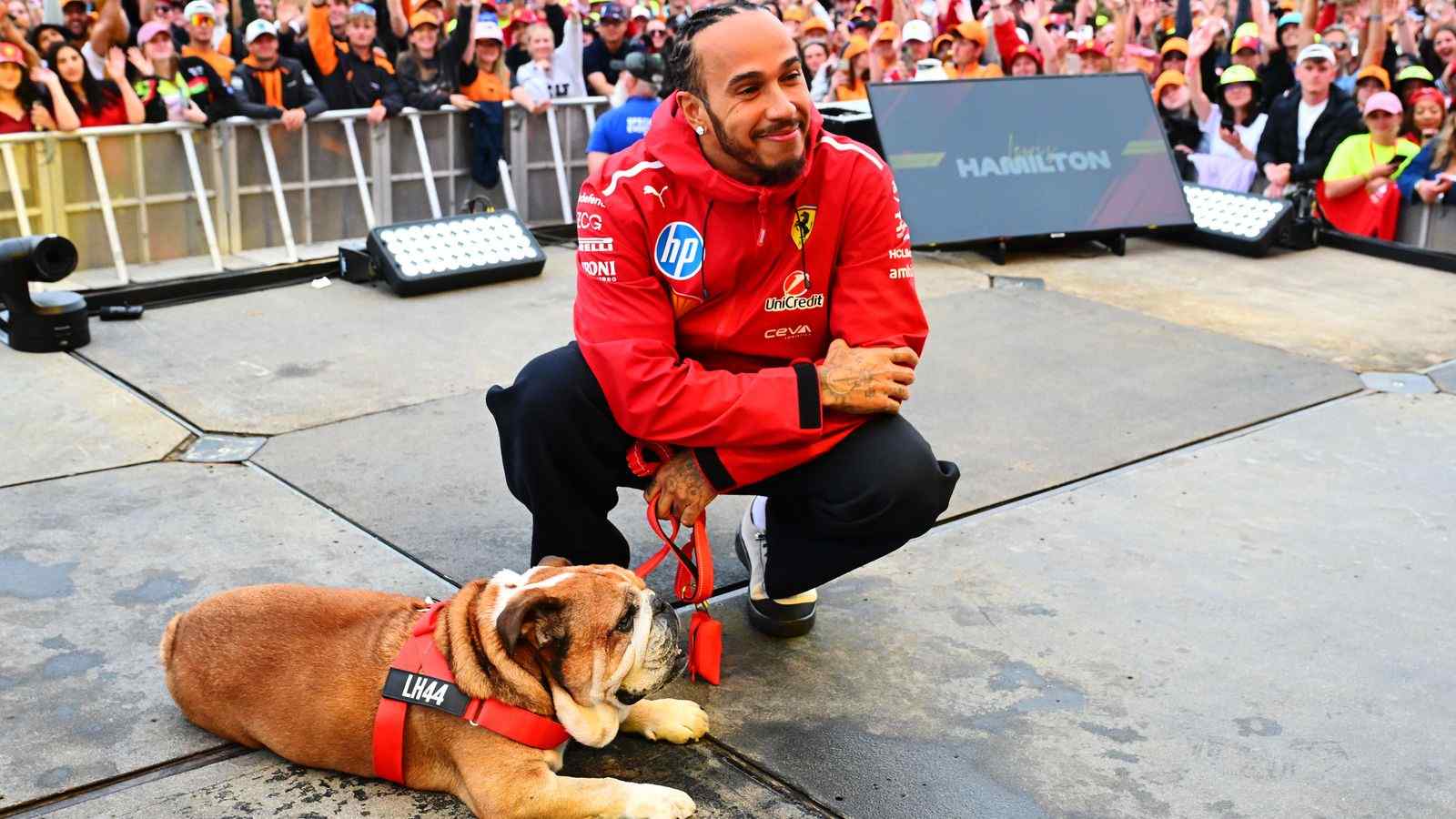
Roscoe’s Final Battle: A Story of Devotion and Loss
On a quiet Sunday evening, the Formula 1 world lost one of its most beloved and unlikely stars. Roscoe, the English bulldog who for over a decade walked paddocks and charmed fans alongside his owner, seven-time world champion Lewis Hamilton, died at the age of 12. His passing marks not just the end of an era for Hamilton, but for the entire motorsport community, which had come to embrace Roscoe as a symbol of warmth and loyalty in the high-octane world of racing.
Hamilton broke the news through a deeply personal post on Instagram. After days of fighting pneumonia and enduring life support, Roscoe died in Hamilton’s arms. “After four days on life support, fighting with every bit of strength he had, I had to make the hardest decision of my life and say goodbye to Roscoe,” Hamilton wrote. “He never stopped fighting, right until the very end. I feel so grateful and honoured to have shared my life with such a beautiful soul, an angel and true friend.”
For Hamilton, Roscoe was more than a pet. He was family, a confidant, and a steady presence through the turbulence of F1 glory and heartbreak. Bringing Roscoe into his life in 2013, at the very start of his transformative move to Mercedes, was, as Hamilton often said, “the best decision I ever made.” Together, they navigated a period that would see Hamilton rise to become one of the greatest drivers in the sport’s history, collecting six world championships with Mercedes, and, more recently, beginning a new chapter at Ferrari.
A Fixture in the Paddock: Roscoe’s Unique Place in Formula 1
Roscoe’s story is woven into the fabric of the modern Formula 1 paddock. From the moment Hamilton adopted him—at just eight weeks old—the bulldog’s presence became an unmistakable part of race weekends. In the tense, competitive air of F1, Roscoe was a calming force. He trotted beside Hamilton on race days, lounged in team hospitality, and offered a friendly face to drivers, engineers, and fans alike.
Unlike most drivers’ pets, Roscoe was a true paddock regular. His Instagram account, @roscoelovescoco, a tribute to his late sister Coco, amassed over 1.4 million followers. Roscoe’s fame was such that his appearances at grands prix often generated as much buzz as the drivers themselves. Social media was peppered with photos of Roscoe wearing headphones, napping in the garage, or posing next to trophies. For Hamilton, who once said on “Hot Ones” that Roscoe’s temperament was “just chill from the get-go,” the dog’s steady nature was both a comfort and a point of pride. “He never chewed anything. He was just the easiest dog,” Hamilton reflected.
Roscoe’s constant presence was all the more remarkable given the intensity of the F1 environment. While other drivers, like Max Verstappen and Pierre Gasly, keep their pets away from the chaos of the paddock, Hamilton made it a priority to bring Roscoe along, especially as the dog grew older. “I try to take him to as many as possible, because Roscoe’s getting old,” Hamilton said in 2021. “And I don’t know how long I’ll have him around. So, I’m trying to keep him with me everywhere.”
Health Struggles and the Pain of Goodbye
Roscoe’s journey wasn’t without its challenges. As an English bulldog, he faced chronic health problems—a reality Hamilton was acutely aware of. According to a 2022 study by The Royal Veterinary College, English Bulldogs in the UK are more than twice as likely to have health issues as other breeds, with particular vulnerability to breathing difficulties, skin conditions, and joint problems (BBC Sport). Hamilton often spoke candidly about these issues, describing how Roscoe struggled with breathing and walking, especially in his later years.
When Roscoe developed pneumonia in late September, the situation quickly became critical. Hamilton skipped a key Pirelli tire test at Mugello to remain by his side, a decision Ferrari fully supported, with reserve driver Zhou Guanyu stepping in for the test (The Athletic). Despite intensive care and sedation, Roscoe’s heart stopped during medical checks. Hamilton faced the agonizing choice of ending treatment after four days on life support. “It is one of the most painful experiences and I feel a deep connection to everyone who has gone through the loss of a beloved pet,” Hamilton wrote. “Although it was so hard, having him was one of the most beautiful parts of life—to love so deeply and to be loved in return.”
Roscoe’s death also brought back memories of Coco, Hamilton’s other English bulldog, who died in 2020 due to heart problems. The two dogs had been inseparable, traveling together to races and sharing the limelight. Their bond, and the grief of their loss, is something Hamilton has shared with millions of fans, many of whom have also experienced the deep pain of losing a pet.
Legacy: A Canine Star and a Lasting Bond
Roscoe’s impact reached far beyond the confines of the F1 paddock. He became a symbol of companionship and unconditional love, resonating with fans around the world. Hamilton frequently thanked supporters for the outpouring of affection for Roscoe, noting how special it was to “witness and feel” the collective support.
Roscoe’s story is also a reminder of the unique human-animal bonds that transcend sport, celebrity, and culture. His presence softened the image of Formula 1, reminding everyone that beneath the helmets and behind the engineering marvels, there are stories of love, friendship, and loss that connect us all. As Hamilton returns to the track—still searching for his first podium with Ferrari—he does so with the memory of Roscoe at his side, carrying forward the lessons of loyalty and resilience that defined their time together.
In a season marked by transition and challenge, Roscoe’s absence will be deeply felt. But his legacy—one of joy, comfort, and steadfast companionship—will endure, both in the heart of his owner and in the collective memory of the sport.
Roscoe’s journey stands as a poignant testament to the profound bonds we form with our animal companions. In the relentless world of Formula 1, his gentle presence offered a rare glimpse of vulnerability and humanity. Hamilton’s openness about his grief underscores a universal truth: love and loss are inseparable, and even in the world’s fastest sport, it’s the slow, steady companionship of a loyal friend that leaves the deepest mark.