
Quick Read
- Russian air attacks on Kyiv and Kharkiv killed one person and injured 23 others.
- Nearly 6,000 homes in Kyiv are without heating, and 60% of the capital lacks electricity.
- Peace talks between Russia, Ukraine, and the U.S. are ongoing in Abu Dhabi.
- Russia demands Ukraine withdraw from all of Donbas, citing a ‘very important condition’ for peace.
- The Pentagon’s 2026 National Defense Strategy labels Russia a ‘persistent but manageable threat’ to NATO.
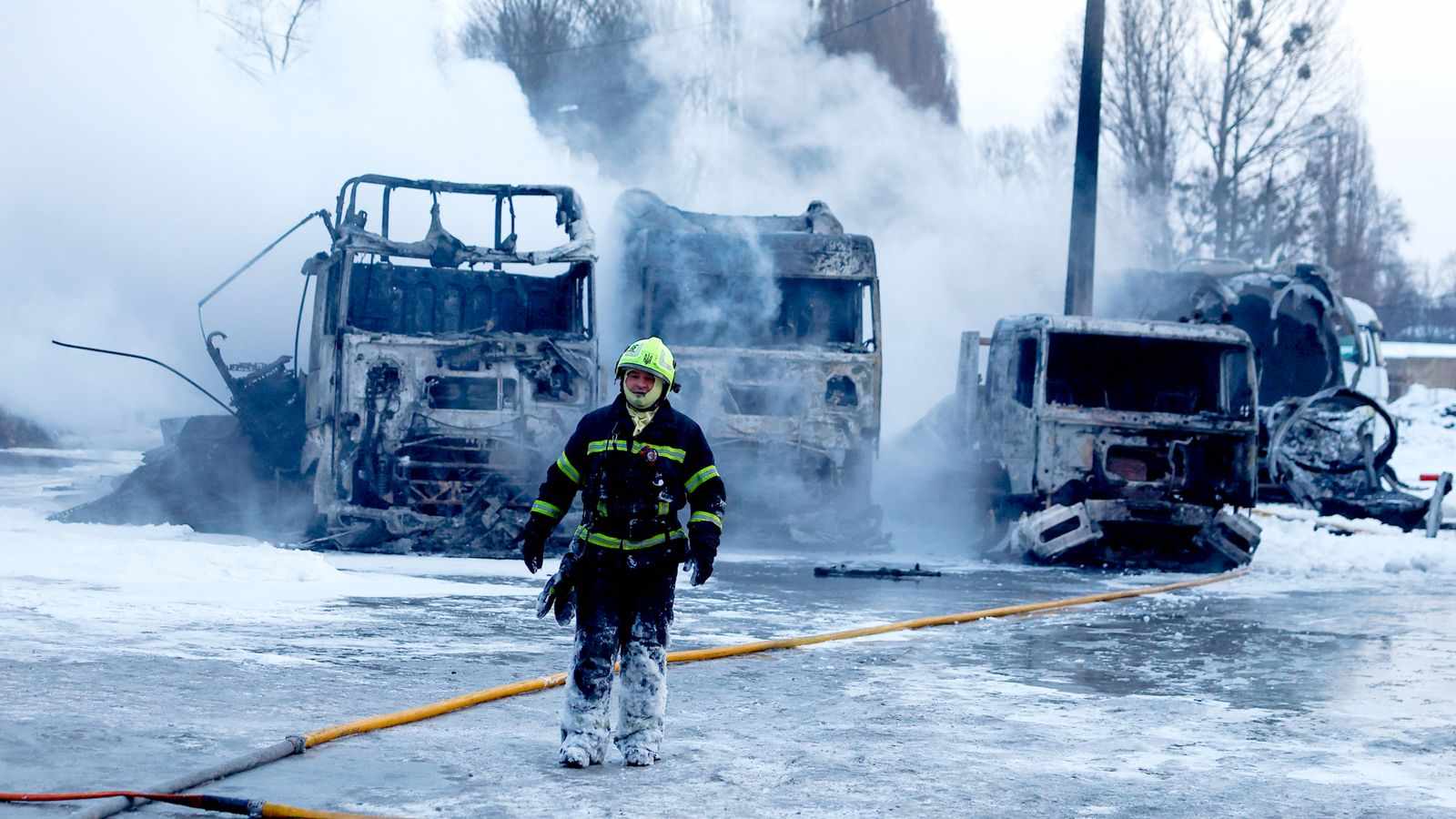
KYIV (Azat TV) – Russian air attacks have targeted Ukraine’s capital Kyiv and the northeastern city of Kharkiv, killing at least one person and injuring 23 others, according to local authorities, even as negotiators from Russia, Ukraine, and the United States engage in a second day of peace talks in Abu Dhabi. The intensified strikes, which have also severely damaged critical infrastructure and left thousands without power and heating, underscore the significant disconnect between diplomatic efforts and ongoing military hostilities.
Kyiv Mayor Vitali Klitschko confirmed that nearly 6,000 homes in the capital were without heating services following overnight attacks, with approximately 60 percent of the city still lacking electricity since earlier assaults in January. Ukraine’s State Emergency Service reported that one woman was killed and two others wounded in Kyiv’s Holosiivskyi district after strikes destroyed the top floor of a confectionery factory. In Kharkiv, at least 19 people, including a child, were injured in what authorities described as a “massive” round of drone attacks, which ignited fires in high-rise apartments, commercial buildings, and a medical facility.
Attacks Intensify Amidst Diplomatic Push
The latest wave of Russian aerial assaults extended across eastern Ukraine, impacting major cities including Dnipro, Zaporizhzhia, and Chernihiv, where a total blackout was reported. Ukraine’s General Staff stated that Russia launched 90 air attacks, 223 bombs, and over 7,600 kamikaze drones over Ukrainian units and settlements in the past day, particularly targeting the Dnipropetrovsk and Zaporizhia regions. Kira Rudik, an opposition member of parliament in Kyiv, described the city as being shaken by explosions, noting that Ukraine’s energy system was “hanging by a thread.”
These attacks occurred concurrently with the second day of direct peace negotiations in Abu Dhabi, involving Ukrainian, Russian, and U.S. officials. The talks, facilitated by the United Arab Emirates and described as “productive” by the White House, aim to establish parameters for ending the nearly four-year-long conflict. Ukrainian President Volodymyr Zelenskyy’s chief negotiator, Rustem Umerov, confirmed discussions focused on the ‘logic of the negotiation process.’
Sticking Points in Peace Negotiations
Central to the ongoing diplomatic efforts is what a senior Russian Foreign Ministry official, Alexei Polishchuk, referred to as the “Anchorage formula.” This agreement, reportedly reached between U.S. President Donald Trump and Russian President Vladimir Putin in mid-2025, forms the basis of Russia’s demand for a territorial settlement. Kremlin spokesman Dmitry Peskov reiterated that Russia insists on Ukraine yielding all of the Donbas region, including the 20 percent of Donetsk still under Ukrainian control, as a “very important condition” for any peace deal.
Conversely, President Zelenskyy has maintained that ‘the issue of Donbas is key’ for Ukraine and has demanded robust security guarantees from Western allies, including the United States, to prevent future Russian aggression. The divergence on territorial integrity and security assurances remains the primary obstacle to a lasting resolution, despite the high-level engagement in Abu Dhabi, which notably included a meeting between President Putin and Trump’s envoys, Steve Witkoff and Jared Kushner, just hours before the three-way talks commenced.
Pentagon’s Strategic Assessment of Russia
Providing a broader strategic context, the Pentagon’s recently released 2026 National Defense Strategy identifies Russia as a “persistent but manageable threat to NATO’s eastern members” for the foreseeable future. The document asserts that the U.S.’s European NATO allies are “strongly positioned” to assume greater responsibility for their security with “critical but more limited US support.”
While the Pentagon does not believe Moscow is in a position to become a hegemon in Europe, it cautions against underestimating Russia’s “reserves of military and industrial power” and its demonstrated “national resolve” to sustain a foreign and protracted war. This assessment highlights the enduring military capabilities of Russia, even as its broader geopolitical influence in Europe is viewed as constrained by the superior “latent military power” of the continent’s larger economies and populations.
The simultaneous escalation of Russian attacks on Ukrainian cities and the commencement of high-level peace talks underscores the complex, often contradictory, dynamics of the conflict, where military pressure is continually applied even as diplomatic channels are pursued.