


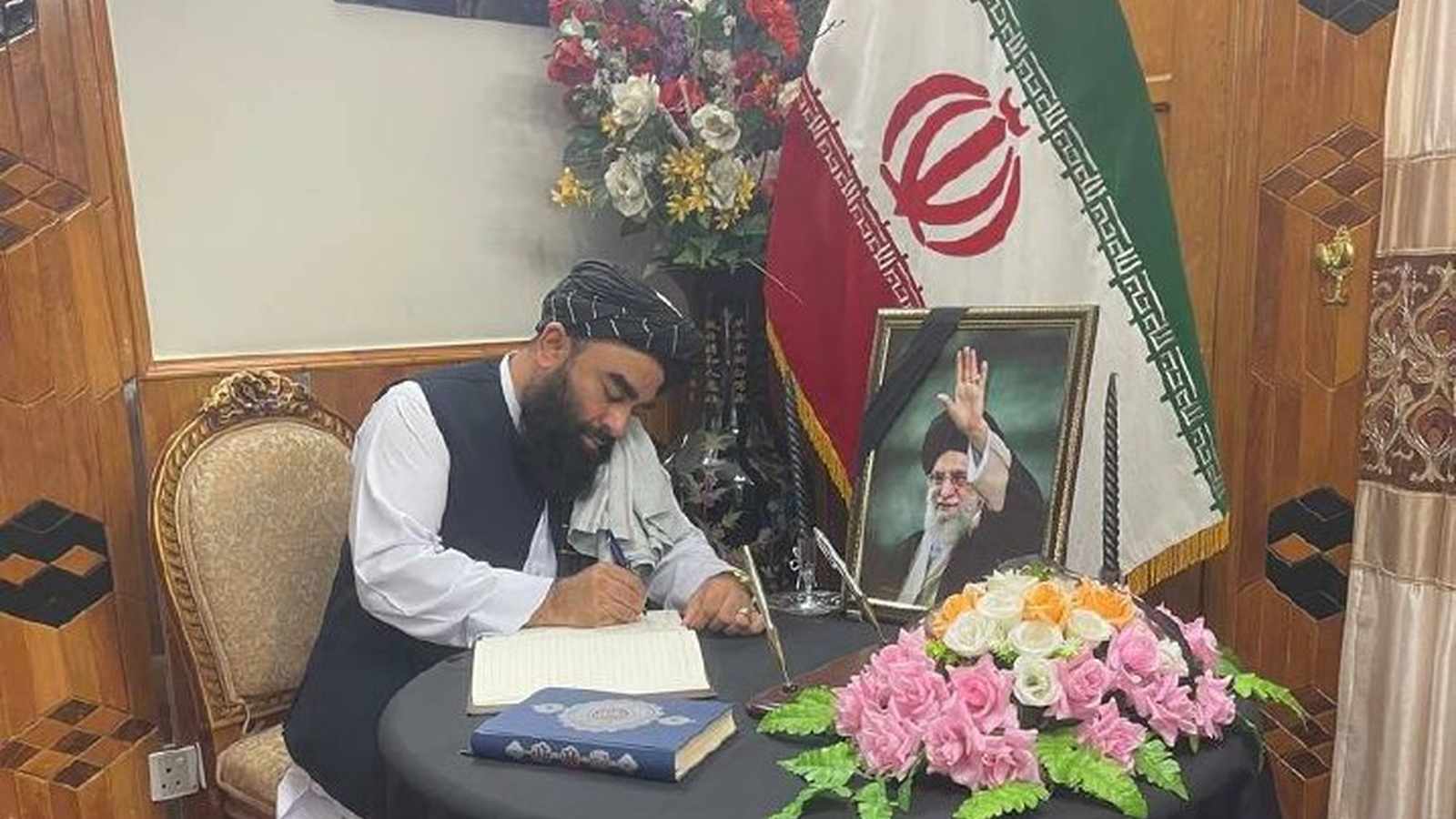
KABUL (Azat TV) – Zabihullah Mujahid, the official spokesman for the Islamic Emirate of Afghanistan, visited the Iranian Consulate in Kabul to offer his condolences on the passing of Ayatollah Khamenei. The visit, confirmed by official reports, marks a notable diplomatic gesture from the Taliban-led administration towards Iran, underscoring the complex and often delicate relationship between the two neighboring nations.
Mujahid’s presence at the Iranian diplomatic mission in the Afghan capital signals a formal acknowledgment of the significant loss for Iran’s leadership and religious establishment. While the Islamic Emirate remains largely unrecognized internationally, such interactions with foreign diplomatic entities are closely watched for insights into its evolving foreign policy and regional engagements. The visit took place as condolences poured in from various global leaders following the death of the prominent Iranian religious figure.
Taliban’s Diplomatic Overture to Iran
The condolence visit by Zabihullah Mujahid represents a specific diplomatic outreach from the Taliban-led government to Iran. Since the Taliban’s return to power in August 2021, Iran has maintained a cautious stance, refraining from formally recognizing the Islamic Emirate while engaging on practical matters, particularly regarding border security, water rights, and the significant Afghan refugee population in Iran. This gesture, therefore, could be interpreted as an attempt by the Taliban to foster goodwill and demonstrate a willingness for formal engagement with Tehran.
The act of an official spokesman visiting a foreign consulate for such a purpose is a standard diplomatic protocol. For the Taliban, whose government struggles for international legitimacy, adhering to such norms, especially concerning a regional power like Iran, is a strategic move. It allows them to project an image of a functioning state capable of engaging in international relations, even as most countries continue to withhold formal recognition.
Regional Implications of Condolence Visit
The relationship between Afghanistan and Iran has historically been fraught with challenges, including disputes over water resources, particularly the Helmand River, and concerns over drug trafficking and border security. Iran has also expressed concerns about the treatment of its ethnic Hazara minority in Afghanistan, who are predominantly Shia, aligning them religiously with Iran. Despite these tensions, both nations share a long border and significant cultural and economic ties.
The condolence visit occurs against a backdrop of ongoing regional shifts. Iran, a Shia-majority nation, and the Sunni-dominated Taliban have often found themselves on opposing sides in regional conflicts. However, pragmatic considerations often dictate their interactions. The death of a high-ranking figure like Ayatollah Khamenei presents a unique moment for diplomatic overtures, allowing for expressions of sympathy that can potentially de-escalate tensions or open channels for future dialogue. This event could pave the way for further discussions on critical bilateral issues, including economic cooperation and regional stability.
Future of Afghanistan-Iran Relations
While a condolence visit does not equate to full diplomatic recognition, it is a significant step in the ongoing, complex relationship between the Islamic Emirate and its neighbors. For Iran, receiving such a visit from a senior Taliban official in Kabul could be seen as an acknowledgment of its regional influence, even from a government it has not formally recognized. For Afghanistan, it is an opportunity to engage a powerful neighbor and perhaps build bridges for broader international acceptance.
The visit underscores the intricate web of regional diplomacy in Central and South Asia, where historical animosities often coexist with pragmatic necessities. As the Taliban continues its efforts to consolidate power and gain international legitimacy, gestures like these become crucial indicators of its strategic priorities and potential future alignments.
The direct condolence visit by a senior Taliban official to the Iranian Consulate in Kabul highlights the pragmatic nature of regional diplomacy, where immediate political and strategic considerations can temporarily override long-standing ideological differences, signaling a potential, albeit cautious, thawing of relations between the Islamic Emirate and Iran.