
Quick Read
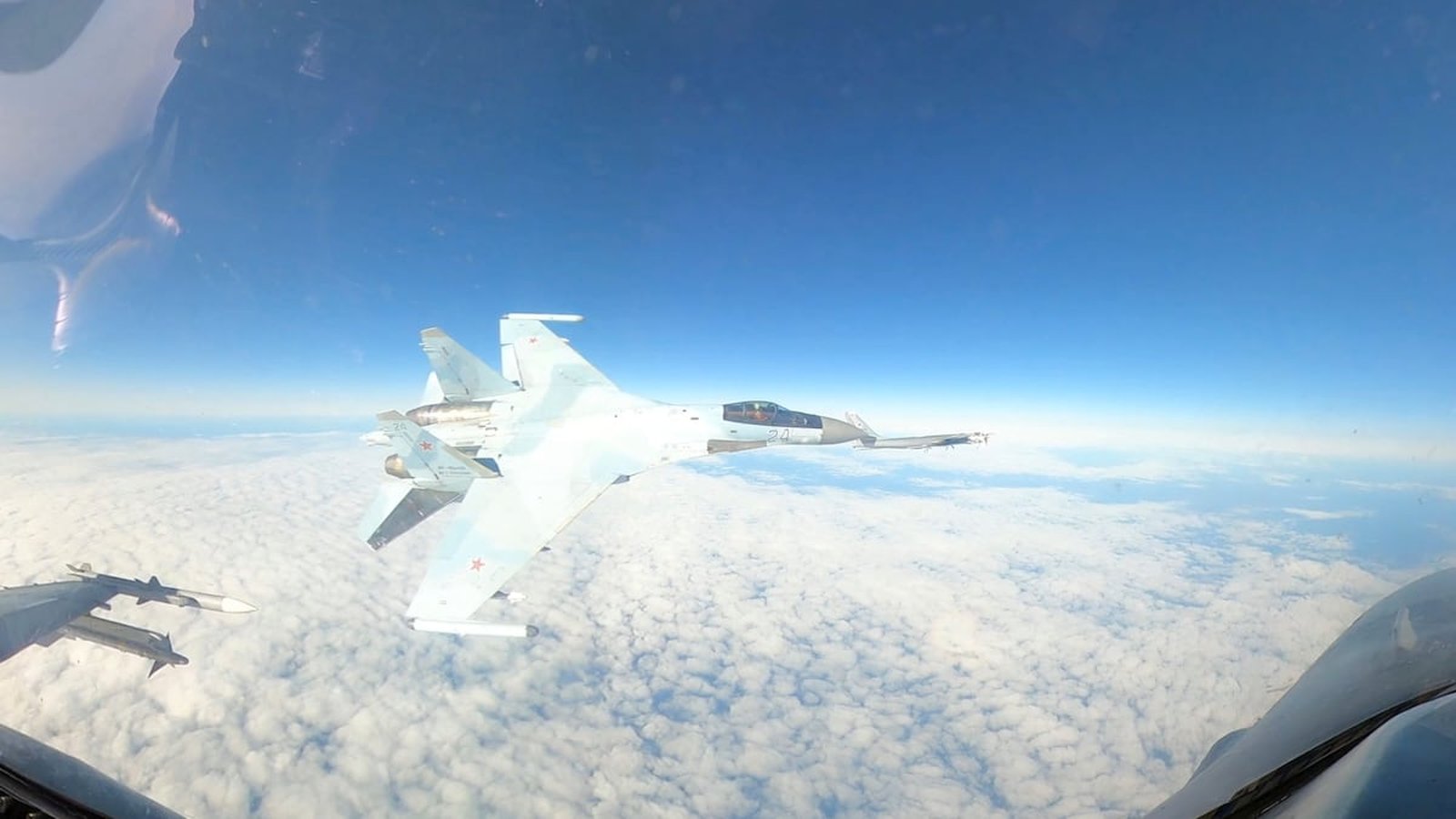
- Four Russian warplanes were intercepted near Alaska on Wednesday.
- This is the ninth such incident reported by NORAD in 2025.
- Russian jets remained in international airspace and did not violate U.S. or Canadian borders.
- NORAD dispatched nine U.S. aircraft to respond, including F-16s and an E-3 Sentry.
- The incident reflects ongoing military tension amid broader U.S.-Russia and NATO dynamics.
Russian Warplanes Detected Near Alaska: Routine or Warning Sign?
In the chilly skies above Alaska, a familiar dance played out once again. On Wednesday, four Russian military jets—two lumbering Tu-95 bombers and two nimble Su-35 fighters—were detected flying in the Alaskan Air Defense Identification Zone (ADIZ). The North American Aerospace Defense Command (NORAD) responded swiftly, dispatching a mix of nine U.S. aircraft: an E-3 Sentry for command and control, four F-16 fighters, and four KC-135 tankers. The goal? To positively identify and intercept the Russian visitors before they could edge any closer to sovereign airspace.
This was not an isolated event. According to NORAD, it marks the third incident in about a month and the ninth this year where Russian warplanes have approached Alaska’s borders. Each time, the Russian aircraft stayed in international airspace, never crossing into American or Canadian territory. NORAD’s official statement, as cited by Military Times, emphasized that such flights are routine and not considered a direct threat. Yet, the frequency of these encounters—and the geopolitical backdrop—has made each interception a moment worth watching.
NORAD’s Role: Vigilance in the North
The North American Aerospace Defense Command, a joint U.S.-Canadian military organization, stands as the guardian of North American skies. Its mission: detect, track, and, if necessary, intercept any airborne threats. The ADIZ, which stretches far beyond Alaska’s land borders into the open Pacific, serves as an early warning buffer. When foreign aircraft enter this zone, NORAD moves quickly—not because the planes are necessarily hostile, but because vigilance is the first line of defense.
The latest incident unfolded against a backdrop of heightened military activity. As reported by Air & Space Forces Magazine, recent large-scale wargames across the Pacific have prompted U.S. defense leaders to rethink supply lines, command structures, and rapid response capabilities. The lesson: preparedness and adaptability are key in the unpredictable theater of the Indo-Pacific.
Geopolitical Ripples: NATO, Ukraine, and Russia’s Calculus
The skies near Alaska are not just a stage for military maneuvers; they are a mirror reflecting global tensions. Just days before the latest intercept, President $1 Trump made headlines by suggesting Ukraine could reclaim all territory lost to Russia—a sharp contrast to his earlier calls for negotiations and concessions. Trump also remarked that NATO countries should not hesitate to shoot down Russian aircraft if their airspace is violated, though he hedged when asked if the U.S. would back such actions, saying, “it depends on the circumstance.”
These comments come on the heels of NATO’s own warnings to Russia. After Russian drones were shot down over Poland and reports of Russian jets intruding into Estonian airspace, NATO issued a clear statement: any further breaches would be met with all available means of defense. The message to Moscow was unmistakable.
Meanwhile, diplomatic efforts have stumbled. After a recent summit in Alaska between Trump and Russian President Vladimir Putin, hopes for direct talks between Putin and Ukrainian President Volodymyr Zelenskyy faded. Moscow has shown little interest in negotiation, opting instead to intensify its military campaign in Ukraine. The shadow of this conflict looms over every encounter in the skies above Alaska.
Routine Encounters or Signals of Strategy?
To NORAD and U.S. defense officials, these Russian flights are routine—a kind of saber-rattling that has occurred for decades. Russian bombers and fighters routinely test the boundaries of North American air defenses, probing for weaknesses and gauging response times. U.S. jets scramble, intercept, and escort the Russian aircraft away, following a well-established protocol. The fact that these encounters have become more frequent is cause for analysis, if not immediate alarm.
Military experts, speaking at the recent Air, Space & Cyber Conference, underscored the importance of maintaining air dominance through innovation and readiness. The future, they argue, belongs to those who can blend stealth, speed, and adaptability. Each encounter near Alaska is not just a test of nerves, but a rehearsal for conflicts that may never come—but must be prepared for all the same.
For local communities in Alaska, the sight of U.S. fighters streaking overhead is both reassurance and reminder. The remote wilderness is no longer a buffer from global politics; it is a front line where national security is measured in split-second decisions and silent watchfulness.
The Bigger Picture: U.S.-Russia Relations and Strategic Messaging
Why do these flights continue? For Russia, projecting power near Alaska is a way to remind the world—and its own citizens—of its military reach. It sends a message to Washington: “We are here, and we are watching.” For the United States, each successful intercept is proof that its defenses are alert and effective. In the chessboard of global strategy, every move is scrutinized, every response calibrated.
In the broader context, the Alaskan intercepts are one piece of a much larger puzzle. They fit into a tapestry of military exercises, diplomatic statements, and technological advances. As Reuters has reported, both sides are investing in next-generation aircraft and surveillance systems, aiming to maintain an edge in a rapidly evolving arena.
As autumn settles over Alaska, the cycle continues. Russian jets will likely return, NORAD will scramble its fighters, and the world will watch—each encounter a reminder of the delicate balance between routine and risk in the age of great power competition.
The persistence of Russian military flights near Alaska underscores not only the strategic importance of the region but also the fragile state of global security. While these encounters are handled as routine by NORAD, their frequency and context signal a world where vigilance and adaptability are paramount. The skies above Alaska, once remote, now reflect the shifting currents of international relations, where every flight is both a message and a test.